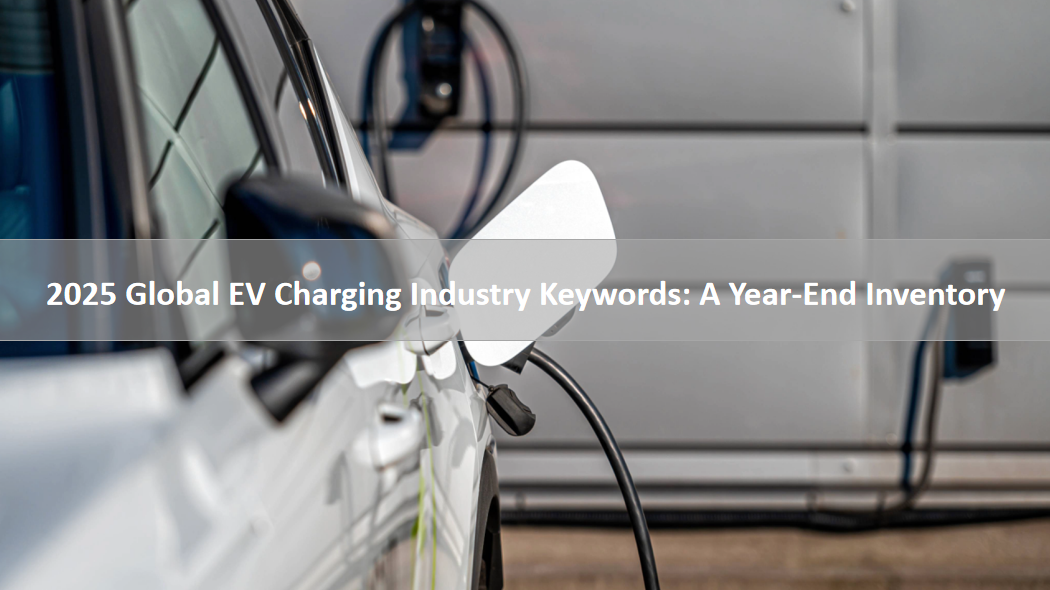
The year-end inventory count always manages to give a clear shape to the passage of time in the charging and battery swapping industry.
In 2025, the "evolutionary roadmap" of the global electric vehicle charging and battery swapping industry continues to be written in a solid and vivid narrative style. Amid this, we have jointly witnessed infrastructure expansion, pursued a profound shift towards Operational Efficiency, and explored better experiences behind various standards and policies. Meanwhile, we have also been honing the new connotations of technology, models, and development resilience in the inevitable involution.
If we were to distill a dedicated annual dictionary for this industry, how would the keywords that pulse with technological vitality, reflect business logic, and carry the expectations of industry practitioners define everyone's 2025?
Based on this, please summarize 10 keywords according to the current development status, opportunities, and challenges of global charging piles, and provide necessary explanations for these 10 keywords (why this keyword was chosen as the annual keyword). We hope that this small prism can reflect the rapid progress of global charging piles and also attempt to leave some industrial footnotes for this year.
As the industry transitions from rapid expansion to sustainable maturation, 2025 is defined not by a single breakthrough, but by the deepening of critical themes. The year’s lexicon reveals a collective shift from building infrastructure to optimizing its value, resilience, and integration. Here are 10 keywords that encapsulate technological vitality, business logic, and practitioner expectations shaping this pivotal year.
1. Grid-Integration
The sheer scale of new high-power charging deployments is colliding with the physical limits of aging electrical grids. In 2025, “building a charger” is no longer just a hardware installation; it is a complex grid negotiation. This keyword dominates utility meetings, project timelines, and financial models, making grid capacity and upgrade costs the primary bottleneck and cost driver for network expansion in key markets like North America and Western Europe.
2. Charging-as-a-Service (CaaS)
To mitigate high upfront capital expenditure (CapEx) barriers for site hosts (e.g., real estate, retailers), the CaaS model has moved from pilot to mainstream. In 2025, providers will offer a full suite—hardware, installation, maintenance, operation, and energy management—for a monthly fee or a share of revenue. This shifts the business model from selling equipment to selling a guaranteed outcome (uptime, energy delivered), aligning growth with operational excellence.
3. Ultra-Fast Charging (UFC)
With battery capacities consistently exceeding 100 kWh, “fast charging” is being redefined. The 150-350 kW Ultra-Fast Charging segment has become the new competitive battleground for public networks along highways and in urban hubs. For manufacturers, it demands advanced liquid cooling and high reliability; for operators, it necessitates entirely new site electrical designs and energy storage buffers to manage demand charges.
4. NACS Dominance
The North American Charging Standard (NACS), pioneered by Tesla, completed its conquest of the North American market in 2025. Nearly all major automakers and charging network operators have committed to the standard. This unexpected acceleration has brought long-awaited connector harmony to a key region, simplifying the driver experience but forcing a costly and rapid retooling of supply chains and product roadmaps for hardware manufacturers globally.
5. Reliability Crisis
As EV adoption crosses the early adopter chasm, driver tolerance for “broken” chargers has hit zero. Widespread media reports and user data highlighting poor public charger uptime (often below 95%) have triggered a “Reliability Crisis.” This has shifted competitive advantage from the number of ports to network uptime, forcing massive reinvestment in remote diagnostics, proactive maintenance, and durable hardware design.
6. Fleet-First Electrification
The electrification of light-duty delivery vans, taxis, rideshares, and municipal vehicles has become the most predictable and concentrated demand driver. These commercial operators prioritize total cost of ownership (TCO) and depot charging solutions over public network convenience. In 2025, winning the fleet segment means offering integrated depot energy management, tailored financing, and guaranteed service-level agreements (SLAs).
7. Subsidy Sunset
Major initial public funding waves (e.g., NEVI in the U.S., ADVENIR in France) are transitioning from blanket subsidies to targeted gap-filling. This “sunset” forces the industry to stand on economically viable fundamentals. Profitability, rather than subsidy capture, is now the core business challenge, accelerating consolidation and killing marginal projects that relied solely on public grants.
8. Consolidation Wave
The capital-intensive “land grab” phase is giving way to a strategic consolidation phase. Smaller charging network operators (CPOs) and hardware specialists are being acquired by larger energy majors, utilities, and automotive OEMs seeking vertical integration. This wave is creating vertically integrated giants that control energy supply, hardware, software, and customer relationships.
9. Bidirectional Power / V2X
Vehicle-to-Everything (V2X) technology moved from R&D labs to initial commercial pilots and regulatory frameworks in 2025. It represents the ultimate integration of the EV with the energy ecosystem, turning fleets into grid assets. While scale is years away, 2025 was the year the industry cemented its strategic roadmap around this capability, influencing hardware design and utility partnerships today.
10. Global Standards Fracture
Contrary to hopes for a single global standard, 2025 solidified regional fragmentation. China’s GB/T, Europe’s CCS2, and North America’s evolving NACS/CCS1 landscape, coupled with differing payment, communication, and safety protocols, have hardened. For global manufacturers and operators, this means increased complexity, higher R&D costs, and constrained economies of scale, defining the challenge of international expansion.
If 2020-2024 was the industry’s “Age of Expansion”—focused on quantity, footprint, and securing sites—then 2025 marks the decisive pivot into the “Age of Optimization and Integration.”
The keywords collectively tell this story: The external challenges of Grid-Integration and Subsidy Sunset are meeting internal priorities like solving the Reliability Crisis and serving the Fleet-First wave. The business model is evolving toward CaaS and through a Consolidation Wave, while the technological frontier is being pushed by UFC and V2X. All of this is set against a backdrop of shifting connective tissue, with NACS Dominance bringing regional clarity even as Global Standards Fracture raises the cost of playing a worldwide game.
The industry’s resilience in 2025 is being honed not by the ease of growth, but by navigating this complex web of interdependencies. The footnotes for this year will record how the foundational infrastructure laid in the prior decade was stress-tested, refined, and began its deeper fusion with the broader energy and transportation systems.




















.png)

