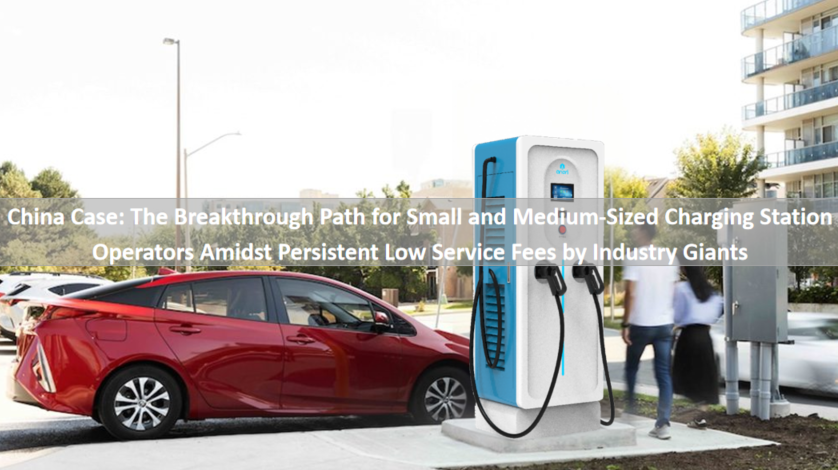
Currently, the electric vehicle charging industry generally continues to compete for customers through "low-price" strategies.
As noted by a leading industry association official: "The prevalent strategy in the charging industry to attract users remains reducing service fees, with limited differentiation,a challenge typical of the industry's early development phase."
Amid this price war, giants such as major oil & gas companies, utility conglomerates, and global energy providers have taken the initiative with their extensive networks, substantial capital, and integrated energy service ecosystems, launching more competitive pricing strategies. This forces small and medium-sized operators (SMOs) to survive within increasingly narrow profit margins.
The questions of when service fees might rise and how to endure periods of intense competition have become critical survival issues for operators, especially for SMOs.
1. The "Price Squeeze" by Giants: Survival Challenges for Small and Medium Operators
Generally, a service fee of $0.03–$0.04 per kWh is considered a reasonable range for operators, with $0.025/kWh often viewed as a "critical threshold." Falling below this level can push some stations into operational loss.
Survey data on operator survival released earlier this year provides a stark illustration of the intense price competition: Over the past year, more than 70% of operators reported average service fees below $0.03/kWh, predominantly concentrated in the $0.02–$0.03 range, which is below the reasonable profitability line.
The data indicates that 40% of operators were forced to reduce their service fees, primarily to "match the prices of key competitors nearby." Moreover, proactive price cuts by industry giants have intensified this competition, creating a dynamic where "when giants cut prices, SMOs must follow."
Unlike giants, who can leverage advantages such as owned land and prioritized power access to sustain short-term losses for market share gains, SMOs often bear multiple fixed costs. They lack the resource advantages and cross-business profit buffers of larger players, making their service fee income directly tied to their survival.
Faced with this "asymmetric competition," SMOs are caught in a dilemma: not matching price cuts leads to customer loss and potential failure, while matching them erodes profits and strains cash flow. The result is either forced exit or struggling at the breakeven point, with industry resources increasingly concentrated among the giants.
2. Beyond "Discounts": The Ecosystem Strategy Behind Giants' Low-Price Models
A closer look at the giants' strategies reveals that their low-price approach is not merely about conceding profit margins. It is a deliberate effort to establish a long-term market presence by building an integrated ecosystem. Each adjustment to service fees precisely targets the vulnerabilities of SMOs.
For instance, some integrated energy companies use tiered promotional pricing on service fees to attract users, while simultaneously linking these offers to their own retail networks and specialty services. This allows them to offset losses from service fee discounts with non-charging revenue.
This combination of "low-price attraction + cross-business subsidy" squeezes the survival space for SMOs. Many lack the capability to offer similarly competitive pricing and, more critically, do not have alternative profit channels. They are forced to match price cuts without being able to recoup the profit shortfall, gradually eroding the profitability of their service fees while their customer base is siphoned off by the giants' ecosystem advantages.
Similarly, major utility companies leverage their grid assets and strategic locations along highways to cater to the temporary charging needs of inter-city travelers. This model capitalizes on the natural foot traffic in service areas and offers pricing flexibility that appeals to cost-sensitive users on-the-go. Coupled with membership benefits that reinforce user preference, this continuously diverts potential customers from SMOs, further weakening their already fragile customer retention and marginalizing their position.
In essence, the core advantage of giants lies in the "service fee discount + diversified profit offset" loop built upon their resource barriers. Each strategic move inadvertently compresses the operating space for SMOs, further entrenching an asymmetrical competitive landscape.
3. Waiting for a Price Hike? Value Enhancement is the Real Path Forward
In the face of pressure from giants and intense price competition, "when will service fees increase?" has become a collective anxiety for SMOs.
However, relying on an industry-wide "price increase cycle" to alleviate difficulties might be a dangerous illusion. For SMOs, instead of passively waiting for price hikes, the proactive path lies in value re-engineering and model innovation, carving out a viable niche within the giants' ecosystem.
① Deliver Exceptional Operational Service to Build a Reputation Moat
Establish a differentiated advantage through superior user experience, turning stations into trusted, high-quality destinations within their locality. Implement daily equipment inspection protocols to ensure high availability rates. Optimize the charging environment by providing clean, safe parking areas, streamlined payment processes, and clear signage. Establish rapid response mechanisms for issues. Through community management and reliable service, attract quality customers who prioritize stability and reliability over the lowest price, building a loyal and self-sustaining customer base through word-of-mouth.
Consider the example of an operator who, over four years in the industry, invested significantly to deploy over a thousand charging points. They adhered steadfastly to three non-negotiable principles: first, equipment quality—refusing to use substandard chargers and treating safety and reliability as foundational; second, safety operations—strict daily checks, regular drills, and hazard prevention, never cutting corners on processes; third, user rights—prohibiting hidden fees, false advertising, or service degradation, always protecting user interests. This long-term commitment to quality, safety, and user value has earned them trust and built a solid foundation for sustainable growth amidst fierce competition.
② Diversify with Value-Added Services to Expand Revenue Streams
Developing non-charging revenue is key to diversifying risk and increasing per-customer value. SMOs can introduce tiered value-added services based on their location's characteristics. At a basic level, introduce low-maintenance conveniences like vending machines and mobile power bank rentals. For enhanced offerings, add quick-service food, coffee, or express car wash services that align with typical charging wait times. Furthermore, explore cross-sector opportunities such as site leasing, partnerships with battery swap service providers or automotive companies, offering dedicated rental car pick-up/drop-off, or facilitating new energy vehicle insurance services.
This model has proven successful. An operator increased its revenue by diversifying its offerings—combining parking space leasing, revenue-sharing from car wash services, hosting battery swap cabinets and vending machines, and developing advertising spaces. This not only created substantial non-charging income but, more importantly, extended user dwell time, enhanced loyalty, and created a virtuous cycle where "services attract longer stays, and longer stays create more consumption," effectively building resilience against price fluctuations.
③ Explore Differentiation to Unlock New Value Growth Points
Stations can explore more differentiated, cost-effective paths based on their specific context. Where feasible and with a sound ROI projection, adopting new technologies can boost competitiveness—for example, implementing "solar + storage + charging" microgrid projects at sites with favorable peak/off-peak electricity price differentials to reduce power procurement costs. In areas with a concentration of premium users, deploying destination high-power charging hubs with faster speeds and superior amenities can build a premium brand image and tap into a new market segment. Optimizing electricity procurement contracts based on local tariff structures is another way to reduce costs at the source.
④ Leverage Unique Resources to Target Niche Scenarios
While SMOs may not have scale advantages, they often possess strengths in flexibility, local market knowledge, and diverse resource structures. Instead of competing head-on with giants in mainstream scenarios, they should proactively identify and deploy their unique assets—such as land, power access, and local partnerships—to extend into more specialized, vertical markets.
Two key scenarios warrant focus: First, high-frequency, necessity-driven dedicated scenarios, such as partnering with local logistics parks, transport hubs, bus depots, or municipal service centers to build exclusive or shared charging facilities, securing stable, scaled B2B clientele. Second, high-potential underserved or "last-mile" scenarios, penetrating communities, townships, tourist spots, and commercial centers to install small-scale, smart charging points, capturing long-tail demand not fully addressed by larger players.
This approach has demonstrated success. For instance, an operator collaborated with local communities, farmers, and boutique lodges in rural tourism areas to install distributed charging stations along key routes. While charging, users could engage in local experiences like fruit picking or purchase regional products. The lodges, in turn, attracted more guests through the charging amenity, creating a win-win-win model of "charging traffic → tourism spending → local income growth."
Industry maturity will not come from waiting for price increases, but from achieving a new equilibrium where reasonable returns are earned through the continuous delivery of value.
SMOs relying solely on "enduring low prices" for survival will eventually be eliminated by the market. Conversely, if giants neglect the health of the broader industry ecosystem, they too may face user backlash during any future pricing adjustments.
The hope is for the industry to move beyond price dependency, competing instead on service quality and technological innovation, ensuring that diligent operators receive fair returns and strengthening the foundation for a sustainable future in the new energy mobility sector.
These core challenges of breaking through in the industry are precisely what countless operators are grappling with today.




















.png)