EV chargers, as the core infrastructure of the electric vehicle refueling network, directly impact investment costs, operational efficiency, and long-term returns through their technological selection. Faced with the two mainstream architectures of Integrated and Split-Type chargers, many investors and operators often find themselves in a dilemma. This article provides an in-depth analysis of their technical characteristics, application scenarios, and investment returns to help you make a precise decision.
1. Introduction to Integrated and Split-Type Chargers
Integrated Chargers consolidate all functions—charging modules, controller, display screen, payment system, and cooling unit—into a single cabinet, forming an independent, complete charging unit. This "plug-and-play" design facilitates simple installation without requiring additional configuration.
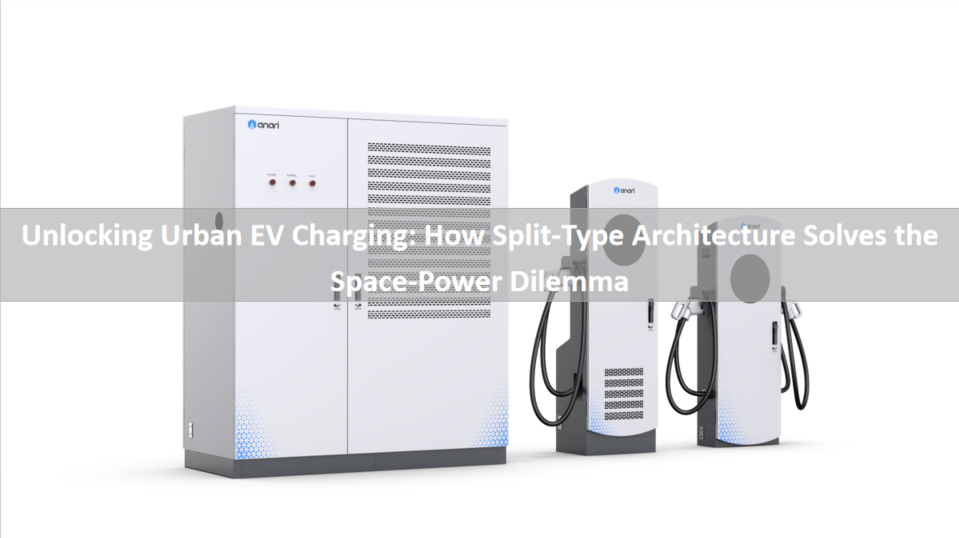
Split-Type Chargers adopt a "host + terminal" separated architecture: the power cabinet (host) centrally houses the charging modules and control system, connecting via cables to multiple charging terminals (gun sockets) installed at different locations. One power cabinet typically supports 2-10 charging terminals, enabling power sharing and dynamic allocation.
The core distinction lies in the fact that an Integrated unit is a standalone device, whereas a Split-Type system is a distributed, "one-to-many" setup.
2. Application Scenarios: Integrated vs. Split-Type
Integrated Chargers are suitable for:
Decentralized Layouts: Such as scattered parking spaces in residential areas, roadside parking spots, or in front of retail stores, where each space requires an independent installation.
Rapid Deployment Needs: Temporary events, emergency charging points, or projects with short construction timelines.
Small-Scale Pilot Projects: Initial projects with limited upfront investment needing to validate market demand (e.g., fewer than 5 parking spaces).
Split-Type Chargers are suitable for:
Centralized Charging Stations: Dedicated parking lots, charging hubs, logistics parks, and other venues with rows of parking spaces (typically 6 or more).
High-Power Demand Scenarios: Such as bus terminals, heavy-duty truck depots requiring concentrated high-power supply.
Space-Constrained Areas: The power cabinet can be placed in an electrical room, while the compact terminals save space at the parking spot, offering a more aesthetic appearance.
3. Meeting Requirements: Integrated vs. Split-Type
|
Dimension |
Integrated Charger |
Split-Type Charger |
|
Power Flexibility |
Fixed power output per gun (e.g., 120kW) |
Dynamic allocation from a power pool, supporting simultaneous multi-gun fast charging or intelligent scheduling |
|
Scalability |
Adding a space requires a new complete unit; expansion costs increase linearly |
Only requires adding terminals; existing power cabinet may suffice, resulting in low marginal cost |
|
Space Utilization |
Each space requires dedicated equipment room, potentially affecting adjacent spaces |
Compact terminals with centralized power cabinet maximize parking space usability |
|
Maintenance Convenience |
Fault requires on-site repair of the entire unit, affecting operation of that single space |
Modular design allows for centralized maintenance at the power cabinet; terminals can be replaced quickly |
|
Initial Investment |
Lower per-unit cost; lower total initial investment for small-scale deployment |
Higher system cost, but cost per parking space decreases significantly as scale increases |
4. Pros and Cons: Integrated vs. Split-Type
Integrated Chargers
Advantages:
Rapid Deployment: Simple wiring, short installation cycle (typically operational within 1-2 days).
Independent Operation: Failure of one unit does not affect other spaces, dispersing risk.
Lower Investment Threshold: Suitable for initial stages with limited budgets.
Disadvantages:
Fixed Power per Gun: Cannot dynamically adjust based on vehicle demand, potentially leading to power waste.
Higher Long-Term Cost: Expansion requires repeated purchase of complete units; high device density leads to increasing operation and maintenance (O&M) costs.
Higher Spatial Footprint: A cabinet must be installed beside each space, affecting site aesthetics and traffic flow.
Split-Type Chargers
Advantages:
High Cost-Effectiveness (Economies of Scale): The more parking spaces, the lower the average cost per space (advantage becomes clear with 10+ spaces).
Intelligent Power Dispatch: Supports power pool management, prioritizing allocation to vehicles in need within total power limits, enhancing overall utilization.
Centralized Management: Remote monitoring, fault diagnosis, and software upgrades can be performed uniformly at the power cabinet, improving O&M efficiency by over 50%.
Strong Future Compatibility: Power cabinet modules can be upgraded to support higher power outputs, protecting long-term investment.
Disadvantages:
Higher Initial Investment: Requires laying cables from the power cabinet to terminals, involving more complex electrical engineering.
Reliance on Professional Design: Requires electrical planning based on site layout; poor design can impact efficiency.
Single Point of Failure Risk: Power cabinet failure may disable multiple terminals (can be mitigated with redundant design).
5. Conclusion: A Guide for Immediate, Scientific Decision-Making
Choosing a charger architecture is not a simple binary choice but an investment return optimization calculation based on specific scenarios. Follow this decision-making process to obtain a highly cost-effective solution:
Decision Tree & Actionable Recommendations:
Define Scale and Planning:
If the number of parking spaces is ≤ 5 with no clear expansion plans → Prioritize Integrated Chargers. Their lower initial investment and faster payback period (typically 2-3 years) better suit small-scale needs.
If the number of parking spaces is ≥ 6, or future expansion is possible → Firmly choose Split-Type Chargers. Although the initial investment is 15%-25% higher, the average cost per space will fall below that of Integrated units within 3 years, offering significant long-term operational cost advantages.
Assess Electrical Capacity:
In areas with high power capacity upgrade costs (e.g., commercial centers), the power-sharing capability of Split-Type systems maximizes the use of existing electrical capacity, avoiding excessive power investment and directly improving the Return on Investment (ROI).
Analyze Operational Model:
For commercial operations requiring high efficiency and remote intelligent management → The centralized management of Split-Type systems will significantly reduce labor costs and improve equipment availability (typically >99%).
For simple hosting or low-frequency use scenarios (e.g., corporate employee charging) → The simpler O&M of Integrated units may be more convenient.
Calculate Key Metrics:
Conduct a comprehensive Total Cost of Ownership (TCO) analysis, including equipment, installation, electricity, maintenance, and expansion costs. The TCO for Split-Type systems over a 5-year period is typically 20%-40% lower than for Integrated units.
Use a "Daily Revenue per Parking Space" model: Split-Type systems, through intelligent power allocation, can serve more vehicles, increasing peak throughput by over 30%.
Final Recommendation:
For the vast majority of investors seeking long-term operation and scalable development, Split-Type EV chargers represent the more scientific and economical choice. Their modular, scalable design not only aligns with technological trends but also creates higher revenue through intelligent dispatch. Although the initial outlay is higher, in scenarios with 6 or more parking spaces, the investment payback period can be shortened by 6-18 months compared to Integrated units, delivering significantly improved long-term returns.
In the wave of new infrastructure for EV charging, correct technology selection is the cornerstone of success. It is recommended to engage a professional team for on-site assessment and simulation modeling before finalizing your decision. Let data drive your investment, ensuring every unit of capital is transformed into sustainable competitive advantage and financial return.




















.png)

