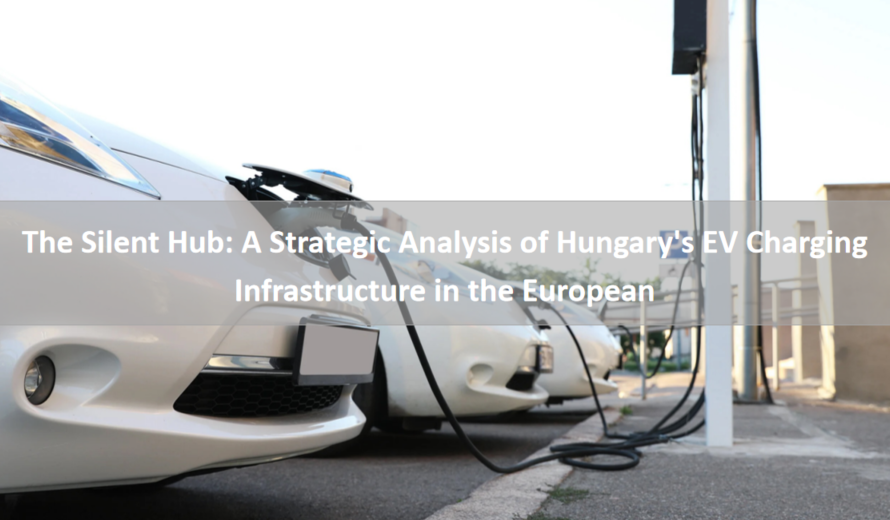
Executive Summary
Hungary occupies a dual, and somewhat paradoxical, position in Europe's electric vehicle landscape. It has emerged as a central European powerhouse for EV manufacturing, attracting monumental investments from BMW, Mercedes-Benz, and most significantly, the recent commitment from Volkswagen for a dedicated EV plant. Yet, its domestic EV adoption and public charging infrastructure lag behind Western European benchmarks. This disconnect creates a unique market dynamic: a pressing, top-down need to develop infrastructure to support both industrial policy and eventual mass adoption, within a complex EU regulatory and funding framework.
This analysis concludes that Hungary's EV charging market is poised for accelerated, structured growth, driven less by immediate consumer demand and more by strategic imperative and EU convergence. The market will be shaped by the efficient absorption of EU funds, the needs of a growing commercial EV fleet, and the necessity to build "infrastructure credibility" to match its manufacturing ambition. Success requires navigating a hybrid ecosystem of state-influenced tenders and private investment, with a premium on solutions that offer EU compliance, robust performance in a continental climate, and scalability. For Anari Energy, Hungary represents a strategic beachhead into the EU's industrial core, where the Vulco DC Series can be positioned as the reliable, high-performance choice for the nation's foundational charging corridors and commercial depots.
1. Hungary's National Charging Station Policy: EU Integration and Strategic Catch-Up
Hungarian policy is a blend of transposing EU directives and crafting national initiatives to support its automotive industrial strategy.
1.1 The Overarching EU Framework
Hungary's roadmap is inextricably linked to the EU's Fit for 55 package and the Alternative Fuels Infrastructure Regulation (AFIR). This mandates strict national deployment targets for publicly accessible charging power, ensuring Hungary must accelerate its roll-out to avoid infringement penalties. EU funds are the primary financial engine.
Strategic Insight: The development timeline is externally mandated, reducing policy risk. The market is on a non-negotiable growth path, with EU cohesion and recovery funds (RRF) providing significant capital. Understanding the tender processes for these funds is crucial.
1.2 The National Charging Infrastructure Development Plan (2021-2030)
This plan outlines Hungary's strategy to deploy over 50,000 charging points by 2030. It emphasizes a balanced geographical distribution and the development of a national charging network operator model. The state plays a coordinating and enabling role, with execution delegated to private consortia.
1.3 Incentives and Local Initiatives
The government offers purchase subsidies for EVs (the “Green Vehicle Programme”) and grants for private charging point installation. Municipalities, especially Budapest, are launching their own ambitious plans for public charging and electric bus fleets, creating a multi-layered market.
2. Current Development Status of Charging Stations in Hungary
The infrastructure is developing steadily but faces a "coverage vs. utilization" challenge in the short term.
2.1 Growing Network, Emerging Hubs
The public network is expanding, with focus on Budapest, major highway corridors (M1, M3, M5, M7), and key regional cities. Coverage is improving, but density and power availability remain inconsistent. The market features a mix of players, including the state-backed MOL Plugee (leveraging its filling station network), utility-backed ventures, and international CPOs like Ionity.
2.2 The Manufacturing vs. Adoption Gap
While Hungary is a top-5 global per capita manufacturer of vehicles, its domestic EV adoption rate is modest. This means the early business case for high-power charging relies heavily on transit traffic (EU cross-border travel) and the premium segment, rather than a deep local user base.
2.3 The Fleet and Municipal Segment as Early Drivers
Corporate fleets of multinationals based in Hungary and municipal public transport electrification (e.g., Budapest's electric buses) are providing early, stable demand for depot and dedicated public charging, de-risking initial investments.
3. Hungary's Requirements for Charging Stations (Climate & Standards)
Operating in Hungary and the wider EU requires specific technical and regulatory adherence.
3.1 Continental Climate Resilience
Hungary experiences cold winters (down to -15°C) and hot summers (up to 35°C). Charging hardware must have a wide operational temperature range with effective thermal management for both battery conditioning in winter and preventing overheating in summer. Robust construction to withstand freeze-thaw cycles is essential.
3.2 Full EU Compliance and Interoperability
To access public funds and serve cross-border users, chargers must comply with the EU's Charging Interface Initiative (CCS2), strict electromagnetic compatibility (EMC) standards, and future-proof Plug & Charge and smart charging capabilities as mandated by AFIR. Ad-hoc solutions are non-starters.
3.3 Grid Integration and Power Quality
Integration with the Hungarian grid (MAVIR) requires compliance with local codes. As power demand grows, features like dynamic load balancing and readiness for vehicle-to-grid (V2G) interactions will become increasingly valuable for managing grid stability and operational costs.
4. Growth Opportunities in Hungary's Electric Vehicle Charging Market
The opportunities are clear and aligned with national and EU strategic goals.
4.1 Winning EU-Funded Corridor Tenders
The strategic deployment of high-power charging (HPC) parks (150-350kW) along the TEN-T core network corridors is a prime, large-scale opportunity. These are likely to be awarded via public tender to consortia comprising utilities, construction firms, and technology providers.
4.2 Serving the Corporate & Logistics Ecosystem
The concentration of manufacturing and logistics hubs around Budapest, Győr, and Kecskemét creates concentrated demand for corporate campus and depot charging. Offering integrated energy management solutions for these fleets is a high-value B2B segment.
4.3 The "Smart City" Municipal Partnership
Partnering with cities like Budapest, Debrecen, or Szeged on their public charging and e-bus depot plans offers a stable, reference-building opportunity. This often involves combining charging hardware with software for public asset management and integration into city mobility platforms.
5. Major Players in Hungary's Charging Stations Market
The landscape is consolidating around well-resourced, strategic entities.
- The State-Energy Champion: MOL Group (Plugee). Leveraging its ubiquitous fuel station network and state ties, it aims to become the leading nationwide CPO.
- The Utility Player: MET Group (e-Mobi). A significant investor, leveraging its energy trading and distribution expertise.
- International CPOs: Ionity, Shell Recharge. Focused on premium, high-power corridor charging, primarily for cross-border travel.
- Automotive OEMs: BMW, Mercedes-Benz. Installing branded chargers at dealerships and key locations to support their local manufacturing presence and customer base.
- Specialist Integrators: Hungarian engineering and construction firms winning tenders for installation and grid connection works.
6. Opportunities for the Anari Energy Vulco DC Series in Hungary
The Vulco DC Series is engineered to meet the precise demands of the Hungarian and EU market.
The Value Proposition of Reliability for HPC Corridors.
For consortia bidding on critical highway HPC tenders, network uptime and driver satisfaction are key to securing future contracts and EU funding. The Vulco DC's proven performance across extreme temperatures ensures reliable service year-round, minimizing the risk of penalties for downtime and building a strong brand reputation from the outset.
The Industrial-Grade Solution for Fleet Depots.
For the manufacturing and logistics fleets that form Hungary's economic backbone, operational predictability is critical. The Vulco DC's modularity and advanced load management allow for efficient, scalable depot electrification. Its durability translates to lower lifetime costs, a compelling argument for cost-conscious corporate operators.
Demonstrating Full EU Compliance and Future-Readiness.
The Vulco DC Series is designed from the ground up for full AFIR compliance, including smart charging capabilities and robust communication protocols. This reduces integration risk for tenders and partnerships, positioning Anari as a safe, forward-compatible technology partner in a regulated environment.
A Partnership-Focused Market Entry.
Success in Hungary hinges on partnerships with local integrators, engineering firms, or energy companies. Anari can position the Vulco DC as the premium, reliable hardware component within these consortia, leveraging local partners' market knowledge and bidding power.
Conclusion and Strategic Outlook
Hungary is not the largest EV market in Europe, but it is one of the most strategically significant in the medium term. Its transformation from a silent manufacturing hub into a comprehensive EV ecosystem is underwritten by EU mandates and national industrial policy.
The market will develop through a series of discrete, high-value projects—corridor HPC hubs, municipal deployments, and industrial fleet electrification. The competitive advantage will go to technology providers who combine uncompromising technical compliance with demonstrable reliability in varied conditions.
For Anari Energy, Hungary is a critical entry point to the EU's core. A successful deployment of the Vulco DC Series on a major Hungarian highway or at a flagship industrial depot serves as a powerful reference case, proving capability within the exacting EU regulatory and operational environment. It is a market where establishing a reputation for quality and reliability today will define market leadership tomorrow.



















.png)

