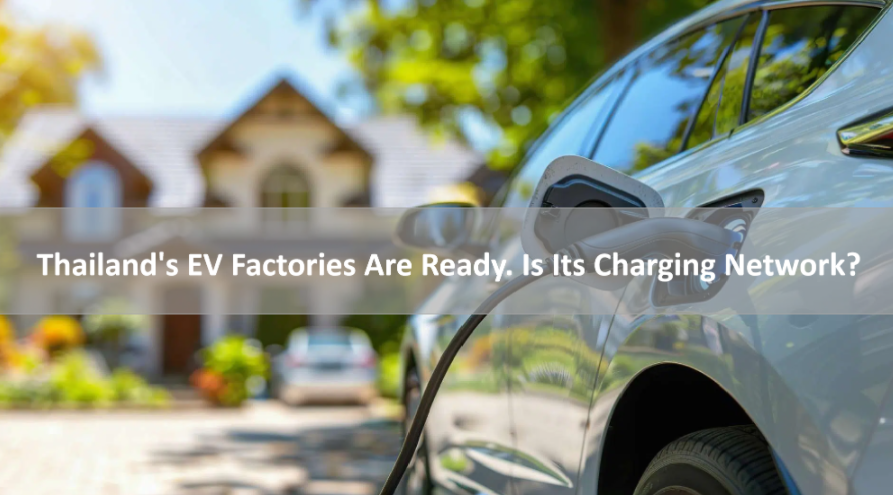
Executive Summary
Thailand stands at a pivotal juncture. As the longstanding "Detroit of Asia" and the ASEAN region's largest automotive manufacturer and exporter, its strategic pivot to electric vehicles (EVs) is not merely a consumer trend but a national industrial imperative. Backed by some of the region's most aggressive and clear incentives, Thailand is successfully attracting global EV and battery manufacturing investments. However, the charging infrastructure required to support this nascent EV ecosystem is developing in a distinct, "supply-push, demand-follow" model.
This analysis concludes that Thailand's EV charging market is poised for rapid, structured growth, but will be characterized by intense competition and a race for prime real estate. Unlike the two-wheeler dominance of Vietnam or the utility-led model of Malaysia, Thailand's landscape is being shaped by a "fuel station versus destination" battle, pitting the expansive networks of national oil companies against the captive audiences of retail and property giants. The key insight for stakeholders is that the market will rapidly segment into high-speed corridor charging and ubiquitous destination charging, with success hinging on strategic partnerships and hardware that delivers reliability in a tropical climate. For technologically resilient solutions like the Anari Energy Vulco DC Series, Thailand represents a premier market to demonstrate superiority in uptime and total cost of ownership for high-utilization commercial and public networks.
1. Thailand's National Charging Station Policy: The 30@30 Vision and Aggressive Incentives
Thailand has established arguably the clearest and most investment-friendly policy framework in Southeast Asia, centered on converting its existing automotive supremacy into EV leadership.
1.1 The 30@30 Vision and EV3.5 Measures
The core of Thailand's strategy is the "30@30" goal: for 30% of all vehicles produced domestically to be zero-emission by 2030. To achieve this, the Board of Investment (BOI) and government have launched the EV3.5 package (2024-2027), which provides direct subsidies for EV purchases (both imported and domestically produced) and, crucially, generous incentives for charging infrastructure deployment.
Strategic Insight: The subsidies directly create immediate market demand for EVs, which in turn creates an urgent and tangible need for charging infrastructure. This de-risks investments for Charging Station Operators (CSOs), as the customer base is being actively cultivated by government spending.
1.2 Unprecedented BOI Incentives for Infrastructure
The BOI offers corporate income tax exemptions and reduced import duties for manufacturers and installers of charging stations. More importantly, it provides grant subsidies per charging socket installed (both AC and DC). This direct financial support significantly improves the ROI model for infrastructure projects, accelerating network roll-out.
Strategic Implication: The incentive landscape makes Thailand a highly attractive and competitive market for infrastructure players. Understanding and leveraging the BOI application process is a critical first-mover advantage.
1.3 The Central Planning Blueprint
The government, through the Ministry of Energy, has published a national charging infrastructure master plan, identifying priority locations and corridors. This provides a roadmap for private investment, reducing market speculation and focusing capital on strategically important areas.
2. Current Development Status of Charging Stations in Thailand
The market is transitioning from pilot projects to rapid scaling, with intense competition for high-visibility sites.
2.1 The "Fuel Station vs. Destination" Battle
Two dominant models are emerging concurrently:
Oil & Gas Conversion: National champion PTT Group, through its subsidiary Arun Plus, and other players like Bangchak are aggressively retrofitting their vast nationwide network of fuel stations into "EV Station Plazas." This provides an unparalleled advantage in terms of existing highway-adjacent real estate.
Destination Charging: Retail giants (Central Group, Mall Group), property developers, and hotel chains are installing chargers as value-added amenities for their customers. This network is growing rapidly in urban and suburban centers.
2.2 The Automotive OEM Rush
Global automakers investing in Thai production (BYD, Great Wall, Neta) and incumbents (Toyota, Nissan) are building branded charging networks at dealerships and select public locations to support their customers and enhance brand loyalty.
2.3 Fleet Electrification: The Emerging Wave
While private EVs lead initial adoption, electrification plans for Bangkok's mass transit buses, hotel limousine fleets, and corporate vehicle pools are underway, creating early, predictable demand for depot and dedicated public charging.
3. Thailand's Requirements for Charging Stations (Climate & Usage)
Thailand's operating environment imposes specific demands on charging hardware.
3.1 Tropical Climate Endurance
High temperatures, intense humidity, and heavy monsoon rains are the norm. Equipment must be engineered for:
Thermal Management: Preventing performance throttling during sustained 35-40°C heat is critical for customer satisfaction. Liquid-cooled cable technology is becoming a differentiator for high-power DC chargers.
Weather and Flood Resistance: A minimum IP65 rating is essential. In flood-prone areas like parts of Bangkok, elevated installation or additional protection is required.
3.2 High-Uptime Demands for Public Networks
As networks scale, operational reliability becomes the key brand differentiator. A charger that is out-of-service ("ICE'd" or faulty) damages operator reputation. Hardware must be designed for minimal maintenance and robust enough to withstand constant public use.
3.3 Grid Interaction and Power Costs
Thailand's peak electricity tariffs are significant. For high-power charging stations, managing demand charges is essential for profitability. Chargers with integrated smart power management and compatibility with on-site solar/storage are increasingly valuable.
4. Growth Opportunities in Thailand's Electric Vehicle Charging Market
Beyond the general expansion, specific high-value opportunities are crystallizing.
4.1 The Strategic Highway Corridor
The development of DC fast-charging hubs along key intercity routes (e.g., Bangkok to Pattaya, Chiang Mai, Hua Hin) is a critical and lucrative opportunity. This requires partnerships with fuel station operators or new real estate development at highway rest stops.
4.2 The Commercial Depot & Fleet-as-a-Service (FaaS) Model
The electrification of ride-hailing, car rental, and logistics fleets will explode. The opportunity lies in providing a complete "Fleet Charging as a Service" solution—encompassing hardware, software, installation, and maintenance—allowing fleet operators to focus on their core business.
4.3 The Condominium and Workplace Revolution
Thailand's vast stock of condominiums and office buildings represents the next frontier for AC charging. Providing scalable, manageable, and safe solutions for property managers (including load-sharing technology to avoid grid upgrades) is a massive, untapped B2B market.
5. Major Players in Thailand's Charging Stations Market
The competitive landscape is consolidating around well-capitalized, strategic incumbents.
The Energy Giants: PTT Group (Arun Plus) and Bangchak. These are the most formidable players, leveraging unparalleled site networks, brand trust, and capital. They aim to be one-stop-shop energy providers.
The Automotive OEMs: BYD, MG, Tesla. Building proprietary or partially open networks to drive vehicle sales and customer loyalty.
The Regional Utility & Conglomerates: Gulf Energy, Energy Absolute. Vertically integrated players involved in power generation, EV manufacturing (EA), and charging networks.
Specialist CPOs: Emerging companies focusing solely on building and operating charging networks through partnerships with destinations.
Competitive Insight: The market is moving from a focus on the number of chargers to network quality, reliability, and user experience. The operator with the highest uptime and fastest, most consistent charging speeds will win customer loyalty.
6. Opportunities for the Anari Energy Vulco DC Series in Thailand
The Vulco DC Series is positioned as the premium solution for building Thailand's reliable, high-performance charging backbone.
6.1 Becoming the Partner of Choice for Network Reliability
For operators like PTT or Bangchak, whose brand reputation is built on reliability, network uptime is paramount. The Vulco DC Series, with its engineered resilience to heat and humidity, minimizes downtime and maintenance costs, protecting the operator's brand and ensuring customer satisfaction. This is a powerful TCO argument against lower-spec competitors.
6.2 Powering the Fleet Electrification Transition
For fleet operators, vehicle availability is revenue. The Vulco DC's high and consistent power delivery ensures faster turnaround times. Its modular design and advanced load management allow for cost-effective scaling of depot charging, making it an ideal foundation for the "Charging-as-a-Service" model targeted at commercial fleets.
6.3 Winning High-Value Public Tenders and Partnerships
For developers of major highway hubs or premium destination charging plazas, the Vulco DC Series represents a future-proof, high-quality investment. Its compatibility with renewable integration and smart grid functions aligns with Thailand's broader sustainability goals and can be a key differentiator in winning public-private partnership (PPP) tenders.
6.4 Establishing a Benchmark for Performance
In a crowded market, Anari can leverage the Vulco DC Series' technical superiority to establish a new benchmark for what "reliable charging" means in Thailand. Marketing focused on engineering specs, uptime statistics, and climate testing can appeal to a market tired of underperforming hardware.
Conclusion and Strategic Outlook
Thailand's EV charging market is on a clear, fast-tracked growth path, uniquely supported by proactive government policy and fierce competition among deep-pocketed domestic champions. The window for establishing a leading position is now, during this foundational build-out phase.
The market will quickly mature beyond a race for locations to a competition based on network intelligence, seamless user experience, and unwavering reliability. Companies that invest now in robust, software-defined, and scalable charging infrastructure will be best positioned to form the strategic partnerships necessary for long-term dominance.
For Anari Energy, Thailand is not just a market; it is a strategic proving ground. Success with the Vulco DC Series here—demonstrating superior uptime in a challenging climate and capturing key fleet and highway segments—would provide a formidable case study for expansion across the entire ASEAN region. The Detroit of Asia is rewiring its future, and the stakes for infrastructure providers have never been higher.




















.png)

