Introduction
As electric vehicles (EVs) accelerate across Southeast Asia, Thailand is fast emerging as a regional test-bed for large-scale public charging infrastructure. Once a modest market, Thailand’s EV adoption, supportive policies, and coordinated infrastructure build-out are transforming its EV charging landscape. The country’s recent growth offers a valuable case study for other emerging markets — illustrating both the promise and the practical challenges of scaling EV-charging networks at national level. This article analyzes current developments, infrastructure deployment trends, and the barriers and opportunities shaping Thailand’s EV-charging future.
1. Thailand’s EV Market & Policy Context
1.1 EV adoption and market growth
In the past few years, Thailand has witnessed a sharp uptick in EV sales — driven by rising consumer awareness, favorable regulations, and a growing variety of EV models. According to [insert credible source — e.g. Thailand’s transport ministry data / automotive market reports], EV registrations grew by X% year-over-year in 2023, signaling strong early demand.
The Thai government has played a key role through incentives and supportive policies. For instance, [insert policy name / year] offers tax reductions and import-duty exemptions for EVs, and public charging infrastructure is prioritized in national energy and mobility strategies. These measures have helped reduce upfront costs for EV buyers and lowered barriers to charger deployment, accelerating both EV adoption and charging-infrastructure rollout.
Beyond private vehicles, there is also growing interest in electrified public transport and fleets — taxis, ride-hailing, and commercial vehicles — which further increases the potential demand for public and semi-public charging infrastructure.
1.2 Demand side & future outlook
Given current trends, many analysts expect EV to constitute Y% of all new vehicle sales in Thailand by 2028 — increasing the demand for accessible, reliable public charging infrastructure. That in turn presents an opportunity (and challenge) for EV-SE (EV supply equipment) providers, grid operators, and policymakers to build out capacity at pace.
2. Charging Infrastructure Deployment — Scale, Types & Distribution
2.1 Rapid expansion of public and private charging networks
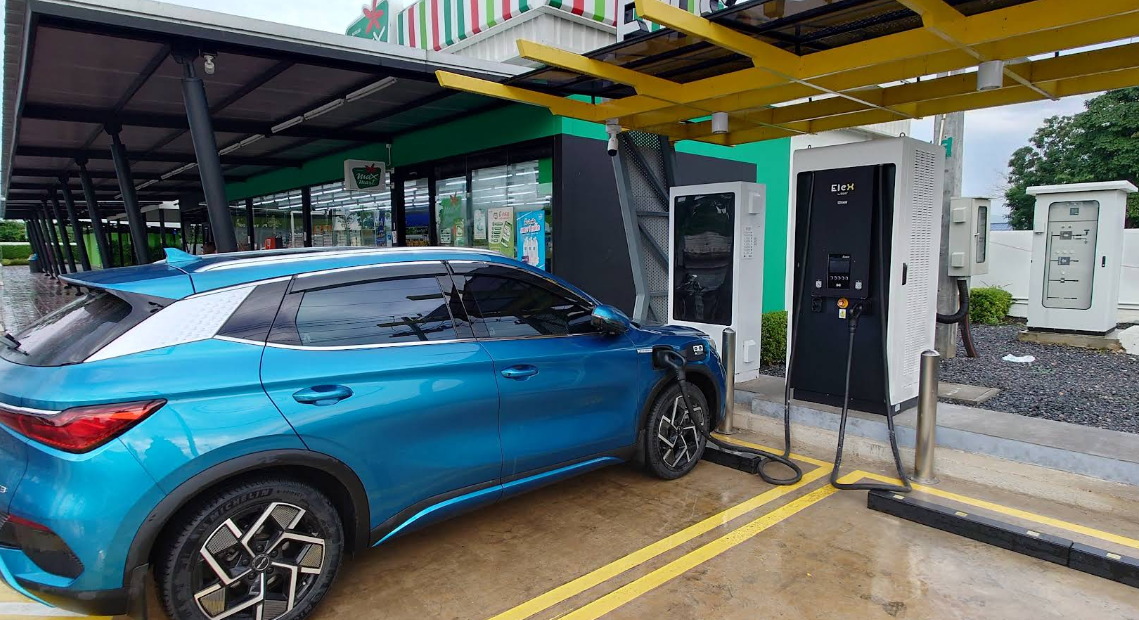
Over the last 2–3 years, Thailand has seen a surge in charger installation. Public-charging stations, DC fast-charging hubs on highways, and urban “destination” chargers (shopping centers, parking garages) are rolling out across major cities and strategic corridors. According to recent market data:
- There are now estimated N public-charging sites across the country.
- The proportion of fast chargers (e.g., DC 50 kW+) has increased from A% in 2022 to B% in 2024, reflecting growing demand for quick turnaround charging — especially among fleet and long-distance drivers.
- Charger coverage is densest in major urban areas (such as Bangkok, Chiang Mai, Phuket), but deployments are gradually extending to secondary cities and key highway routes, supporting inter-city travel and EV adoption beyond metropolitan zones.
2.2 Mix of charger types: AC, DC fast, destination & workplace charging
Thailand’s charging ecosystem is not limited to public fast chargers. The rollout includes:
- AC Level-2 chargers at residential buildings, workplaces, and malls — catering to overnight or “destination” charging.
- DC fast charging stations along highways and major roads — critical for enabling long-distance travel and commercial fleet operations.
- Destination chargers at parking facilities, malls, hotels — designed for convenience charging during shopping, overnight stays, or other activities.
This diversified charging mix helps to meet different user needs — from daily commuters relying on workplace/home charging to inter-city travelers needing fast top-ups, all while providing a more resilient network overall.
2.3 Deployment stakeholders & business models
Chargers are being deployed by a mix of players: private EVSE vendors, commercial charging-network operators (CPOs), energy utilities, and in some cases, government/public–private partnerships. Business models vary:
- Pay-per-use public DC charging (hourly or per-kWh billing).
- Subscription or membership-based models for frequent users or fleet operators.
- Destination/retail-hosted charging (malls, hotels) offering “free charging as a service amenity.”
Operators are experimenting with different pricing and service models to find the right mix for profitability while encouraging EV adoption.
3. Challenges & Bottlenecks: What’s Slowing Down the Surge
Despite the fast growth, Thailand’s charging infrastructure build-out still faces significant headwinds.
3.1 Grid capacity & power-distribution constraints
The expansion of fast-charging stations — especially DC high-power chargers — puts pressure on local grid capacity. In many areas, the existing distribution-grid infrastructure was not originally designed for high-power, concurrent charger loads. This raises concerns about transformer capacity, load balancing, and potential demand spikes during peak hours. Rural or semi-urban areas with weaker grid infrastructure are especially vulnerable.
Without coordinated planning and upgrades from utilities, rolling out fast chargers broadly may lead to delays, grid overloads, or underpowered/inefficient chargers.
3.2 Regulatory, permitting, and standardization issues
Deploying chargers across diverse locations — from urban malls to highway rest areas — involves a myriad of regulatory and permitting hurdles. These include site approval, land-use permits, safety and electrical compliance, and zoning restrictions.
Additionally, standardization remains a challenge. Although many EVs support common standards (e.g., CCS, CHAdeMO, AC Type 2), the mix of connector types and absence of universal interoperability in some deployments can limit charger usability and deter EV drivers who worry about compatibility.
3.3 Utilization rate and business sustainability
Public DC fast chargers require relatively high utilization to be economically viable (given high capital cost, grid connection costs, maintenance). In areas with low EV adoption or sparse traffic, underutilization may discourage further investment.
Destination or workplace AC chargers — while cheaper — shift the revenue model from pay-per-use to either subscription, amenity, or employer-funded charging. This creates complexity in revenue modeling, especially for third-party CPOs.
Finally, public awareness and driver behavior remain factors: many EV owners may prefer home or workplace charging, limiting demand for public chargers — especially for DC fast charging unless long-distance travel is frequent.
4. What Thailand’s Experience Means for Broader EV Adoption in Southeast Asia
Thailand’s charging infrastructure journey offers several lessons for other emerging EV markets in Southeast Asia — from Indonesia and Vietnam to Malaysia, Philippines, and beyond.
4.1 A diversified charging portfolio is critical
Relying solely on DC fast chargers or only on home/workplace AC chargers will not suffice. A mix of AC destination chargers, workplace/home chargers, and strategically placed DC fast chargers works best — meeting diverse user needs and maximizing infrastructure utility.
4.2 Coordination between stakeholders is essential
Utilities, regulators, EVSE vendors, network operators, and policymakers must coordinate. Grid-capacity planning, permitting streamlining, and standardization (connectors, billing, interoperability) help avoid bottlenecks and accelerate deployment.
4.3 Business and pricing models must adapt to local context
In emerging markets, where EV adoption is still growing, CPOs must wisely choose business models: subscription-based for frequent users or fleets; amenity-based for retail hosts; pay-per-use for highway / long-distance charging. Flexibility will determine sustainability.
4.4 Supportive policy & incentives remain a key driver
Government incentives — for EV purchases and for charger installation — can significantly accelerate both demand and supply side. Subsidies, tax breaks, permit streamlining, and grid-upgrade support can de-risk charger deployment and encourage private participation.
4.5 Data-driven deployment and phased roll-out
Start with high-demand corridors / urban centers, monitor utilization, adapt deployment in phases. Use utilization data to inform next sites rather than over-building up front — this conserves CAPEX and avoids under-used assets.
5. Recommendations & What’s Next
Based on Thailand’s experience and the broader regional context, the following steps can help accelerate EV-charging infrastructure build-out effectively:
- Conduct national charger-demand forecasting. Use EV adoption forecasts, traffic data, and urbanization trends to model future charging demand and plan grid upgrades accordingly.
- Promote public–private partnerships. Governments can de-risk charger deployment by sharing grid-upgrade costs, simplifying permitting, and providing incentives to early CPOs.
- Standardize charging protocols across ASEAN. To foster interoperability and reduce consumer friction, regional standards (connectors, communication, billing) would help avoid fragmentation.
- Encourage flexible business models. Given variable utilization rates, CPOs should tailor pricing (subscription, pay-per-use, amenity-based), host retail/parking partners, and diversify revenue (e.g., advertising, ancillary services).
- Educate consumers and fleets. Awareness campaigns about EV benefits — combined with transparent information about charging networks — will build trust and drive adoption.
- Monitor & publish utilization data. Transparency on charger usage, downtime, and reliability helps operators improve service, plan expansion, and build investor confidence.
Conclusion
Thailand’s emergence as a regional frontrunner in EV-charging infrastructure offers valuable lessons for Southeast Asia and beyond. Its combination of rising EV adoption, diversified charger deployment, and evolving business models shows what a coordinated approach can achieve — but also underscores the practical barriers that must be addressed: grid readiness, regulatory compliance, utilization challenges, and long-term sustainability.
For developing economies racing toward electrified mobility, the Thai experience suggests that success lies not in isolated charger installations, but in holistic planning — grid, policy, business model, and user behavior. As more countries in the region shift toward EVs, Thailand’s roadmap may well become a blueprint.
---
References & Data Sources
- Data on EV registrations and growth rates in Thailand (e.g., transport ministry or EV market reports)
- Recent studies or reports on charger deployment and infrastructure distribution in Thailand
- Regional comparisons / EV adoption forecasts for Southeast Asia
- Grid-capacity and power-distribution studies relevant to EV charging demand






















.png)

