




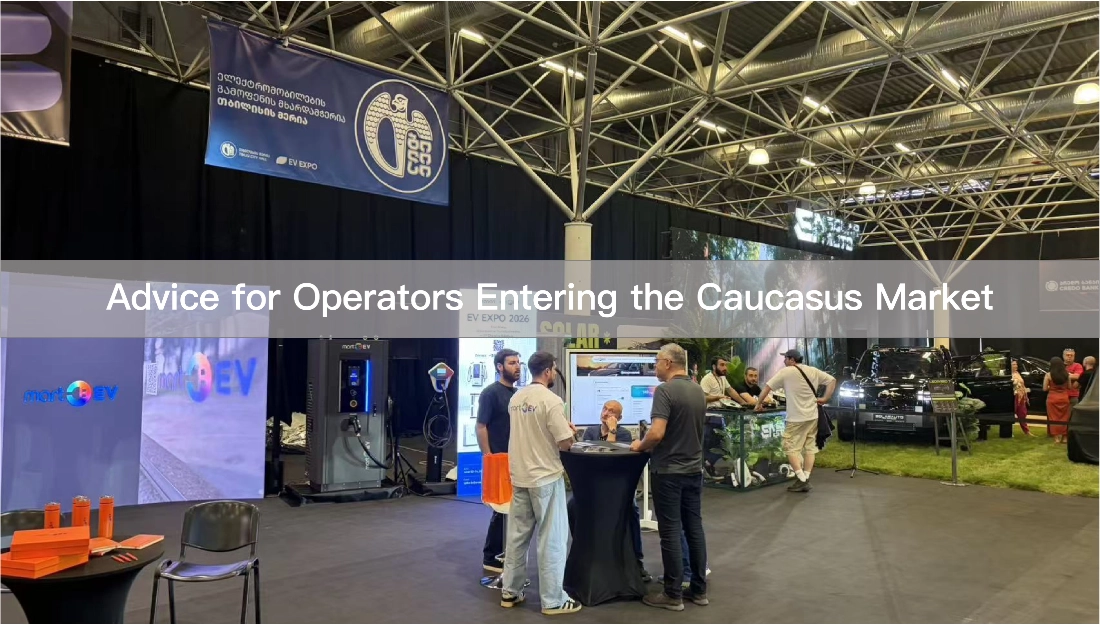
If you’re considering building or investing in charging stations in the Caucasus — whether you’re converting a gas station, adding charging to a hotel property, or launching a pure-play charging operation — here are six pieces of advice grounded in hundreds of expo conversations and real operating experience. Each one has a story behind it. Someone already paid the tuition.
1. You’re not selecting a spec sheet. You’re selecting “who can fix it when it breaks.”
The consensus on the expo floor: the acceptable fault response window in the Caucasus is 24–48 hours. The average response time from offshore suppliers is 10–14 days. The gap between these two numbers is the survival line for your site’s reputation.
This means: before you sign a contract with an equipment supplier, the questions to ask aren’t “what’s the peak power?” — they’re:
• Do you have local spare parts inventory in Georgia / Armenia / Azerbaijan?
• From fault report to engineer on-site, what’s the fastest path?
• How long have your chargers been operating here? Can I talk to an existing customer?
When you’re comparing three supplier quotes, the most expensive option may have the lowest long-term total cost if it comes with a local warehouse and a 48-hour response commitment. Because one extended downtime incident costs more than charging revenue — it costs the hardest thing to rebuild in a small market: customer trust.
2. Evaluate your local partner as part of your operational capability, not as a “channel.”
A gas station owner in Georgia converting a diesel island into a charging island doesn’t just need a charger — they need the entire set of capabilities that make that charger work in the real world: electrical adaptation, local payment integration, government subsidy applications, and expansion planning a year down the road.
Can your equipment supplier provide these? If not, can your local partner fill the gaps?
The lesson from the expo floor: in the “equipment supplier + local partner” equation, the local partner matters at least as much as the hardware. The best specs in the world mean nothing if no one shows up to handle the installation issues, or if there’s no one to call when something breaks.
3. Treat your first site as a stress test, not a profit center.
The Caucasus market has near-zero margin for error in site selection. Remember the operator on the outskirts of Tbilisi — a “good location” that averaged 2–3 sessions per weekday. EV adoption may grow slower than you project. Seasonal swings may be sharper than you expect.
Start with a small, expandable configuration — say, 2–4 AC units + 1 DC unit. Run it for six months. Get real utilization data, seasonal curves, and a failure log. Then decide how big your second site should be. In the Caucasus, proving your model first and then scaling gives you far better odds than grabbing sites now and fixing mistakes later.
4. Ask about OCPP compatibility — not “do you support it,” but “which platforms have you actually integrated with?”
Multiple operators at the expo flagged the same issue: certain brands claim OCPP support, but when connected to their CMS platform, compatibility problems surfaced — no remote diagnosis, firmware update failures, delayed fault alerts.
“Supports OCPP” and “actually works with your CMS platform” are two different things. Demand a list of platforms the equipment supplier has actually integrated with. Better yet, ask for contact information from an existing customer using that platform so you can verify. What you save by skipping this step isn’t money — it’s the accumulated frustration of every fault diagnosis over the next two years.
5. Engineer-Friendly isn’t a nice-to-have — it’s a hidden cost driver.
The maintenance team lives with these chargers every day. How easy are the modules to remove? Are the fault codes readable? Can replacement parts be sourced locally? None of these appear on your procurement checklist — but they’ll define the daily reality of your operations team.
The feedback from the expo was direct: if the maintenance engineers find a charger “easy to work with,” they’ll advocate for that brand when reporting to management. Conversely, a charger with beautiful tech specs will get vetoed with four words: “too hard to fix.”
Bring your maintenance lead into the selection process. Don’t rely on the sales rep’s spec sheet alone.
6. Send customers three quotes — not one.
Customer segmentation in the Caucasus is sharper than in Europe: from budget-first boutique hotels to reliability-first fleet operators, needs vary dramatically.
An effective practice validated at the expo: send a potential customer three proposals at once — high, mid, and entry tier — and let them choose. Price-sensitive customers who pick the entry tier won’t feel treated as second-class. Reliability-sensitive customers who pick the premium tier will see you as professional. Customers aren’t choosing a power rating — they’re choosing the option they trust most within their budget constraints.
Closing Note
If you’re already operating chargers in the Caucasus — we hope this report resonates with what you’ve experienced. The traps you’ve stepped into, we’ve stepped into too. The models you’re validating, we’re validating alongside you.
If you’re considering entering this market — gas station owner, hotel group energy manager, real estate developer, fleet operator in transition — here’s our simplest advice: don’t treat the Caucasus as a “small Europe.” Treat it as a business model stress test.
The grid here won’t give you 400 kW. The electricity margins won’t subsidize your operating losses. One bad customer experience can cost you your reputation in a market where everyone knows everyone. But the flip side: tourism is growing. Diesel islands are turning into charging islands. Hotels are making EV charging a differentiator for road-tripping guests. And the operators who prove their model first will build a trust barrier that latecomers will struggle to cross.
Anari is doing this work in the Caucasus right now: with a local partner, delivering reliable hardware, local service, and a stress-tested business model to operators. If we spoke at the expo, or if you want to dig deeper into the Caucasus market — come find us.
Website: www.anariev.com
Email: inquiry@anarienergy.com
Phone: +86 18866205186