




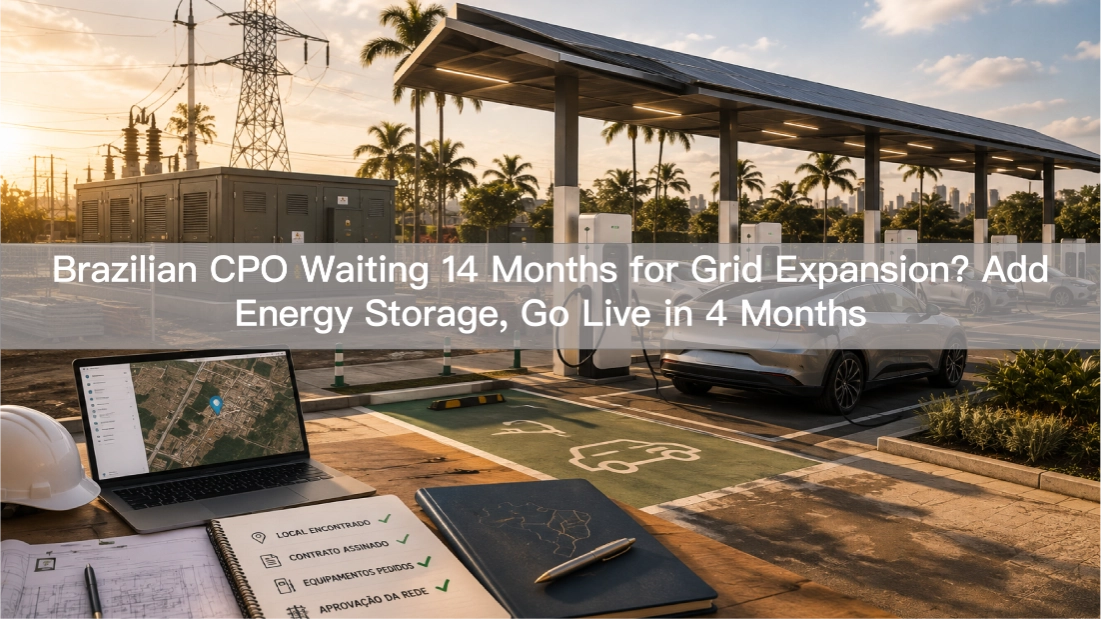
How one Brazilian charging point operator cut site launch time by 70% — and what the numbers actually look like.
You found the site. Signed the lease. Ordered the chargers.
Then the utility tells you: 14 months for the transformer upgrade.
While you wait, your competitor down the highway opens a station and starts collecting R$2 per kWh from the EVs that could have been yours.
Brazil’s charging market doesn’t have a demand problem or an equipment problem. It has a grid connection problem.
One operator found a way around the queue. Here’s the math that made it work.
1. The 14-Month Problem
Grid connection for a high-power charging station in Brazil averages 8 to 14 months. In some states, longer.
It’s not about money. Transformer procurement, utility engineering reviews, construction permits, scheduling — each step has its own queue. None of them care about your lease payments.
What 14 months costs a CPO with a 6-charger station:
| Cost category | Monthly (R$) | Over 14 months (R$) |
| Site lease (idle) | 15,000 | 210,000 |
| Depreciation on installed-but-idle hardware | 8,500 | 119,000 |
| Lost revenue (6 × 120kW, 15% utilization, R$2/kWh) | 93,000 | 1,302,000 |
| Total | 116,500 | 1,631,000 |
R$1.6 million. That’s the cost of waiting. Not an abstract risk — a line item on your P&L.
The lost revenue dominates. Six 120kW chargers at 15% utilization generate roughly R$93,000 per month in charging fees. Fourteen months of zero revenue is R$1.3 million you never recover.
2. The 4-Month Alternative
A São Paulo-based CPO — let’s call them Operator X — faced exactly this scenario in late 2025.
They had secured a site near the Rodoanel with confirmed EV traffic. Six DC fast chargers planned. The utility quoted 13 months for the required 800kVA transformer.
Instead of waiting, they added a battery energy storage system (BESS).
The BESS acts as a buffer. It charges from the available grid connection — in this case, a much smaller 300kVA line that could be approved in weeks — during off-peak hours. When EVs pull up, the battery discharges alongside the grid, delivering the full 720kW the chargers need during peak sessions.
Timeline comparison:
| Phase | Grid-only path | Grid + BESS path |
| Site assessment & lease | 1 month | 1 month |
| Utility application & approval | 3–5 months | 3–5 weeks (smaller load, simpler review) |
| Transformer procurement & install | 4–6 months | Not required (existing capacity used) |
| Construction & commissioning | 2 months | 2 months |
| Total to first charge | 10–14 months | 3–4 months |
Operator X launched in 4 months. They captured the corridor traffic while competitors were still in the utility queue.
3. The Math: Does Storage Actually Pay for Itself?
Batteries cost money. No way around that. Let’s run the numbers.
3.1 Assumptions
Site: 6 × 120kW DC chargers (720kW peak load)
Available grid 300kVA (what you can get quickly)
BESS sizing: 500kW / 1,000kWh lithium-ion system — enough to cover peak demand gaps and 2 hours of high-utilization discharge
BESS cost: ~R$1.2 million installed (Brazil market, 2026 pricing — down ~30% from 2024)
BESS lifespan: 10 years, 4,000 cycles
Electricity spread: R$0.40/kWh off-peak → R$2.00/kWh sold (arbitrage benefit)
Charger utilization: 15% average, growing 3pp annually as fleet expands
3.2 TCO Comparison: 5-Year View
Path A: Wait for grid upgrade (14 months), then operate
| Year | Revenue | Grid cost | Lease | Maintenance | Net |
| 1 | 466,000 | 93,000 | 180,000 | 60,000 | +133,000 |
| 2 | 1,120,000 | 225,000 | 180,000 | 72,000 | +643,000 |
| 3 | 1,345,000 | 270,000 | 180,000 | 78,000 | +817,000 |
| 4 | 1,570,000 | 315,000 | 180,000 | 84,000 | +991,000 |
| 5 | 1,795,000 | 360,000 | 180,000 | 90,000 | +1,165,000 |
5-year cumulative: +3,749,000
Path B: Add BESS, launch in 4 months
| Year | Revenue | Grid cost | Lease | Maintenance | BESS amortization | Net |
| 1 | 1,120,000 | 225,000 | 180,000 | 72,000 | 120,000 | 523,000 |
| 2 | 1,345,000 | 270,000 | 180,000 | 78,000 | 120,000 | 697,000 |
| 3 | 1,570,000 | 315,000 | 180,000 | 84,000 | 120,000 | 871,000 |
| 4 | 1,795,000 | 360,000 | 180,000 | 90,000 | 120,000 | 1,045,000 |
| 5 | 2,020,000 | 405,000 | 180,000 | 96,000 | 120,000 | 1,219,000 |
5-year cumulative: +4,355,000
5-year advantage of Path B: +R$606,000.
The BESS pays for itself in approximately 2.3 years from the arbitrage and early-revenue advantage alone. After that, it’s net positive — even before counting the strategic value of being first to market.
What doesn’t show up in the spreadsheet
– Market capture: Every EV driver who charges at your station in month 5 becomes a repeat user. The operator who waits 14 months has to win those drivers from you.
– Grid fee avoidance: Brazil’s peak demand charges (demanda contratada) can be 30–40% of a station’s electricity bill. A BESS lets you shave peak demand, directly reducing this line item.
– Future-proofing: When the utility eventually completes the grid upgrade, the BESS doesn’t become obsolete. It shifts from “primary power source” to “peak shaving + backup + energy arbitrage.”
4. Not Every Site Needs Storage
BESS isn’t always the right call. Here’s when to skip it and wait for grid:
Skip BESS if:
– Grid approval is under 6 months (some urban sites in São Paulo with existing capacity)
– Site is low-power (AC chargers only, 2–4 units)
– Lease terms allow delayed possession (you haven’t started paying yet)
– Electricity spread is under R$0.20/kWh (thin arbitrage margin)
Add BESS if:
– Grid wait time exceeds 8 months
– DC fast chargers (120kW+) with high peak-to-average power ratio
– Lease payments start immediately upon signing
– Competitor activity in the corridor (first-mover matters)
– Site has space for a containerized BESS (~20-foot footprint for 1MWh)
5. How to Model This for Your Site
Every site has different numbers. Five variables determine whether storage pencils out:
Grid wait time (months) — ask your utility for a written estimate, then add 30%
Available existing capacity(kVA) — what can you connect to today without an upgrade?
Peak load requirement(kW) — sum of your chargers at full simultaneous draw
Electricity spread (R$/kWh) — your off-peak purchase price vs. what you sell to drivers
Site lease cost (R$/month) — idle rent is the hidden killer
Plug your numbers in. If `(grid_wait_months × monthly_lease × 1.5) + (grid_wait_months × monthly_lost_revenue × 0.7) > bess_installed_cost`, add storage.
For most DC fast-charging sites in Brazil today, the inequality holds.
6. The Bottom Line
The Brazilian EV fleet hit 400,000 vehicles in 2025 and is adding 300,000+ per year. Every month of grid delay is a month you’re not collecting revenue from drivers who are already on the road, looking for somewhere to charge.
Grid expansion will catch up eventually. ANEEL is streamlining approvals. Transformer supply chains are improving. But “eventually” doesn’t pay your lease.