



Table of Contents
As electric vehicle (EV) adoption accelerates worldwide, intercity travel is undergoing a fundamental transformation. While home and workplace charging cover daily commutes, long-distance highway travel depends entirely on reliable, high-speed public charging infrastructure. For highway hotels and roadside service areas, this shift represents a major commercial opportunity.
Today’s EV drivers plan their routes around charging stops. Properties that offer dependable DC fast charging no longer view chargers as a passive utility—they leverage them as a strategic asset to capture high-value travelers, boost ancillary sales, and secure a decisive competitive edge. This guide examines how highway hotels and service area operators can plan, deploy, and monetize commercial DC fast charging infrastructure effectively.
Understanding Traveler Behavior: Highway Hotels vs. Service Areas
Although both highway hotels and service areas serve transit travelers, their dwell times, charging expectations, and operational dynamics differ significantly. Designing a profitable charging hub begins with aligning hardware power levels to driver behavior.
Highway Service Areas: Speed and Throughput
Drivers pulling into a highway service area prioritize speed. Their typical dwell time ranges from 15 to 30 minutes—just enough time to use the restroom, grab coffee, or enjoy a quick meal. To match this rhythm, service areas require high-power DC fast chargers (typically 180 kW to 480 kW or split-type ultra-fast systems). High throughput ensures rapid turnover during peak holiday travel and minimizes queuing, which is critical for maintaining driver satisfaction.
Highway Hotels: Convenience and Versatility
Highway hotels serve a dual audience. Overnight guests have 8 to 10 hours of dwell time, which traditionally suited Level 2 AC chargers. However, relying solely on AC charging creates blind spots:
- Late-night arrivals and early departures often need a rapid top-up before getting back on the road.
- Daytime transit drivers will stop at a hotel’s parking lot if fast charging is publicly accessible, often purchasing meals, coffee, or day-use amenities.
- EV fleet and business travelers frequently require quick turnarounds between meetings or delivery legs.
Installing 60 kW to 180 kW DC fast chargers—ideally paired with a few AC units for overnight guests—positions a highway hotel as a premier stopover destination.
Comparison of Highway Charging Profiles
| Operational Factor | Highway Service Areas | Highway Hotels |
|---|---|---|
| Typical Dwell Time | 15 – 30 minutes | 30 – 60 minutes (transit) / 8+ hours (overnight) |
| Recommended DC Power | 180 kW – 480 kW+ (Ultra-Fast / Split-Type) | 60 kW – 180 kW (Mid-to-High Speed DC) |
| Primary User Persona | Long-distance commuters, road-trippers, heavy logistics | Overnight travelers, business fleets, regional tourists |
| Core Operational Goal | Maximum vehicle turnover and minimal wait times | Higher booking conversion and extended guest spend |
| Primary Revenue Streams | Direct kWh sales, convenience retail, QSR dining, DOOH ads | Room bookings, on-site dining, charging fees, loyalty retention |
Commercial Benefits and Revenue Models
Deploying DC fast charging along highway corridors unlocks multiple revenue streams that extend well beyond the electricity dispensed.
1. Direct Charging Revenue and Dynamic Pricing
Operators can monetize charging sessions through per-kilowatt-hour (kWh) pricing, session fees, or idle fees that discourage drivers from occupying bays after charging completes. With smart backend software, highway sites can implement dynamic pricing—charging premium tariffs during peak weekend travel hours and offering discounted rates during off-peak periods to attract local fleets and rideshare drivers.
2. Higher Occupancy and Ancillary Spend
EV charging has become a top search filter on major hospitality and navigation platforms, including Google Maps, Booking.com, and TripAdvisor. Highway hotels equipped with reliable DC fast chargers capture bookings from EV drivers who actively bypass competing properties without charging access.
At highway service areas, the 20-to-30-minute charging window directly translates into higher retail conversion. Compared to traditional five-minute gasoline stops, EV drivers spend significantly more time inside service plazas, driving higher average ticket sizes at restaurants, cafes, and convenience stores.
3. Digital Out-of-Home (DOOH) Advertising
Commercial DC charging stations equipped with integrated high-definition LCD screens create an additional passive income stream. Service areas and hotels can sell advertising space to regional brands or use the screens to promote on-site meal combos, loyalty programs, and room upgrades directly to a captive audience standing right beside their vehicles.
4. Brand Differentiation and ESG Alignment
Roadside hospitality and fuel retail operators face growing pressure from corporate clients and regulators to reduce carbon footprints. Offering clean-energy infrastructure enhances brand perception, helps hotels qualify for corporate travel contracts with strict sustainability mandates, and often unlocks government grants or tax incentives for commercial EV infrastructure.
Key Technical and Infrastructure Considerations
Highway environments place heavy demands on charging hardware. Unlike sheltered office garages, roadside sites experience high daily utilization, diverse vehicle types, and harsh weather conditions. Operators must evaluate four critical technical pillars before procuring equipment.
Power Capacity and Dynamic Load Balancing
Grid connection upgrades are often the largest capital expense and longest timeline bottleneck in highway EV projects. Rather than immediately paying for a massive transformer upgrade, site operators can deploy dynamic power allocation (load balancing). Intelligent power-sharing technology distributes available site power across active connectors in real time based on each vehicle’s actual charge curve. For example, a site with a constrained 200 kW grid connection can operate multiple 60 kW chargers simultaneously without tripping breakers. In locations with severe grid constraints, integrating a Battery Energy Storage System (BESS) enables peak shaving and lowers utility demand charges.
Wide-Voltage and Multi-Standard Compatibility
The EV market spans compact sedans running on 400V architectures, luxury vehicles and modern SUVs utilizing 800V platforms, and commercial electric vans. To prevent stranded capacity, commercial DC chargers must support a 200V–1000V wide-voltage output range. Additionally, offering region-appropriate multi-standard connectors (such as CCS1, CCS2, NACS, or GB/T) ensures compatibility with over 99% of passenger and light commercial EVs on the road.
Hardware Reliability and Environmental Resilience
Along remote highway stretches, a downed charger damages brand trust and immediately halts revenue. Commercial-grade hardware should feature:
- Rugged Protection Ratings: Minimum IP54 weatherproofing and IK08 impact resistance to withstand extreme heat, freezing temperatures, humidity, dust, and coastal salt fog.
- Modular Architecture: Hot-swappable power modules allow field technicians to replace a faulty unit in under 30 minutes rather than taking the entire station offline.
- Redundant Control Systems: Dual-chip redundancy ensures that minor processing faults do not abruptly terminate active charging sessions.
Recommended DC Fast Charger Tiers for Highway Sites
| Power Tier | Typical 20%–80% Charge Time | Ideal Site Application | Key Technical Features |
|---|---|---|---|
| 40 kW – 60 kW | 40 – 60 minutes | Small highway motels, boutique roadside inns | Compact footprint, wallbox or floor-mounted, lower grid impact |
| 120 kW – 180 kW | 20 – 30 minutes | Mid-to-large highway hotels, regional rest stops | Dual-gun simultaneous charging, dynamic load sharing, optional ad screen |
| 240 kW – 480 kW | 12 – 20 minutes | High-traffic interstate service areas, travel plazas | High-current cables, expandable power modules, wide 200–1000V output |
| 600 kW – 1200 kW (Split) | 10 – 15 minutes | Major highway hubs, mixed passenger & heavy-duty plazas | Centralized power cabinet with 6–12 liquid-cooled satellite terminals |
Avoiding Vendor Lock-In: The Role of OCPP and Smart Management
Purchasing commercial DC fast chargers is a 10-year operational commitment. One of the costliest mistakes highway operators make is buying hardware locked into a single manufacturer’s proprietary backend software. If that platform later fails to support advanced features—such as fleet billing, dynamic tariffs, or multi-site analytics—migrating to a new system can require replacing hardware at 40% to 60% of the original investment.
Choosing hardware with native OCPP (Open Charge Point Protocol) 1.6J and OCPP 2.0.1 compliance eliminates this risk. OCPP acts as a universal language between charging hardware and any certified Charge Station Management System (CSMS), such as Driivz, Ampeco, or ChargeLab.
For highway operators, native OCPP delivers three decisive operational advantages:
- Software Independence: You can switch backend management platforms or expand your network with multi-vendor hardware without replacing existing stations.
- Dramatically Lower Maintenance Costs: OCPP supports real-time fault diagnostics, remote configuration, and Over-the-Air (OTA) firmware updates. Roughly 80% of operational glitches can be resolved remotely, eliminating expensive technician dispatches to remote highway locations.
- Future-Proof Scalability: OCPP 2.0.1 establishes the protocol foundation for ISO 15118 Plug & Charge (allowing drivers to plug in and pay automatically without apps or cards) and future Vehicle-to-Grid (V2G) energy services.
Step-by-Step Deployment Blueprint for Site Operators
Transitioning a highway hotel or service area into an EV-ready hub requires structured execution:
- Site and Traffic Assessment: Analyze daily highway traffic volume, peak seasonal surges, parking layout, and proximity to competing charging hubs. Pull-through bays should be considered at service areas to accommodate EVs towing trailers and light commercial vans.
- Grid Evaluation and Scalable Design: Coordinate early with the local utility to assess transformer capacity. Select chargers with expandable power module slots so you can start with 120 kW today and scale up to 240 kW or higher as local EV traffic grows—without excavating the parking lot twice.
- Hardware Selection and CSMS Integration: Prioritize certified hardware (CE, TÜV, or UL depending on region) with verified first-pass OCPP integration to avoid costly software integration delays.
- Driver-Centric Amenities: Install canopies for weather protection, clear overhead lighting, safety bollards, and visible wayfinding signage directing drivers from the highway exit straight to the charging bays.
- Digital Visibility and Marketing: Once commissioned, ensure real-time charger status and availability are synced with Google Maps, Apple Maps, PlugShare, and hotel booking engines so drivers can confidently route to your location.
Elevate Your Highway Site with the Anari Commercial DC Charging Solution
For highway hotel operators, service area managers, and Charge Point Operators (CPOs) seeking a reliable, high-ROI partner, the Anari Commercial DC Charging Solution delivers end-to-end “service empowerment”—covering everything from AI-assisted site selection and station design to equipment delivery and intelligent operation.
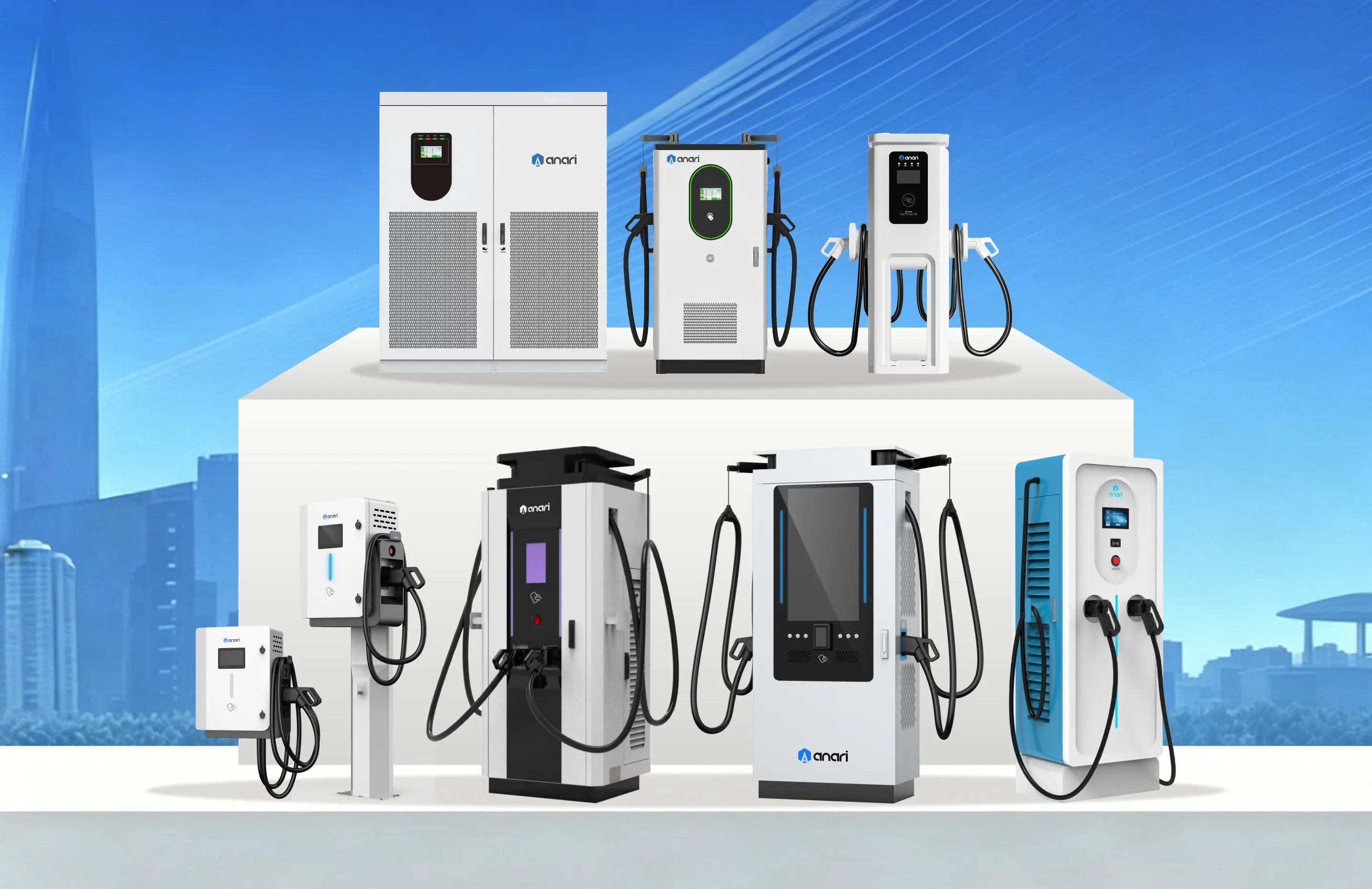
Key advantages of partnering with Anari Energy include:
- Scalable, Future-Proof Hardware: Anari offers a comprehensive commercial portfolio ranging from compact 20–40 kW DC wallboxes and 60–480 kW integrated floor-mounted stations to 1200 kW liquid-cooled split-type systems. Expandable, hot-swappable power modules allow operators to achieve “one-time deployment, long-term profitability” while keeping field repairs under 30 minutes.
- Native OCPP Without Vendor Lock-In: Every Anari DC charger ships with OCPP 1.6J and 2.0.1 natively pre-integrated, having passed first-attempt integration testing with leading global CSMS platforms including Driivz, Ampeco, and ChargeLab. Combined with remote OTA updates and diagnostics, this cuts on-site maintenance by over 60%.
- Unmatched Compatibility and Extreme Stability: With a 200–1000V wide-voltage output supporting over 99% of EVs on the market and A-HAL dual-chip redundancy, Anari chargers maintain public-station-grade uptime. Built to IP54/IK08 standards, they resist lightning, corrosion, salt fog, and extreme temperatures across harsh highway climates.
- Built for Commercial Revenue and Branding: Anari supports deep customization—including cabinet colors, logos, cable management, and multilingual UI—to reinforce your hospitality or retail brand. Operators can also deploy Anari’s 60–240 kW Dual-Gun Advertising DC Stations featuring 32-inch HD LCD screens to generate high-margin advertising revenue alongside charging fees.
FAQs
1. Do highway hotels really need DC fast chargers, or are Level 2 AC chargers enough?
While Level 2 AC chargers work well for overnight guests who stay 8 to 10 hours, relying exclusively on AC limits a highway hotel’s revenue potential. Adding one or two 60 kW–180 kW DC fast chargers serves late-arriving guests who need a rapid morning top-up, attracts daytime highway travelers who stop to charge and dine, and appeals to commercial EV fleets. A hybrid setup—combining AC for overnight stays with DC fast charging for quick turnarounds—delivers the highest overall ROI.
2. How can a highway service area deploy multiple DC fast chargers without paying for a massive utility grid upgrade?
Operators can avoid or delay costly grid upgrades by using dynamic load balancing and scalable modular hardware. Dynamic power allocation intelligently shares existing site capacity across all active vehicles based on real-time demand, allowing multiple high-power chargers to run safely within current electrical limits. For high-traffic corridors with severe grid bottlenecks, pairing DC fast chargers with a Battery Energy Storage System (BESS) buffers peak loads and minimizes utility demand charges.
3. How do operators maintain high uptime and control maintenance costs at remote highway locations?
High uptime at remote roadside locations relies on three factors: rugged hardware design, modular serviceability, and remote software management. Choosing weatherproof (IP54/IK08) chargers with dual-chip redundancy prevents unexpected shutdowns in harsh weather. Native OCPP connectivity enables remote diagnostics and OTA updates—resolving roughly 80% of issues without dispatching a technician—while hot-swappable power modules ensure any necessary on-site hardware repair takes less than 30 minutes.