



Table of Contents
Electric vehicle (EV) adoption has moved firmly into the mainstream, reshaping how business and leisure travelers choose accommodations. Today, major online travel agencies (OTAs) and navigation platforms allow guests to filter properties specifically by EV charging availability. For hotel owners, asset managers, and engineering directors, offering reliable charging is no longer a novelty amenity—it is a core driver of occupancy, guest satisfaction, and brand loyalty.
However, deploying commercial charging infrastructure on a hospitality property involves far more than mounting hardware to a parking garage wall. Meeting hotel EV charging station installation requirements demands careful coordination across electrical engineering, local building codes, accessibility standards, network connectivity, and guest operations. Planning these elements thoroughly before breaking ground prevents costly change orders, minimizes parking lot disruption, and ensures your investment scales smoothly as EV adoption accelerates.
1. Assessing Electrical Capacity and Site Infrastructure
Every successful EV charging deployment begins with an electrical engineering evaluation. Commercial properties often operate near their peak power thresholds during summer afternoons or full-occupancy evenings, making an accurate baseline assessment essential.
Conducting a Professional Load Study
Before selecting hardware, a licensed commercial electrical contractor or engineer must perform a 30-day load study or review 12 months of historical utility peak demand data. This analysis determines how much spare amperage is available on your existing main distribution panel (MDP) or sub-panels.
- Voltage Availability: Most commercial hotels utilize 208V three-phase electrical systems, which pair efficiently with commercial Level 2 chargers. If you plan to install DC Fast Chargers (DCFC), your site will typically require 480V three-phase power, which may necessitate a dedicated step-down or utility transformer.
- Dedicated Circuits: Under standard electrical codes, EV charging stations are classified as continuous loads. Circuits and breakers must be rated for 125% of the charger’s maximum continuous current. For example, a 48-amp charger requires a 60-amp dedicated circuit.
Leveraging Dynamic Load Management (DLM)
Upgrading a hotel’s main electrical service or adding a new utility transformer can cost tens of thousands of dollars and add six to twelve months to a project timeline. Fortunately, modern Dynamic Load Management (DLM) systems allow hotels to bypass expensive service upgrades.
DLM software monitors real-time building energy consumption or allocates a fixed pool of power across a group of chargers. When ten guests plug in simultaneously at 6:00 PM, the system automatically balances available power across all active ports. As vehicles finish charging overnight, power dynamically shifts to the remaining cars so every guest wakes up to a full battery without tripping the property’s main breaker.
Parking Layout and Make-Ready Civil Work
The physical distance between your electrical room and the designated charging stalls directly impacts installation costs.
- Surface Lots: Installing chargers in an open parking lot often requires saw-cutting asphalt, trenching, laying underground PVC or rigid metal conduit, pouring concrete mounting pads, and repaving. Selecting spaces close to existing electrical rooms or utility transformers drastically lowers trenching costs.
- Structured Parking Garages: Concrete garages avoid asphalt trenching, as conduit can be surface-mounted along ceilings and columns. However, contractors must carefully plan core drilling through post-tensioned concrete slabs using X-ray or ground-penetrating radar (GPR) scanning to avoid severing structural cables.
2. Selecting the Right Charger Hardware: Level 2 vs. DC Fast Charging
Choosing the appropriate charging speed depends on guest dwell time, property type, and available electrical capacity.
Level 2 Charging: The Hospitality Standard
For most full-service, select-service, and extended-stay hotels, commercial Level 2 chargers (delivering 7.2 kW to 19.2 kW) represent the optimal balance of cost and performance. Because overnight guests typically park for 8 to 12 hours, a standard 7.2 kW to 11.5 kW Level 2 unit easily replenishes 200 to 300+ miles of range before morning checkout. Dual-port pedestals are especially popular in hotel environments, allowing two adjacent parking spaces to be served from a single mounting footprint.
DC Fast Charging (DCFC): Strategic Use Cases
DC Fast Chargers (50 kW to 150+ kW) replenish an EV battery to 80% in 20 to 45 minutes. While DCFC equipment and installation costs are substantially higher, they make strategic sense for highway-adjacent properties, resorts with high day-guest traffic (spas, golf courses, restaurants), or conference hotels hosting short-term visitors. Many properties adopt a hybrid model: deploying a bank of Level 2 chargers for overnight guests alongside one or two DCFC stalls for transient travelers.
Connector Standards: J1772 and NACS Compatibility
North American EV infrastructure has transitioned toward the North American Charging Standard (NACS / SAE J3400), while millions of existing vehicles on the road still utilize the SAE J1772 connector. To serve every guest seamlessly without requiring front-desk adapter loans, hotels should install chargers equipped with native NACS cables alongside J1772 units, or select commercial stations featuring integrated dual-standard or universal adapter holsters.
Comparison of Commercial EV Charger Types for Hotels
| Feature | Commercial Level 2 Charger | DC Fast Charger (DCFC) |
|---|---|---|
| Power Output | 7.2 kW – 19.2 kW | 50 kW – 150+ kW |
| Electrical Requirement | 208V / 240V AC (40A – 100A circuit) | 480V 3-Phase AC (100A – 400A+ circuit) |
| Average Charging Speed | 25 – 45 miles of range per hour | 150 – 250+ miles in 30 minutes |
| Ideal Hospitality Use Case | Overnight guests, valet lots, extended-stay | Highway corridor hotels, dining/spa visitors |
| Hardware & Install Complexity | Low to Moderate | High (often requires utility upgrade) |
| Estimated Installed Cost / Port | 4,000–12,000 | 50,000–150,000+ |
3. Permitting, Codes, and Regulatory Compliance
Navigating regulatory frameworks is one of the most critical aspects of commercial EV deployment. Non-compliant installations can result in failed inspections, insurance liabilities, or forced retrofits.
National Electrical Code (NEC) Article 625
All EV supply equipment (EVSE) installations in the United States must comply with NEC Article 625, which governs electrical conductors, grounding, circuit sizing, disconnecting means, and cable management. Key requirements include:
- Safety Listing: Chargers must be certified by a Nationally Recognized Testing Laboratory (NRTL), such as UL or ETL, and carry a NEMA 3R or NEMA 4 enclosure rating for outdoor weather resistance.
- Ventilation and Mounting Height: Couplers and operable controls must be mounted at compliant heights (typically between 18 and 48 inches above grade depending on indoor/outdoor classification and accessibility rules).
- Disconnecting Means: Chargers rated above 60 amps or more than 150 volts to ground require a lockable disconnecting means within sight of the equipment.
ADA Accessibility Requirements
Because hotels are places of public accommodation, EV charging stations must adhere to Americans with Disabilities Act (ADA) design guidelines and applicable state accessibility codes (such as California’s Title 24). Even if an EV charging space is not designated strictly for drivers with disability placards (so that any EV driver can use it on a “use-last” basis), the stall itself must be physically accessible.
Core accessibility criteria include:
- Stall Dimensions: At least one accessible EV space should be van-accessible (typically 11 feet wide with a 5-foot access aisle, or 8 feet wide with an 8-foot access aisle).
- Accessible Route: A clear, unobstructed path of travel must connect the charging stall to the hotel entrance without forcing a wheelchair user to travel behind parked vehicles.
- Operable Parts: Card readers, touchscreens, and charging connectors must fall within the ADA reach range (15 to 48 inches above the ground) and require no more than 5 pounds of force to operate without tight grasping or twisting.
- Surface Slope: The charging stall and access aisle should have a maximum slope of 1:48 (2%) in all directions.
Local Permitting and Fire Safety
Municipal building departments require engineered site plans, single-line electrical diagrams, and load calculations before issuing electrical and building permits. Additionally, if chargers are being installed inside an underground or enclosed parking structure, local fire marshals may enforce specific NFPA guidelines regarding sprinkler coverage, emergency shut-off (EPO) switches at garage exits, and clear spacing from fire risers.
4. Network Connectivity, Software, and Payment Systems
While “dumb” (non-networked) plug-and-play chargers cost less upfront, commercial hotels almost universally benefit from networked smart chargers. Networked stations provide remote diagnostics, automated firmware updates, usage reporting, and flexible monetization.
Ensuring Reliable Connectivity
Smart chargers rely on continuous data connections to process payments, execute load management, and report faults.
- Cellular (4G/5G): The most common connection method, built directly into commercial stations. However, thick concrete slabs in underground hotel garages frequently block cellular signals, requiring the installation of a commercial cellular repeater/booster.
- Hardwired Ethernet or Commercial Wi-Fi: Running Cat6 Ethernet conduit alongside electrical wiring provides the most reliable connection for subterranean garages. Avoid connecting chargers to open guest Wi-Fi networks that use captive portals, as chargers cannot click through login screens.
Future-Proofing with OCPP
Always specify hardware that is certified under the Open Charge Point Protocol (OCPP) 2.0.1 (or at minimum 1.6J). OCPP is an open-source communication standard that separates charger hardware from management software. If your current charging network provider raises fees or goes out of business, OCPP compliance allows you to migrate your existing hardware to a new software platform without replacing the physical units.
Billing Models and Access Control
Hotels have several options for managing guest access and pricing:
- Complimentary Amenity: Free charging for registered guests, unlocked via an RFID keycard issued at the front desk or an automated mobile access code.
- Cost-Recovery or Revenue Generation: Charging guests per kilowatt-hour (kWh) or a flat session fee via credit card tap-to-pay (NFC), QR code web checkout, or mobile app. Note that some jurisdictions require Weights and Measures certification (such as CTEP/NTEP) when billing strictly by the kWh.
- Idle Fees: Implementing a modest per-minute fee after a vehicle finishes charging (with a 30- to 60-minute grace period, often suspended overnight) encourages guests to move fully charged vehicles and maximizes port turnover.
5. Physical Site Design, Signage, and Equipment Protection
Thoughtful physical design protects your capital investment from vehicle damage while delivering a frictionless guest experience.
Strategic Stall Placement and Preventing “ICEing”
Placing EV chargers directly next to the main lobby entrance often invites “ICEing”—non-EV (internal combustion engine) vehicles parking in charging stalls out of convenience. Instead, position chargers in well-lit, moderately convenient stalls slightly removed from the front doors, paired with clear, enforceable signage stating “EV Charging Only While Actively Charging.” For valet-operated properties, placing chargers in a dedicated back-of-house or valet-only zone gives staff complete control over rotation and eliminates guest frustration.
Physical Protection and Cable Management
Parking lots are harsh environments for electronic equipment. Standard site protection measures include:
- Steel Bollards and Wheel Stops: Install concrete-filled steel bollards (minimum 4 inches in diameter) and wheel stops to prevent vehicles from backing into pedestals.
- Cable Retractors: Heavy 18- to 25-foot charging cables dragged across concrete wear out quickly and create tripping hazards. Spring-loaded overhead or pedestal-mounted cable retractors keep cords off the ground, extend equipment lifespan, and maintain a clean, upscale property aesthetic.
- Lighting and Security: Ensure charging zones are well-illuminated and covered by existing property CCTV cameras so guests feel safe plugging in late at night.
6. Budgeting, Incentives, and Installation Workflow
Successfully executing hotel EV charging station installation requirements involves aligning your capital budget with available financial incentives and a realistic construction schedule.
Understanding Total Project Costs
A comprehensive project budget should account for four distinct categories:
- Hardware: Commercial chargers, pedestals, cable retractors, and extended parts/labor warranties (3 to 5 years recommended).
- Make-Ready Electrical & Civil Work: Panel upgrades, conduit, wiring, trenching, bollards, striping, and signage. In many projects, make-ready work accounts for 50% to 70% of total upfront costs.
- Soft Costs: Site engineering, stamped drawings, permit fees, and utility application fees.
- Operating Expenses (OpEx): Annual software networking fees, payment processing fees, preventive maintenance, and electricity utility costs.
Capturing Incentives and Rebates
Before signing an installation contract, investigate local and federal funding programs that can offset 30% to 80% of project costs:
- Utility Make-Ready Programs: Many electric utilities offer direct rebates covering trenching, conduit, and transformer upgrades for commercial hospitality properties.
- State and Municipal Grants: State energy offices and air quality boards frequently fund public and workplace EV infrastructure, especially along designated Alternative Fuel Corridors.
- Federal Tax Credits: Commercial properties located in eligible census tracts may qualify for federal Alternative Fuel Vehicle Refueling Property credits, subject to prevailing wage and apprenticeship rules.
Typical Hotel EV Charging Installation Timeline
| Project Phase | Key Activities | Estimated Duration |
|---|---|---|
| 1. Site Assessment & Design | Electrical load study, stall selection, hardware specification, ROI & rebate analysis | 2 – 4 Weeks |
| 2. Engineering & Permitting | Stamped electrical/civil drawings, ADA review, municipal permit & utility approval | 4 – 10 Weeks |
| 3. Equipment Procurement | Ordering chargers, pedestals, switchgear, and cellular boosters | 2 – 6 Weeks |
| 4. Construction & Installation | Trenching, conduit/wiring runs, mounting hardware, bollards, striping, and signage | 1 – 3 Weeks |
| 5. Commissioning & Launch | Final inspection, software activation, payment testing, staff training, OTA listing updates | 1 – 2 Weeks |
(Note: Projects requiring a new utility transformer or major service upgrade may add 3 to 9 months to the permitting and utility coordination phases.)
Conclusion
Installing EV charging stations is a strategic capital improvement that future-proofs your hotel, elevates guest satisfaction, and strengthens your competitive position on booking platforms. By starting with a thorough electrical load assessment, choosing scalable OCPP-compliant Level 2 hardware, adhering strictly to NEC and ADA codes, and designing a protected, well-signed parking layout, hospitality operators can deploy reliable charging infrastructure without budget overruns. Once live, be sure to update your property amenities across Google Maps, PlugShare, and major OTAs so EV-driving travelers can easily discover and book your hotel.
Elevate Your Property with the Anari Commercial DC Charging Solution
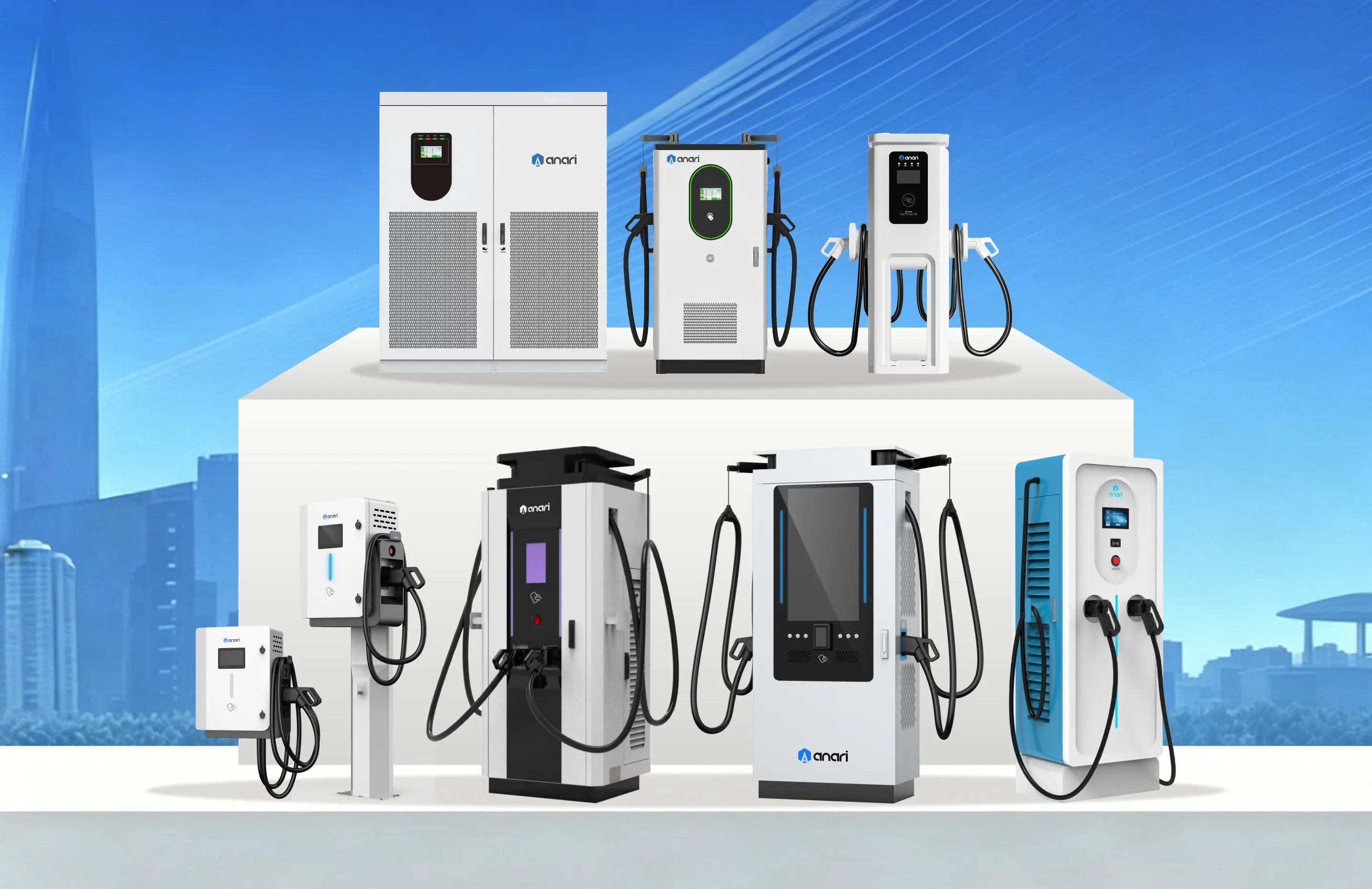
For hospitality operators looking to deploy reliable, high-ROI fast charging without vendor lock-in, the Anari Commercial DC Charging Solution provides a purpose-built platform designed for commercial scalability and long-term profitability:
- Native OCPP 1.6J & 2.0.1 Interoperability: Every Anari DC station ships with OCPP natively pre-integrated and verified for first-pass compatibility with leading CSMS platforms (including Driivz, Ampeco, and ChargeLab). Operators retain full control over their backend software, benefit from remote OTA diagnostics that resolve up to 80% of issues without on-site dispatch, and remain ready for future V2G upgrades.
- Scalable Power & Dynamic Load Balancing: From compact 20–40 kW DC wallboxes suited for boutique hotels to 60–480 kW fast chargers for high-traffic resorts, Anari’s expandable, hot-swappable power modules and intelligent dynamic power allocation allow properties to maximize existing electrical capacity while avoiding costly grid upgrades.
- 99%+ Vehicle Compatibility & All-Climate Durability: Built with a 200–1000V wide-voltage output, A-HAL dual-chip redundancy, and weatherproof, salt-fog-resistant enclosures, Anari chargers maintain stable, high-output performance across virtually all EV models—even in extreme heat, cold, or coastal environments.
- Brand Customization & Incremental Revenue: Tailor cabinet colors, logos, UI languages, and cable management to match your hotel’s brand identity, or choose models equipped with integrated HD advertising screens to generate additional on-property ad revenue.
- End-to-End Turnkey Empowerment: From AI-assisted site selection and system design to commissioning and rapid global spare-parts delivery, Anari supports hospitality teams through every phase of deployment for worry-free operation.
FAQ
1. How many EV charging stations should a hotel install initially?
A practical rule of thumb for most hotels is to install 1 to 2 charging ports per 25 to 50 guest rooms as a starting baseline, or roughly 2% to 5% of total parking spaces. Rather than overspending on hardware today, the smartest strategy is to size your conduit and electrical panel capacity (“EV-ready” infrastructure) for 10% to 20% of your lot during initial construction. This makes adding extra chargers in the future fast and inexpensive as guest demand grows.
2. Can a hotel install EV chargers without upgrading its main electrical panel?
Yes. In many cases, hotels can avoid expensive main panel or utility transformer upgrades by deploying Dynamic Load Management (DLM) technology. DLM allows multiple EV chargers to safely share a single existing circuit or spare panel capacity by automatically throttling power output during peak hotel energy usage and ramping speeds back up overnight when building demand drops.
3. Should hotels charge guests for EV charging or offer it for free?
Both models work depending on your property tier and market positioning. Luxury and select-service hotels often offer complimentary Level 2 charging as a high-value perk to drive direct bookings and loyalty, treating the modest electricity cost (typically 3 to 8 per overnight session) as a marketing expense. Conversely, urban hotels, high-volume properties, and those operating DC Fast Chargers usually implement per-kWh or flat-rate billing to cover electricity, networking fees, and maintenance while preventing non-guests from occupying spaces.