



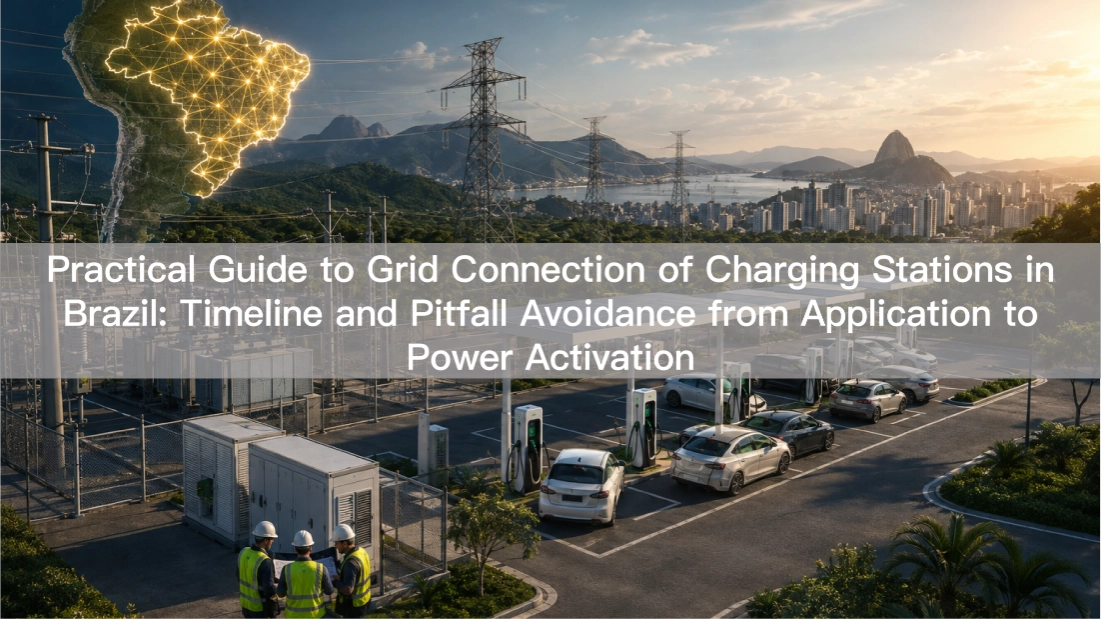
Introduction Brazil is rapidly emerging as one of Latin America’s most dynamic markets for electric vehicle (EV) charging infrastructure. With over 1.2 million EVs and light electric vehicles on the road as of 2024, and government targets to expand charging point networks to over 50,000 locations by 2030, the urgency for Charging Point Operators (CPOs) to understand the grid connection process has never been greater.
However, navigating Brazil’s electrical grid regulations remains one of the most significant barriers to market entry. Misunderstandings about timelines, technical requirements, and regulatory expectations routinely lead to project delays, cost overruns, and in some cases, abandoned investments. This guide provides CPOs with a clear, practical roadmap from initial application to power activation — and helps you avoid the most common pitfalls along the way.
Understanding Brazil’s Power Grid Landscape Brazil’s electricity sector is structured around a complex regulatory framework governed by the National Electric Energy Agency (ANEEL) and operated by regional transmission and distribution companies.
The country’s grid is divided into three main regimes:
– Distributive Regime (Regime Distributivo): Low-voltage connections up to 2,500 volts, typically serving small commercial loads.
– Shared Generation Regime (RGCS): For distributed generation with excess energy injection.
– Free Energy Market (Liberalised Market / Mercado Livre de Energia): For consumers with contracted demand above 3 MW, allowing direct energy purchasing.
For most charging station deployments, CPOs fall under the distributive regime or the free energy market, depending on the installed power capacity. According to ANEEL data, as of 2024, over 60% of new charging station projects in Brazil require connections exceeding 75 kW, placing them firmly in the medium-voltage category — a factor that significantly extends approval timelines. The country’s National Transmission System (SIN) covers approximately 95% of the territory, but regional distribution companies (concessionárias) such as Enel, CPFL, Light, and Cemig each manage their own connection procedures, technical standards, and processing times. This fragmentation is a primary source of confusion for new market entrants.
1. The Grid Connection Process: Step by Step
Step 1: Preliminary Technical Feasibility Assessment
Before submitting any formal application, conduct a thorough feasibility study.
This includes:
– Determining the total installed power demand of your charging station (considering both current and future expansion).
– Identifying the local distribution concessionaire responsible for your site. – Evaluating whether the existing grid infrastructure can support your load or if reinforcement is required.
Common pitfall: Many CPOs underestimate power requirements by ignoring simultaneous charging scenarios and future scaling plans. A station designed for four 50 kW chargers may need a 250 kW connection once high-power DC fast chargers are added — and the distribution company will require this upfront.
Step 2: Formal Application Submission
The application is submitted to the local distribution company through their online portal or physical office.
Required documentation typically includes: – Legal documentation of the operating company (contrato social, CNPJ, etc.)
– Property ownership or lease agreement for the installation site
– Technical project signed by a qualified engineer (ART – Anotação de Responsabilidade Técnica)
– Single-line electrical diagram – Load calculation and demand profile
– Site layout and equipment specifications Processing times for initial application review range from 30 to 90 days, depending on the concessionaire and project complexity.
Step 3: Technical Review and Approval
Once the application is received, the distribution company conducts a technical analysis to verify compliance with ANEEL Resolution 1,000/2021 and local technical standards (NBR 5410, NBR 14039).
This phase includes:
– Review of the electrical project
– Assessment of grid impact (voltage drop, harmonic distortion, power factor)
– Determination of connection points and metering requirements If the grid requires reinforcement — such as new transformers, cable runs, or substation upgrades — this is communicated during this stage. Grid reinforcement costs are typically borne by the applicant, and can range from R$$ 50,000 to $$ 500,000+ depending on infrastructure needs.
Step 4: Connection Agreement and Payment
Upon technical approval, the distribution company issues a Connection Agreement (Termo de Concessão de Uso do Sistema) and a cost estimate for connection fees. The applicant must: – Sign the agreement – Pay the connection tariff (taxa de disponibilidade) – Comply with any conditional requirements (e.g., power factor correction, surge protection)
Step 5: Installation and Inspection
The CPO or their contracted electrical contractor installs the charging infrastructure according to the approved project. The distribution company then schedules an inspection and testing visit to verify compliance. This step typically takes 15 to 45 days after the installation completion notification.
Step 6: Power Activation (Ligação)
Following a successful inspection, the distribution company performs the physical connection and energises the point of use. The charging station is now operational.
Timeline Expectations and Key Variables
| Phase | Typical Duration |
| Feasibility Assessment | 2–4 weeks |
| Application Review | 30–90 days |
| Technical Approva | 30–60 days |
| Connection Agreement | 15–30 days |
| Installation & Inspection | 30–60 days |
| Power Activation | 7–15 days |
| Total (no reinforcement) | 4–8 months |
| Total (with reinforcement) | 8–18+ months |
The single largest variable is grid reinforcement. In urban centres with mature infrastructure, connections can proceed relatively quickly. In rapidly growing regions or areas with constrained grid capacity — such as parts of the Northeast and Centre-West — reinforcement projects can add 6 to 12 months to the timeline.
2. Debunking Common Misconceptions
Myth 1: “I can connect a charging station in under 30 days.” Reality: Even in the most favourable circumstances — a low-voltage, low-power installation in an area with spare grid capacity — the process rarely completes in under 60 days. Most projects take 4 to 8 months. Planning for 30 days will result in significant schedule and financial disruption.
Myth 2: “All distribution companies follow the same process.” Reality: Each concessionaire has its own internal procedures, document requirements, and processing speeds. Enel’s portal, for example, is more digitised and transparent, while smaller regional companies may rely on paper-based processes with less predictable timelines. Research your specific concessionaire before beginning.
Myth 3: “The connection cost is only the application fee.” Reality: Connection fees represent only a portion of the total cost. Grid reinforcement, internal electrical work, metering equipment, and potential demand charge adjustments can far exceed the base connection tariff. Budget for reinforcement costs from the outset.
Myth 4: “I can start charging before power activation is complete.” Reality: Operating a charging station without formal grid connection and power activation is illegal under ANEEL regulations and can result in fines, disconnection, and liability for any incidents. Always wait for official energisation.
3. Best Practices for Charging Point Operator
3.1 Engage a local electrical engineering firm with proven experience in ANEEL compliance and distribution company interactions. This alone can reduce approval timelines by 30–50%.
3.2 Request a preliminary feasibility study from the distribution company before signing a lease or purchasing equipment. Many companies offer this service, and it provides critical early insight into potential grid constraints. 3. Design for modularity and scalability. Install conduit and metering capacity for future expansion rather than retrofitting later, which is significantly more expensive.
3.4 Monitor regulatory updates. ANEEL regularly updates connection procedures, and Resolution 1,000/2021 introduced significant changes to distributed generation and charging infrastructure rules. Stay current.
3.5 Build realistic project timelines. Factor in a minimum of 6 months for standard connections and 12+ months for projects requiring grid reinforcement.
4. Conclusion
Grid connection is the critical gateway between a charging station concept and a revenue-generating asset. For Charging Point Operators entering Brazil’s EV infrastructure market, understanding the process, respecting the timelines, and avoiding common pitfalls is essential to project success. The path from application to power activation typically spans 4 to 8 months under normal conditions — and considerably longer when grid reinforcement is required. By conducting thorough feasibility assessments, engaging qualified local expertise, and maintaining realistic expectations, CPOs can navigate Brazil’s grid connection process efficiently and position their charging networks for long-term operational success. The Brazilian EV market is growing fast; those who master the grid connection process will be ready to capitalise on the opportunity.