




Anari Energy | July 2026
1. The Real Market
EV industry conferences talk about Europe’s AFIR mandates, America’s NEVI corridors, China’s 3 million chargers. The top 10% of the market.
Meanwhile: a Nairobi fleet operator watches diesel eat 60% of his margin. A Bishkek solar engineer can wire anything but has never touched an OCPP server. A São Paulo developer has twelve properties, board approval, and zero charging experience.
These are not edge cases. They are the majority of the global EV transition — happening where big brands don’t operate and equipment suppliers drop a container and leave. This is the CPO capability gap.
2. Four CPOs, One Problem
Engineering companies with construction expertise and no charging technology knowledge. They build stations they can’t operate.
Fleet operators under electrification pressure with no infrastructure experience. They risk building depots that bottleneck operations.
Energy and real estate firms with capital and land but no charging tech team. Board approval requires certainty they can’t provide alone.
Independent entrepreneurs with sharp instincts and zero supplier network. No room for expensive mistakes.
All want to build and operate stations. None can go from zero to operational solo.
3. Seven Modules, One Partner
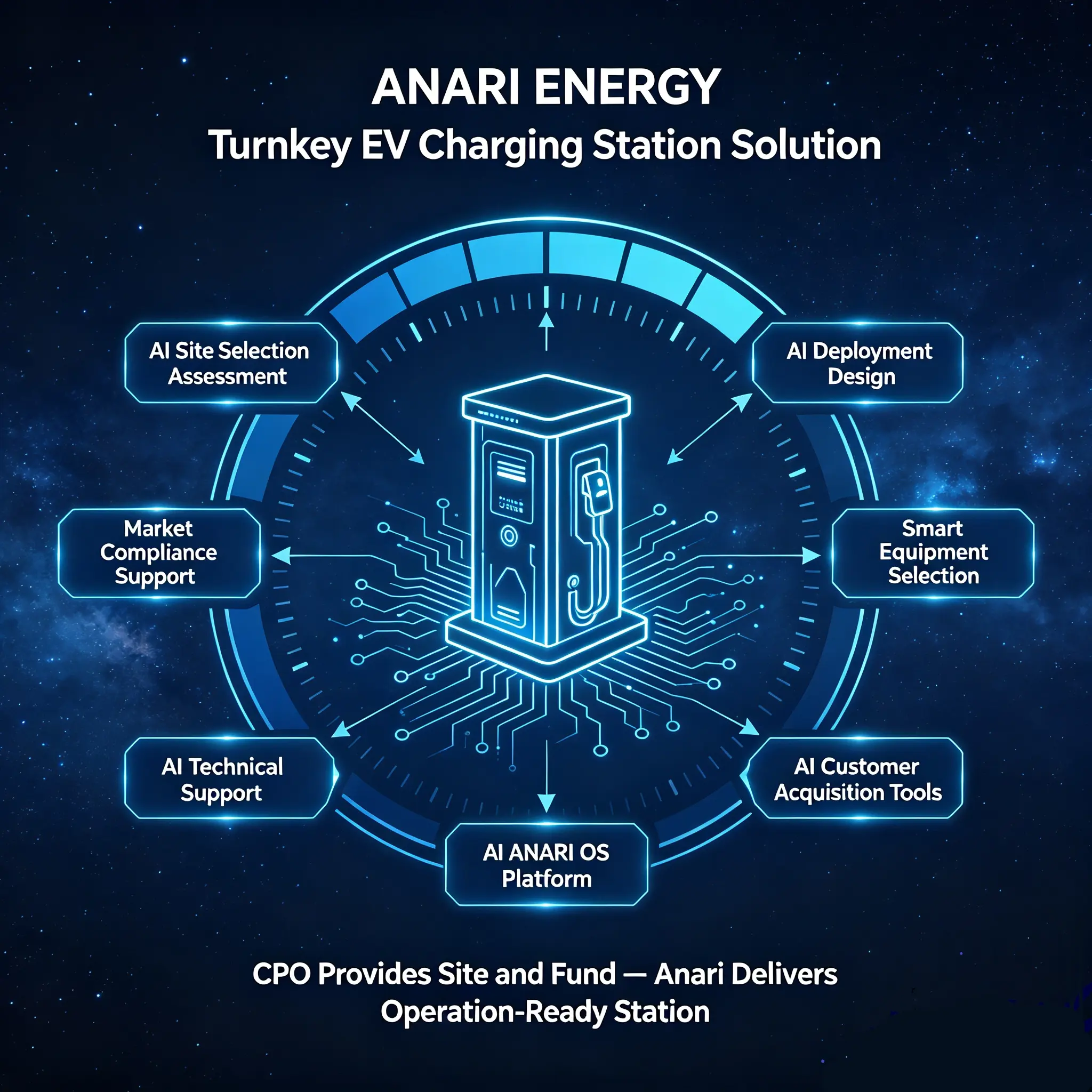
Turnkey replaces the transactional supplier model with an accountable partner across the full lifecycle:
3.1 AI Site Selection
— Traffic, grid, competition, land economics. Data replaces intuition. A bad location can underperform by 40%.
3.2 AI Solution Design
— Layout, power, specs. Weeks become days.
3.3 Smart Equipment Selection
— Multi-brand global pool, optimized for TCO not supplier margin.
3.4 Compliance & Licensing
— Regulations, permits, certifications across 12+ countries. License time cut by half.
3.5 ANARI OS
— Remote monitoring, payments, analytics. 24/7 unmanned operation.
3.6 N-Tech AI Support
—Fault diagnosis, O&M guidance. Response in minutes.
3.7 N-SDR Customer Acquisition
— Automated lead generation. From building stations to filling them.
The supplier is no longer selling hardware. They guarantee an operational outcome.
4. Market Structure
Global brands serve large energy groups. Small CPOs get silence. Emerging market presence is a logo, not a team.
Chinese manufacturers ship hardware containers. No site selection, compliance, software, or support.
Local EPC contractors pour concrete well. Charging technology depth is outside their scope.
The gap is structural: nobody connects hardware supply to operational reality for small and mid-sized CPOs in emerging markets. Anari occupies that space — emerging markets specialist, global supply chain, charging expertise, local delivery.
5. Roadmap: Station to Energy Node
H2 2026— V2G-ready architecture. Bidirectional provisions. ISO 15118-20 monitoring.
2027 — Autonomous energy agents. Grid interconnection, DER optimization, dynamic tariffs at 15-minute resolution. Automated charge-discharge arbitrage.
2028–2030 — Every station becomes a distributed energy resource. Peak shaving, demand response, microgrid islanding (PV + BESS + EV), peer-to-peer energy trading. The station earns money while idle.
The infrastructure deployed today is designed for the energy market of 2030.
6. Conclusion
The EV transition is an execution story, not a hardware story. The markets that need charging infrastructure most are the ones with the least capability to build it. Closing that gap requires a delivery model that replaces fragmented suppliers with a single accountable partner — and technology that compresses the learning curve.
That’s what Turnkey means. Not a product. A promise.
→ Turnkey EV Charging Station Solution
→ inquiry@anarienergy.com