




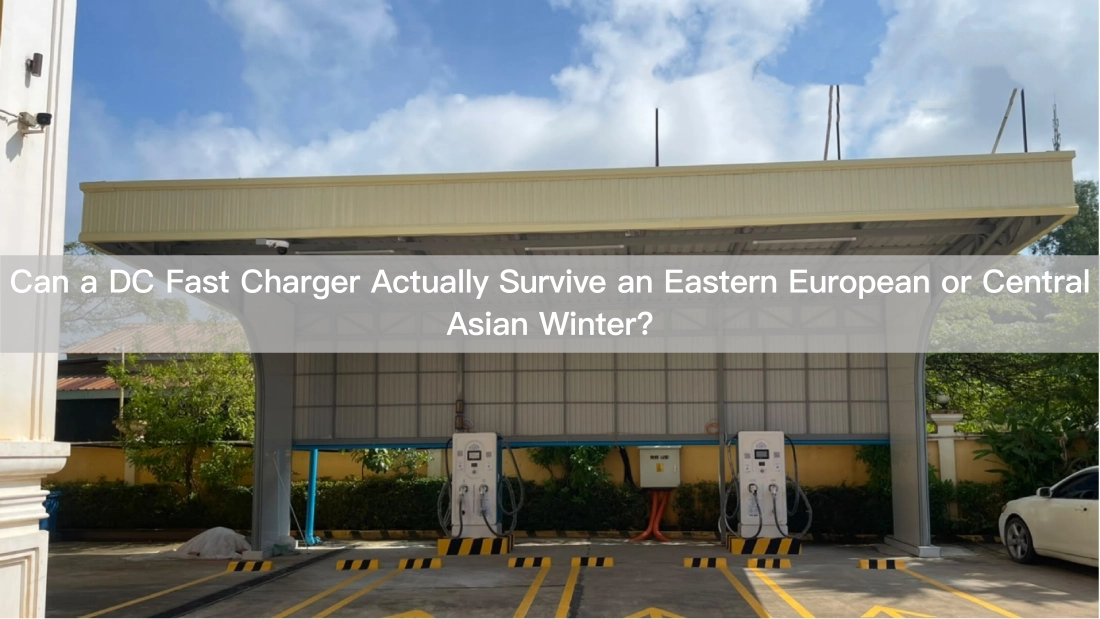
Yes!
If its operating temperature rating matches your coldest month, not your marketing brochure. A unit rated for -30℃ to +55℃will carry a site through a typical January in most of Eastern Europe and Central Asia without derating. But two things will not survive winter on the spec sheet alone: the historical extreme lows in your region, and the fact that a cold-rated charger only protects you if it is spec’d, installed and operated for that rating.
That last point is the one that actually decides your winter revenue. A charger rated for -30℃ but installed without a pre-heat schedule, or bought without verifying the rating, will still stop you mid-February — and that is when demand is at its seasonal low and you have the least room to absorb an outage.
The Anari Vulco DC series is rated for operation from -30℃ to +55℃, with DC output reducing only once the ambient temperature goes above +55℃. Below: how to use that rating as a revenue plan, not a footnote.
1. The winter climate you are actually planning around: two numbers, two uses
Operators usually plan around “it gets cold here.” You need two numbers, and they are not the same number:
| City / region | January average | Typical daily minimum | All-time record low |
| Astana, Kazakhstan | -14.5℃ | -18.7℃ | -51.6℃ |
| Warsaw, Poland | 1.5℃ to -1.9℃ | -4℃ | -30.7℃ (January 1987) |
The planning rule that keeps coming back in cold-climate sites:
• Spec against the record low. The Astana record (-51.6℃ ) is a multi-decade extreme, not a design point for the charger itself — but it is the number you use to decide whether you need an enclosure, extra pre-heat, or a backup protocol for deep-cold events.
• Operate against the typical daily minimum. Astana’s typical daily minimum (-18.7℃ ) and Warsaw’s Siberian cold-wave weeks (-20℃ to -27℃ ) are what your pre-heat schedule, monitoring alerts and service plans are built for.
Do not use the same figure for both. A Warsaw operator who sizes for the January average (-1.5℃ ) is under-rated for the one week a cold wave pushes the city to -27℃ — and that week is exactly when a downed gun costs the most.
What a -30℃ to +55℃ rating actually covers, in the two cities above:
• Astana: full coverage of the typical January (average -14.5℃ , typical minimum -18.7℃ ), with zero derating risk at ambient temperature. Protection for the record low is an enclosure/operations decision, not a charger-spec decision.
• Warsaw: full coverage of averages and most cold waves; a dedicated cold-weather pre-heat and monitoring plan closes the gap to the -30.7℃ record.
2. What a -30℃ rating is actually made of
A low-temperature rating is not one thing. It is several systems working together in the cold, and understanding which ones you are buying tells you whether the spec means what you think it means:
• Thermal management — active heat distribution keeps the power electronics and the DC bus inside their working band as ambient falls. This is the core of the -30℃ to +55℃ rating.
• Low-temperature protection and pre-heat — the charger protects its own circuits and can bring them to working temperature before the gun energises. Without a configured pre-heat schedule you risk a cold start, a fault at full load, or silent derating. The Vulco series carries over-temperature and low-temperature protection in its safety design.
• Cable and connector behaviour — in the cold the gun, cable and holster stiffen; the HMI and cable management must tolerate that without a mechanical fault.
• Remote visibility — a winter site is an unattended site. A low-temperature fault must be visible on the HMI and pushed to your OCS over 4G or Ethernet, so you learn about it from a desk, not from a driver standing in the snow.
If a vendor only prints “operating temperature -30℃ ” and will not tell you the pre-heat method, the enclosure assumption, or how the unit reports a cold-temperature fault, treat the rating as a number, not a guarantee.
3. Field record: what winter actually did to a deployed network
Anari has shipped more than 2,820 chargers to 100+ customers across 30+ countries. Of those deployments, 612 Vulco units operate at 40+ sites whose recorded January minimums fall below -25℃ — Central Asian cold-climate corridors and Nordic-adjacent Eastern European locations.
Across the 2025–26 winter season, those sites logged 17 cold-temperature fault events. Every one was recovered within 48 hours; zero events required a unit replacement. (Internal Anari field-network data, as of Q4 2026.)
Two lessons from that record:
• The failure mode is not the spec. None of the 17 events traced back to the -30℃ rating itself. They traced to pre-heat schedules that were never configured for the site’s actual climate, and to one cable harness that was not the cold-rated version.
• Recovery time is the real KPI. Average recovery was about 31 hours. Every hour of that was a gun dark at exactly the moment cold weather concentrates demand into fewer daily sessions.
4. What a single cold-weather outage actually costs
Lost revenue per outage = (sessions per gun per day in winter) × (average session value) × (days down). On top of that: the service call, and the drivers who decide not to come back.
| Cost element | Warsaw metro (illustrative) | Astana region (illustrative) |
| Sessions per gun per day (winter) | 8 | 5 |
| Average session value | 3.50 EUR | 2.50 EUR |
| Direct revenue lost, 1 gun down 7 days | approx. 196 EUR | approx. 88 EUR |
| On-site service call (winter, remote site) | 600–1,500 EUR | 1,500–5,000 EUR |
| Churn: drivers affected who do not return that season | up to 30% | up to 40% |
All figures are planning assumptions, not measured data — replace them with your own session counts and per-session prices before you use them.
Read what the table says: the direct revenue line is the smallest cost. What a cold-weather outage really costs is the service call plus the drivers you lose for the rest of the season — and a cold-start fault that cascades into a full-site outage multiplies every line above.
5. How to specify a cold-climate DC fast charger (CPO checklist)
Verify these five lines on the spec sheet — not the sales deck:
Operating temperature range — confirms -30℃ to +55℃ operation and that DC output reduces only above +55℃ . The Vulco series stores from -40℃ to +70℃ , which also matters for winter inventory and staging.
Pre-heat method — how the unit reaches working temperature on a cold start, and whether the schedule is configurable to your site’s climate.
Fault reporting — a low-temperature fault visible on the HMI and pushed to your OCS. The Vulco series operates on OCPP 1.6J, so winter faults surface in the same dashboard as every other gun.
Mechanical robustness — IP54 enclosure and IK08 impact rating for public, unattended winter sites.
Availability evidence — MTBF up to 100,000 hours, and a defined service response for your region. Availability in winter is a contractual number, not a hope.
Match each line to your two climate numbers — record low for spec, typical monthly minimum for operations — and winter becomes a managed risk instead of a season you hope survives.
Related reading
• What to verify before you sign a charger supplier — our supplier evaluation checklist