



1. The Central Asian Climate Challenge
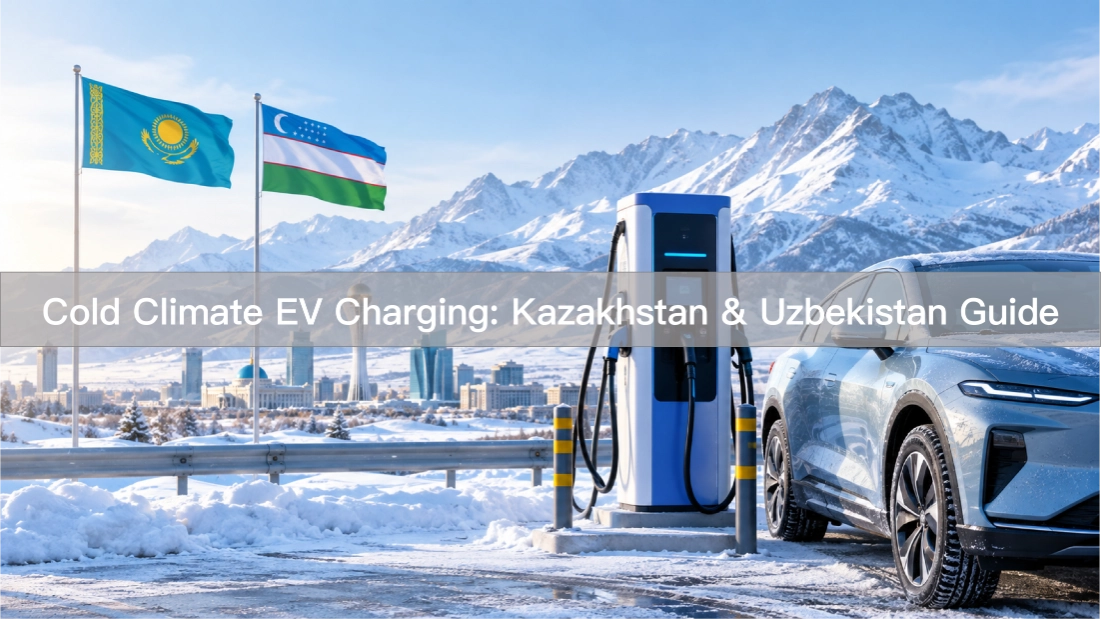
Kazakhstan and Uzbekistan present some of the most demanding operational conditions for EV charging infrastructure in the emerging markets spectrum. Winter temperatures regularly drop below -30℃ in Kazakhstan’s northern regions and -25℃ in Uzbekistan’s interior, with wind chill factors creating additional thermal stress on charging equipment.
These conditions differ fundamentally from the hot-climate challenges faced in the Middle East or Southeast Asia. Cold weather affects battery chemistry, connector integrity, and electronic component performance in ways that standard chargers are not designed to handle.
Key cold-weather challenges:
- Lithium-ion battery chemistry slows charge acceptance at low temperatures
- Connector materials become brittle below -20℃, increasing failure risk
- Electronic components have specified operating temperature ranges that may be exceeded
- Condensation and ice formation inside enclosures causes short circuits
- Grid voltage stability decreases under heavy winter loads
2. Regulatory Framework and Infrastructure Status
Kazakhstan adopted new mandatory standards for EV charging stations on April 22, 2024, through the Committee for Construction, Housing and Utilities of the Ministry of Industry and Construction.
Key regulatory requirements:
- Charging stations must be included in projects for newly constructed residential, commercial, and industrial buildings
- Parking lots must provide EV spaces with equipped chargers
- Only factory-built charging stations are permitted (no DIY or assembled units)
- Fast and super-fast charging stations recommended at petrol and gas stations
- At least one charging space per fuel station must be accessible for wheelchair users
Legal framework: Law No. 126-VIII ZRK (July 18, 2024) amended existing legislation to include electrocharging stations in parking and infrastructure requirements. The law defines electrocharging stations as electrical installations designed for charging mechanical vehicles equipped with electric motors.
Current infrastructure: As of 2024, Kazakhstan has approximately 269 charging stations, concentrated in major cities (Almaty, Astana, Shymkent). Highway and intercity charging infrastructure remains limited, creating range anxiety for long-distance EV travel.
EV incentives:
- Electric vehicles exempt from transport tax until December 31, 2025
- EV owners exempt from recycling fees (since July 2021)
- Customs duty exemptions on EV imports
3. Uzbekistan: Regulatory Framework and Deployment Targets
Uzbekistan has established one of the most ambitious EV infrastructure deployment targets in Central Asia through Presidential Decree PP-444 (December 19, 2022).
Key regulatory requirements:
- Mandatory inclusion of EV charging stations in projects for shopping centers, business centers, entertainment complexes, gas stations, hotels, and infrastructure along international and state highway routes
- At least 5% of parking spaces at these facilities must be designated for EV charging (minimum one space)
- Regional electric networks (ASO “Mahaliy Elektro Seti”) must install at least 500 charging stations near power lines and substations along highway routes
- Land auctions for 1,500 charging station sites to be conducted in 2023
- Minimum 60kW four-channel charging stations required at existing fuel stations (at least one per station)
Deployment targets:
- Minimum 2,500 charging stations nationwide by end of 2024
- Land plots auctioned through AIS “K-SAVDO” system for station placement
Tax incentives:
- Customs duty exemption on EV charging stations, components, and service infrastructure imported from abroad (January 1, 2023 – January 1, 2028)
- Excise tax exemption on EV imports
4. Cold-Weather Charger Design Requirements
Standard DC fast chargers rated for -10℃ to +45℃ operation will fail in Central Asian winter conditions. The following design features are essential:
Heated enclosures: Enclosure heating systems maintain internal temperatures above component minimums during extended cold exposure. Power consumption for heating typically ranges from 50W to 200W depending on enclosure size and insulation quality.
Cold-rated electronics: Electronic components must be rated for extended temperature ranges. Standard industrial-grade components (0℃ to +70℃) may fail at -30℃. Military or extended-grade components (-40℃ to +85℃) are recommended for Central Asian deployments.
Battery pre-conditioning: Chargers with integrated battery pre-conditioning capability can warm EV batteries before high-power charging begins, reducing charge time and improving battery longevity. This feature is particularly valuable in extreme cold where batteries may not accept high charge currents until reaching optimal temperature.
Connector heating: Heated charging connectors prevent ice formation on contact pins and maintain material flexibility at low temperatures. This is critical for CCS2 connectors, which rely on precise pin alignment for safe high-current transfer.
IP rating considerations: While IP65 is standard for outdoor installations, cold climates require additional sealing against snow and ice ingress. IP66 or IP67 ratings provide enhanced protection against water and dust under pressure, suitable for conditions where snow melt and refreeze cycles create moisture exposure.
5. Grid Considerations for Cold Climate Deployments
Central Asian grids face unique challenges during winter:
Voltage stability: Heavy heating loads during winter can cause voltage drops on distribution networks. Chargers with wide input voltage tolerance (380V–480V for 400V nominal systems) can operate stably under varying grid conditions.
Power quality: Cold weather increases harmonic distortion risk when chargers operate at reduced power due to battery temperature limitations. Chargers with active power factor correction and low harmonic distortion (<5% THD) reduce impact on local grid quality.
Transformer capacity: Cold climate sites often require transformer upgrades to support high-power DC charging. Early engagement with local distribution companies during site selection prevents costly retrofitting after installation.
6. Certification and Compliance
Kazakhstan:
- GOST standards alignment with IEC requirements
- Technical regulation compliance for electrical equipment
- Customs certification for imported charging equipment
Uzbekistan:
- Uzstandart certification for electrical equipment
- Technical regulation compliance
- Import documentation for charging infrastructure
Common requirements: Both countries require electrical safety certification for imported charging equipment. Suppliers should verify that their products meet GOST or Uzbek technical regulation standards before shipping.
7. Deployment Recommendations
Site selection:
- Prioritize locations with grid capacity confirmation
- Select sites with wind protection (building shelter or terrain barrier)
- Ensure snow clearance access for maintenance
- Consider proximity to heating sources for connector warming
Installation practices:
- Elevate chargers above potential snow accumulation levels
- Install windbreaks or enclosures for extreme exposure sites
- Use heated cable trays for underground connections
- Implement remote monitoring for early fault detection
Maintenance considerations:
- Schedule pre-winter inspections for heating systems
- Maintain spare parts inventory for cold-weather failures
- Train local technicians on cold-climate troubleshooting
- Establish winter response protocols for remote sites
Market Opportunity
Kazakhstan and Uzbekistan represent emerging EV markets with significant growth potential. Both countries have established regulatory frameworks and deployment targets, but current infrastructure remains limited — approximately 269 stations in Kazakhstan and a target of 2,500 stations in Uzbekistan by end of 2024.
The cold climate requirement creates a natural filter: suppliers without cold-weather capable products cannot compete effectively. This advantage favors manufacturers who have engineered their products for extreme temperature operation rather than those adapting standard designs with minor modifications.
Data sources:
Kazakhstan Law No. 126-VIII ZRK (July 2024);
Uzbekistan Presidential Decree PP-444 (December 2022);
Chambers and Partners analysis of Central Asian EV markets; construction norm updates from Kazakh and Uzbek ministries. Regulatory information current as of September 2026.