



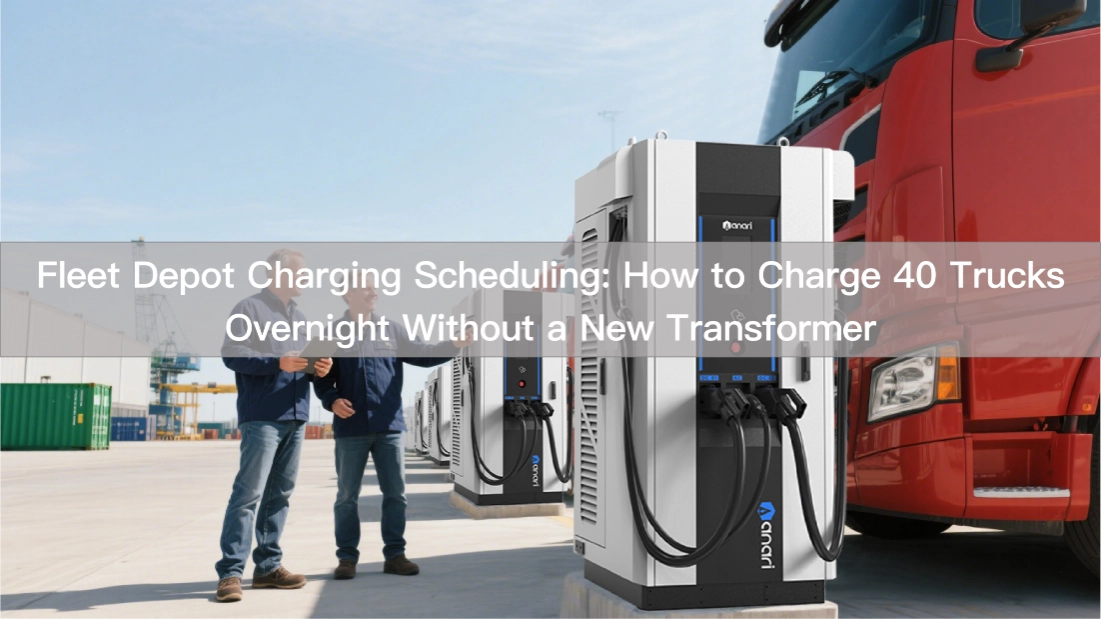
The first winter after a fleet goes electric is how many operators learn the hard way. At 6 a.m., dispatch opens the yard and a third of the trucks are not charged. The chargers work. The power arrived. But every driver plugged in the moment they got back, twenty units pulled at the same time, the transformer tripped, the chargers throttled each other down, and nobody got a full battery.
You bought DC fast chargers, not slow AC boxes. Why is there still not enough?
Because overnight charging at a depot was never a hardware problem. It is a scheduling problem. You get one eight-hour window per night and one transformer. Until you solve those two constraints, more chargers only make the problem more expensive.
1. Do the math first: how much energy does one night actually need
Buying chargers before building a model is the most common way depot charging fails. The numbers are simple, three steps:
Energy per truck per day = daily mileage × energy consumption per kilometer. A light logistics van doing 150 km a day at 0.35 kWh/km needs about 52 kWh.
Fleet daily demand = per-truck × fleet size. Forty trucks means about 2,100 kWh per night.
Required charging power = total demand ÷ effective charging hours. In an eight-hour window, after plugging and unplugging and the tapering at the end of the battery curve, you get about six useful hours. 2,100 kWh ÷ 6 hours ≈ 350 kW of average power.
That is your floor. Put your own mileage and consumption into the formula before you talk to a single charger vendor.
2. A worked example, with your own numbers to swap in
Take a mid-size parcel operator: 30 vans, 180 km average daily route, 0.4 kWh/km. That is 72 kWh per van, 2,160 kWh for the fleet each night.
Six useful charging hours means the depot needs about 360 kW of average power. Without scheduling, the vans come back between 6 and 9 p.m. and everyone plugs in on arrival, so the real peak can hit 550 to 600 kW. The transformer has to be sized for that spike. With overnight charging management, the same energy spreads across the whole window, the peak drops to about 400 kW, and a 500 kVA transformer that was already on site can usually carry the fleet.
The difference between 600 kW and 400 kW of required capacity is not academic. Transformer upgrades run into real money and real lead time. In many cases the scheduling software costs less than the transformer upgrade it avoids.
3. The two constraints: time window and grid capacity
The first constraint is time. Trucks return at 8 p.m., they leave at 6 a.m. Ten hours on paper, eight usable in practice. To fit more energy in, you either raise power or shorten turnaround. There is no third option.
The second constraint is the grid. Nameplate charger power is not the power you can use; the transformer is the ceiling. Ten 60 kW chargers add up to 600 kW on paper, but the depot transformer may only be rated 400 kVA. Run everyone at full power at the same time and the transformer overloads. That is not a charger problem, it is a grid connection problem, and grid upgrades routinely take months and a serious line item on the budget.
Depot charging, in one sentence, is the work of distributing energy to each truck on time within an eight-hour window and a finite transformer. Hardware sets the ceiling. Scheduling decides whether you ever reach it.
4. What scheduling actually buys you: three levers
Lever one: push charging into the off-peak tariff window. Most commercial electricity markets price peak and off-peak hours differently, and overnight power is often half the peak price or less. Forty trucks drawing 2,100 kWh a night, even half of it moved from peak to off-peak, saves a meaningful five-figure sum in annual electricity cost. Without scheduling, trucks charge when they arrive and the cheap window goes unused. With scheduling, overnight charging automatically concentrates in the cheapest hours.
Lever two: flatten the power curve and skip the transformer upgrade. Same forty trucks, same 2,100 kWh, same eight hours. Without scheduling, everyone plugs in at once and peak demand can hit 600 kW, so the transformer must be sized for 600 kW. With scheduling, the load spreads across the night, the peak stays under 400 kW, the existing transformer may be enough, and the upgrade bill disappears. Same fleet, same energy, very different grid investment.
Lever three: prioritize by departure time. Not every truck leaves at the same hour. The first wave at 5 a.m. must be full first. The trucks that roll out at 9 a.m. can charge later and slower. A scheduling system allocates power by departure order so every vehicle hits its target state of charge before it leaves. Plug-and-pray can never do this.
5. When the transformer is truly maxed: storage as a fourth lever
Sometimes the existing transformer cannot carry the fleet even after scheduling, and upgrading is not possible this year. That is the one case where a battery buffer earns its place. The battery charges during off-peak hours, then discharges to the chargers during the concentrated evening window, so the depot draws a flat, modest load from the grid all night.
Storage is not a default answer. It adds capital cost and a second system to maintain. But when the grid connection is the bottleneck and it cannot move, a battery can buy you the same fleet capacity at a fraction of the transformer upgrade’s cost and wait time. Size it on the same math: what the fleet needs overnight, minus what the transformer can deliver, is what the battery must cover.
6. How it works technically
Scheduling is not magic, it is standard charging management protocol. OCPP 1.6J includes the Smart Charging feature set, which lets chargers and a charging management platform negotiate power and time windows in real time. At the depot level, dynamic load balancing (DLB) distributes power across the transformer, giving more to the truck that needs it now and less to the one that can wait. The platform issues a charge plan, the chargers execute it, and in the morning every truck is where it needs to be.
There is one question to ask before you buy: does your charger actually support platform scheduling, or does it only carry an OCPP sticker? Some units claim OCPP compliance with only the most basic messages, Smart Charging never implemented, and no platform can schedule them no matter how good the software is.
7. Scheduling is not a cure-all
Scheduling solves how power is divided and when. It does not solve three things:
• Late returns. A truck that comes back at 1 a.m. has five hours left in the window, not eight. Scheduling does its best; the physics is the physics.
• Extreme weather. In a cold snap, batteries accept a charge less efficiently, so the same energy takes longer. The plan needs margin.
• Hardware failure. When one charger dies, its trucks have to move to another unit, and the system has to re-plan automatically.
So leave buffer in the plan. Operating right up against the full eight hours is how a normal day becomes an outage. Planning for seven effective hours with one hour of margin is the steadier practice.
8. How we approach it
When we design a depot for a customer, the order is always: grid first, power second, chargers last. We look at what the transformer can actually deliver, then what the fleet needs per night, then decide charging power and whether storage earns its place.
Our DC chargers run OCPP 1.6J with the Core and Smart Charging feature sets open, so they are not locked to our own platform and can be scheduled by the major charging management systems. Dynamic load balancing is standard across the DC range, which means a depot on a tight transformer can serve more trucks inside the capacity it already has. Lead time is about 30 days, so the purchase decision does not sit in a queue for half a year.
If your fleet is doing this math right now, send us the fleet size, daily mileage, and transformer capacity. We will tell you whether your existing grid can carry your fleet, or whether the transformer has to move.
Do the math before you buy the chargers. It is cheaper than learning the math after.
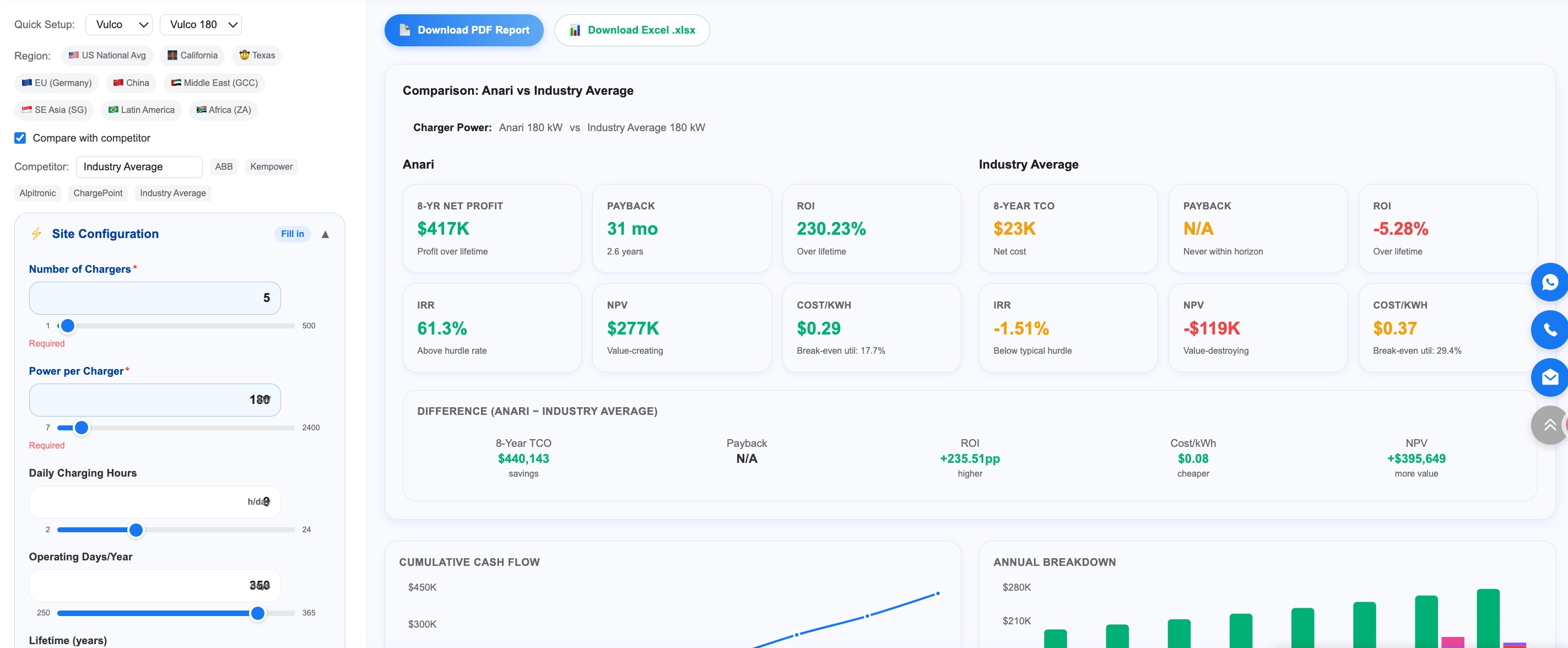
If you want to learn more about the cost and payback period of fleet charging pile operation, you can learn about our latest calculation tool – TCO Calculator, click the link.