


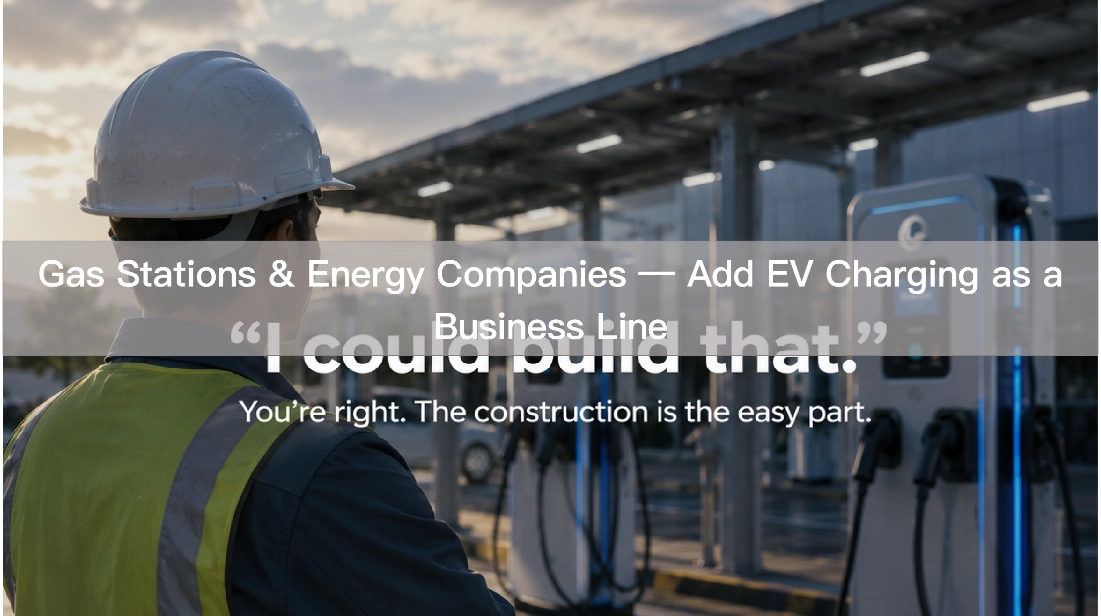
You run 15 gas stations. Or a regional power utility. Or a commercial real estate portfolio with parking assets worth more than the buildings above them.
Your board has been watching the EV adoption curves. They know what happens to a gas station operator who waits until 40% of vehicles on the road are electric before making a move — by then, someone else already owns the charging relationship with those drivers.
So the decision gets made: add EV charging.
Then someone asks the obvious question: “Who here knows how to build a charging station?”
Silence.
1. The Capital-Rich, Knowledge-Poor Problem
This is the defining challenge for energy and real estate companies entering EV charging. You have what most CPO startups would kill for: existing sites, operating capital, brand recognition, customer traffic. A gas station operator with 15 locations already has the real estate, the utility connections, the customer base, and the operational team that a startup would spend five years building.
What you don’t have is anyone in the building who knows the difference between OCPP 1.6J and 2.0.1. Or which charger model works with which payment terminal in your country. Or what a grid connection study actually costs.
This is not a competence gap. It’s a category gap. You didn’t need to know these things until now, and building that knowledge internally would take 18-24 months — roughly the same window during which your competitors are capturing the EV drivers who currently fuel with you.
The question is not whether to enter. The question is how to enter without building a new division from zero.
2. The Gas Station Operator: A Multi-Million Dollar Pivot
Consider a mid-size fuel retailer. Twelve stations across a region. Strong locations. Established brand. The owner sees the writing on the wall and decides to convert the portfolio to hybrid fuel-EV stations over three years.
A project like this easily crosses seven figures. But here is the problem they face:
No local reference case. In emerging markets, there may be zero examples of a fuel retailer successfully adding DC fast charging and operating it profitably. The owner cannot drive across town, visit a competitor’s installation, and reverse-engineer it. There is nothing to copy.
End-to-end capability is missing. They have people who understand fuel pumps, underground tanks, and convenience store margins. Nobody in the company has ever spec’d a 120kW DC charger, negotiated a grid upgrade with the utility, or configured a charging management platform. The pieces exist, but nobody knows how to assemble them.
The pace is unfamiliar. Fuel retail moves slowly. A new pump installation follows a template refined over decades. EV charging moves faster — new protocols, new vehicle models with different charging curves, new payment standards. A fuel retailer’s five-year equipment lifecycle doesn’t match a charger’s three-year technology cycle.
Yet the opportunity is real. A driver who charges at your station for 20 minutes spends more time on site than a fuel customer who pumps for three minutes. That’s 20 minutes of exposure to your convenience store. Add a decent coffee and a clean restroom, and the profit per visit shifts from fuel margins to retail margins — which, for most stations, were always the better business anyway.
3. M1: Assess the Site You Already Own
A gas station operator starting EV charging has one enormous advantage: the sites. But not every existing station is a good charging location.
M1 evaluates your portfolio against charging-specific criteria. A highway-side station with high turnover and short dwell time may be perfect for 180kW+ ultra-fast chargers. An urban station with limited space and slower throughput may be better suited to fewer, strategically placed 60-120kW units alongside existing pumps.
For real estate developers, the question is different: which properties in your portfolio have the parking capacity, grid access, and traffic patterns to support a profitable charging operation? M1 converts property data into site-specific feasibility assessments — not generic reports, but ranked recommendations you can take to your investment committee.
4. M2: Design That Works Alongside Your Existing Business
A hybrid fuel-EV station is not a gas station with chargers bolted onto the parking lot. The traffic flow is different. An EV stays 15-40 minutes. A fuel customer stays three minutes. Two types of vehicles, two dwell times, one site.
M2 designs the station layout to prevent EV charging from creating fuel queue congestion — and vice versa. It accounts for the power infrastructure: if the station currently draws 50 kVA and you want to add 400 kW of EV charging, the transformer upgrade is not an afterthought. It is the design constraint that determines whether the project is viable at all.
For power utilities adding public charging, M2 addresses a different challenge: leveraging your own grid infrastructure advantage while designing a customer-facing service that your organization has never operated before.
5. M3: Equipment That Makes the Right Impression
A fuel retailer’s EV chargers will be the first electric charging experience for many of their customers. If the charger is slow, confusing, or unreliable, the customer doesn’t just avoid the charger — they associate the experience with your brand.
M3 selects equipment based on three criteria: reliability (uptime, field failure rates, modular serviceability), user experience (screen clarity, connector ergonomics, payment simplicity), and total cost of ownership. The cheapest charger at purchase is rarely the cheapest over five years — and for a company planning 12+ installations, the wrong decision gets multiplied across every site.
6. M4: Compliance — Where Fuel Meets Electricity
Co-locating high-power electrical equipment with flammable fuel storage introduces regulatory complexity that neither a pure fuel station nor a pure charging station faces.
M4 handles the compliance layer: fire safety codes for hybrid stations, environmental regulations, electrical safety certification, and grid connection permits. This is the work that delays projects by months when done reactively and keeps them on schedule when handled up front.
7. M5: A Platform That Treats Charging as a Business Line
A gas station operator runs a fuel business. If they add 24 chargers across 12 sites, they are now running two businesses: fuel and EV charging. Each has its own pricing, its own utilization metrics, its own revenue reporting, its own customer experience.
ANARI OS gives you a dedicated platform for the EV business. It supports dynamic pricing — charge more during peak hours, less overnight. It tracks utilization per charger, per site, and across the portfolio. It integrates with payment terminals and loyalty programs. For an operator who already knows how to run a multi-site retail fuel business, ANARI OS provides the equivalent operating layer for EV charging — without requiring a software development team to build it.
8. M6: Technical Support — Because No One on Your Team Fixes Chargers Yet
A fuel pump technician can diagnose a dispenser in their sleep. A charger fault is a different language.
M6 — N-Tech — provides 7×24 technical support with remote diagnostics. For operators with no EV technical team, this is not a luxury. It is the organization’s charging competency delivered as a service, available in minutes instead of built over years.
9. M7: Filling the Chargers You Just Installed
A fuel station doesn’t need to acquire customers. The canopy is a 20-foot advertisement visible from the highway. Drivers pull in because they see it.
EV charging is different. Drivers use apps to find chargers. They check availability before they drive. They compare prices and speeds. If your chargers aren’t visible on the platforms drivers use — PlugShare, in-vehicle navigation, fleet routing tools — they might as well not exist.
M7 — N-SDR — manages customer acquisition across digital channels. It ensures your stations appear where drivers look, with accurate availability data, pricing, and charger specifications. For a fuel operator transitioning to hybrid, this closes the gap between “we built it” and “they came.”
10. The Competitive Clock
The energy and real estate companies entering EV charging today have an advantage that will not last forever: they own the sites. The gas stations, the utility substations, the commercial properties. These are not assets a charging startup can replicate.
But site ownership is a depleting advantage. Every month, another competitor secures a location, another charging network expands coverage, another driver builds a charging habit that doesn’t include your station.
The window to convert site ownership into charging market share is open now. It will close. The question is whether you build a team internally — 18 to 24 months, significant hiring risk, no guarantee of competence — or partner with someone who has already solved the charging-specific parts of the problem.
For energy and real estate companies, the case for partnership is straightforward: you have the capital, the sites, and the customer base. A turnkey partner has the charging expertise, the equipment supply chain, and the operating platform. The combination is what neither side can build alone on the same timeline.