



Table of Contents
As electric vehicle (EV) adoption continues to surge globally, the demand for robust, accessible, and high-speed public charging infrastructure has never been more critical. For long-distance travelers, range anxiety remains a significant barrier to entry. The solution lies in developing a comprehensive DC fast charging network strategically positioned along major travel routes. However, planning a reliable DC Fast Charging Network for Highway Corridors requires more than simply dropping hardware onto a map; it demands a meticulous orchestration of data analysis, site selection, energy management, and user experience design.
1. Data-Driven Site Selection and Spatial Planning
The foundation of any successful DC fast charging network is strategic site selection. Placing chargers where they are most needed—and where the grid can support them—is paramount.
Understanding Traffic Flows and EV Adoption Rates
Before breaking ground, network planners must analyze macro-level data. This includes evaluating average daily traffic (ADT) volumes on specific highway segments, origin-destination patterns for long-haul travel, and regional EV adoption rates. Utilizing geographic information systems (GIS) and AI-powered infrastructure planning tools helps identify “hot spots” where demand will predictably outstrip current supply.
Spacing and Proximity to Amenities
A widely accepted standard for a highway corridor EV charging network is to position stations every 50 miles along designated alternative fuel corridors. However, spacing is only one part of the equation. Because DC Fast Charging (DCFC) can take anywhere from 20 to 45 minutes to add substantial range (e.g., 80% charge), stations must be located near appealing amenities.
Ideal off-highway locations include:
- Travel Plazas and Truck Stops: Offering food, restrooms, and 24-hour security.
- Retail Centers and Grocery Stores: Allowing drivers to run errands while charging.
- Dining Establishments: Providing a comfortable place to rest.
Crucially, stations should ideally be located within one mile of a highway exit to minimize detour time for drivers, ensuring the charging experience is as seamless as a traditional gas station visit.
2. Electrical Grid Capacity and Energy Management
Deploying multiple high-power DC fast chargers (often ranging from 150kW to 350kW per port) places immense stress on the local electrical grid. Early engagement with utility providers is a critical step in planning a reliable DC Fast Charging Network for Highway Corridors.
Utility Coordination and Upgrades
Planners must assess the existing grid capacity at proposed sites. Upgrading transformers, running new medium-voltage lines, or installing new substations can add months (or years) to project timelines and significantly inflate costs. Working closely with local utilities helps identify sites with sufficient existing “make-ready” infrastructure, streamlining deployment.
Smart Charging and Renewable Integration
To mitigate grid impact and manage high peak-demand charges from utilities, a modern DC fast charging network must employ smart energy management systems.
- Load Balancing: Software that dynamically distributes available power among multiple charging EVs based on their vehicle’s maximum acceptance rate and state of charge (SoC).
- Battery Energy Storage Systems (BESS): Installing on-site battery storage can buffer the grid during peak charging times, releasing stored energy when demand is highest and recharging when grid demand (and prices) are lower.
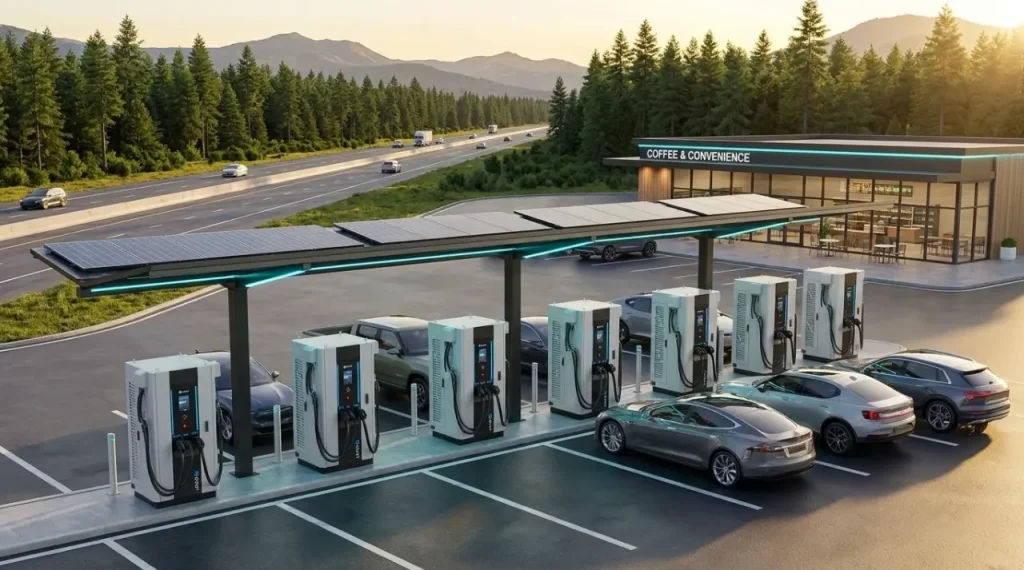
- Renewable Energy: While not feasible for every site, integrating solar canopies provides shade for drivers and supplements power requirements, contributing to a truly green highway corridor EV charging solution.
3. Hardware Selection and Future-Proofing
The physical equipment selected for a DC fast charging network dictates the user experience, charging speed, and long-term viability of the site.
High-Power Output and Scalability
To cater to the latest generation of EVs capable of ultra-fast charging, networks should prioritize 150kW to 350kW chargers. However, planners must also adopt a scalable mindset. “Future-proofing” involves installing larger conduits and oversized switchgear during the initial construction phase. This allows operators to easily add more charging ports or upgrade to faster, higher-capacity hardware (like Megawatt Charging Systems for heavy-duty commercial vehicles) as EV adoption scales, without requiring major civil engineering rework.
Reliability and Redundancy
A single broken charger on a remote highway corridor can leave drivers stranded. Reliability is the ultimate metric of success. Networks must mandate strict Service Level Agreements (SLAs) with hardware vendors, aiming for a minimum of 97% to 99% operational uptime.
Site design should also incorporate redundancy. A minimum of four to six DC fast charging ports per location is recommended to ensure that if one unit is down or occupied, drivers still have options.
4. Seamless User Experience and Interoperability
Even the most powerful highway corridor EV charging station will fail if the driver cannot easily activate and pay for their session.
The e-Mobility Service Provider (eMSP) Layer
A robust software backend, often managed by an eMSP, connects the driver to the charger. The user experience must be frictionless:
- Payment Options: Moving beyond restrictive membership cards to universal solutions like credit card readers, Tap-to-Pay, and mobile apps.
- Plug & Charge (ISO 15118): Implementing technology where the vehicle automatically authenticates and handles billing simply by plugging in, mimicking the Tesla Supercharger experience for all EV brands.
- Roaming Protocols: Utilizing Open Charge Point Interface (OCPI) to allow drivers using different network apps to seamlessly access your DC fast charging network.
Safety, Accessibility, and Design
Site design must prioritize driver safety and comfort. This includes:
- Ample Lighting: Ensuring 24/7 safety with well-lit canopies.
- ADA Compliance: Designing wider spaces and accessible charger screens/cables for drivers with disabilities.
- Pull-Through Configurations: Accommodating EVs towing trailers or electric medium-duty trucks, eliminating the need to unhitch before charging.
Summary Table: Key Considerations for Highway DCFC Networks
| Planning Phase | Key Objectives | Critical Action Items |
| Site Selection | Optimize location for high utilization and convenience. | Analyze ADT data; ensure sites are <1 mile from exits; prioritize locations with 24/7 amenities. |
| Grid & Energy | Ensure sufficient power delivery while managing costs. | Conduct early utility feasibility studies; integrate load balancing software; consider BESS for peak shaving. |
| Hardware | Deploy fast, reliable, and scalable equipment. | Install 150kW-350kW chargers; implement minimum 4-6 ports for redundancy; lay oversized conduit for future expansion. |
| User Experience | Create a frictionless, accessible charging event. | Enable universal payment options (credit card readers); implement ISO 15118 Plug & Charge; ensure ADA compliant site design. |
Conclusion
Planning a reliable DC Fast Charging Network for Highway Corridors is a complex, multi-disciplinary endeavor. It requires aligning the physical realities of real estate and electrical grids with the digital demands of smart software and driver expectations. By prioritizing data-driven site selection, robust power management, scalable hardware, and a frictionless user experience, network operators can build the critical infrastructure necessary to propel the global transition to electric mobility, making range anxiety a relic of the past.
Anari Turnkey AI Charging Station Solution

We don’t sell EV chargers.
We deliver the capability
to build a charging network.
Full-stack turnkey EV charging station solution for local
entrepreneurs in emerging markets. AI agent–powered
EV charging station turnkey project delivery across
the complete charging infrastructure lifecycle — from
site feasibility assessment to ongoing operations.
FAQs
What is the ideal distance between charging stations when planning a reliable DC Fast Charging Network for Highway Corridors?
The widely accepted standard, established by initiatives like the U.S. NEVI formula program, is to place DC fast charging stations no more than 50 miles apart along designated highway corridors, ensuring drivers always have a reachable destination.
Why is proximity to the highway and amenities so important for a highway corridor EV charging site?
Since DC fast charging typically takes 20 to 45 minutes, drivers need a safe, comfortable place to wait. Locating stations within one mile of a highway exit reduces travel disruption, while nearby amenities like restrooms, food, and retail turn the charging wait time into a convenient rest stop.
How do network planners manage the immense power requirements of a DC fast charging network without overloading the local grid?
Planners manage power demands by working closely with utilities early in the process and employing smart energy solutions. This includes load-balancing software that distributes power based on vehicle needs, and installing Battery Energy Storage Systems (BESS) to store energy during off-peak hours and discharge it during periods of high charging demand, mitigating stress on the grid.