



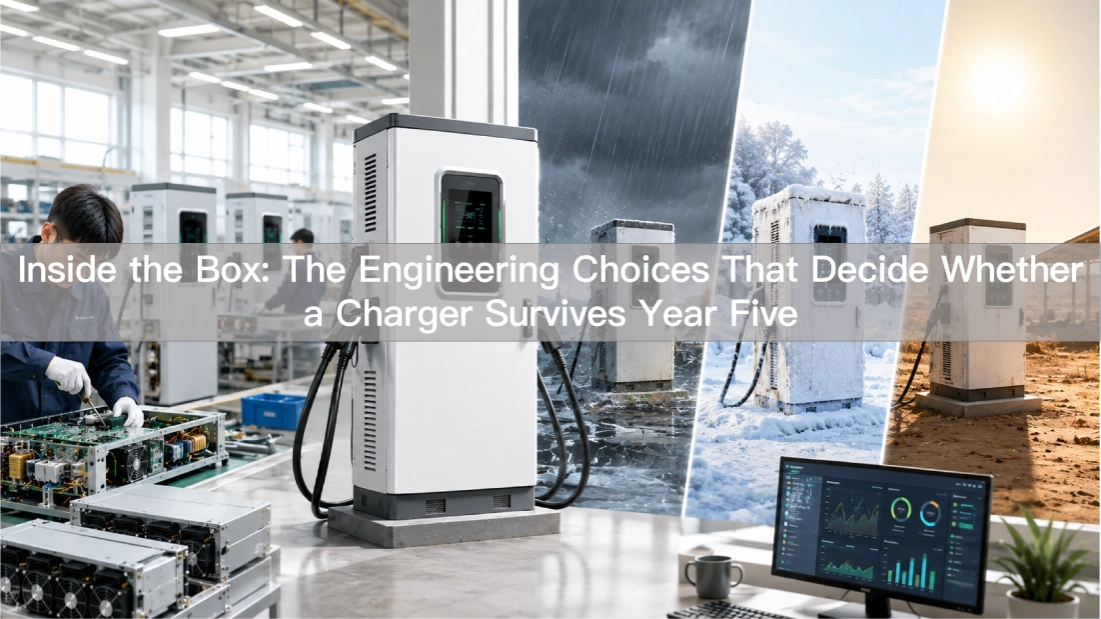
You can find a 120 kW DC fast charger on Alibaba in under three minutes, from forty different Shenzhen manufacturers. The spec sheets look identical: CCS2, OCPP 1.6J, IP54, a two-year warranty. The prices span a 2.5x range.
Here is what the spec sheet does not tell you: what the charger costs you in year three. The purchase price is the smallest number in your P&L. A station that loses a power module in a humid climate, a station that refuses to start at -20℃, a station that silently derates in a heatwave. Each of those costs more than the difference between two quotes. The decisions that decide those outcomes are made on the factory floor, not in the datasheet.
We design EV charging hardware in Shenzhen. This article is a walk through the engineering choices we make on every unit, the failures they prevent, and the deployments that prove them.
1. Semi-Potting: Protecting the Most Expensive Part in the Machine
The power module is the most expensive single component in a DC charger, and the one most likely to fail. Dust and humidity get onto the board, corrode the electronics, and the module dies. The station then runs at reduced power, or stops entirely, until a replacement module arrives and someone goes to site.
Anari’s Vulco DC Series charger(60-480kW Integrated Floor-Mounted DC EV Charging Station) uses a semi-potting process: the critical components are individually sealed against dust and moisture. It costs a little more per unit at the factory. It avoids module failure, a site visit, and loses charging revenue in the field, which costs a lot more.
This is not a theoretical concern. Our 120 kW chargers have been running through Cambodia’s wet and dry seasons since late 2025, where high temperatures and humidity are the norm year-round. They passed the test.
2. Salt and Humidity: Built for Coasts, Because That’s Where Chargers Live
A lot of charging hardware is developed and rated for benign indoor environments in its home market. Real deployments happen on coasts, in ports, on islands. Salt air corrodes connectors and enclosures faster than almost anything else.
Our enclosures pass a 48-hour salt spray test as standard, with an upgraded enclosure option for harsher coastal exposure. We test this because our chargers actually live on coasts.
In Batumi, on Georgia’s Black Sea coast, our 60-480 kW integrated DC units are deployed in partnership with Mart EV, the country’s leading charging operator. Coastal salt, tourist-season traffic, and continuous operation are the normal conditions there, not the edge case.
3. Cold: A Station That Starts at -20℃
Fast chargers stop being fast when they are cold. At -20℃, the electronics and charging control can take a long time to start, or refuse to deliver rated output. For a fleet operator or a CPO in a high-latitude market, that means a station that sits dark in January.
Our DC units carry a reserved heater interface: a heating module can be installed to bring the station to rated output quickly in cold weather. And this is not a roadmap feature. Our 120 kW and 180 kW chargers with the heater interface are already deployed and operating in high-cold regions of Georgia.
4. Heat: Rated Power at 50℃, Not 25℃
Many chargers are rated at 25℃ ambient and derate silently in real summer conditions. In a Gulf summer or a desert corridor, a “120 kW” charger can quietly deliver far less.
Our DC Series chargers are designed to deliver full rated power at 50℃ ambient, with IP54-rated, IK10 impact-resistant enclosures.
In Saudi Arabia, our 120 kW chargers are deployed specifically for extreme heat conditions. In Israel, our largest local partner runs 120 kW units through hot Mediterranean summers. Derating is a design decision, and it is one we design.
5. OTA, Remote Diagnostics, and the OCPP Stack We Wrote Ourselves
Every site visit costs money and downtime. Two capabilities cut both: OTA firmware updates, so fixes and features reach the fleet without a technician, and remote diagnostics, so a fault can be assessed from a screen before anyone drives anywhere.
There is a deeper layer. Our OCPP 1.6J stack is written in-house, not licensed from a third party. When a CSMS integration misbehaves, we can open the code and fix it. A manufacturer who licenses someone else’s stack cannot. That difference shows up at 3 AM, with a station down.
Our customers report the same. One operator’s feedback on after-sales: when their station needed a firmware upgrade, our team responded within a few hours. That is the standard the engineering is designed around.
6. The Revenue Side: A Station That Earns Beyond the kWh
Chargers earn from electricity sold. Our DC stations(60-240kW Dual Guns DC Fast Charging Advertising Station) can also carry a 32-inch HD LCD advertising screen, certified on CE/CB hardware, that hosts advertising alongside charging. One operator using the advertising screen reports that advertising revenue contributed 10% of their station revenue. In markets with established advertising demand, that is real money on top of the charging business.
7. What These Choices Add Up To
Each engineering decision maps to a line in your P&L:
• Semi-potting protects against module replacement cost and downtime in humid climates.
• Salt spray testing protects stations on coasts and in ports.
• The heater interface protects winter revenue in high-latitude markets.
• Full power at 50°C protects Gulf and desert sites from silent derating.
• OTA and an in-house OCPP stack cut truck rolls and integration dead-ends.
• The advertising screen adds a second revenue line where the market supports it.
None of these appear on the spec sheet. All of them decide what the charger costs you in year three, and year five.
8. Five Questions to Ask Any Manufacturer Before You Sign
• wrote your OCPP stack? Can you open the code when an integration fails?
• What is your salt spray rating, and where are your coastal deployments?
• Where is the cold-weather support? Is a heater interface standard, and where is it deployed?
• How do firmware updates reach the fleet? OTA or a technician?
• When a unit faults at 3 AM in year three, who answers, and how fast?
The spec sheet tells you the charger works on day one. These five answers tell you whether it still works on day 1,500.
———
Anari Energy designs EV charging infrastructure in Shenzhen, with deployments across Europe, Southeast Asia, Central Asia, the Middle East, and South America. Products are certified to CE, TÜV, and CB standards, with an OCPP 1.6J stack written in-house. If you want to see these choices in your climate, send us your site parameters, and we will come back with a deployment reference and a cost comparison.