




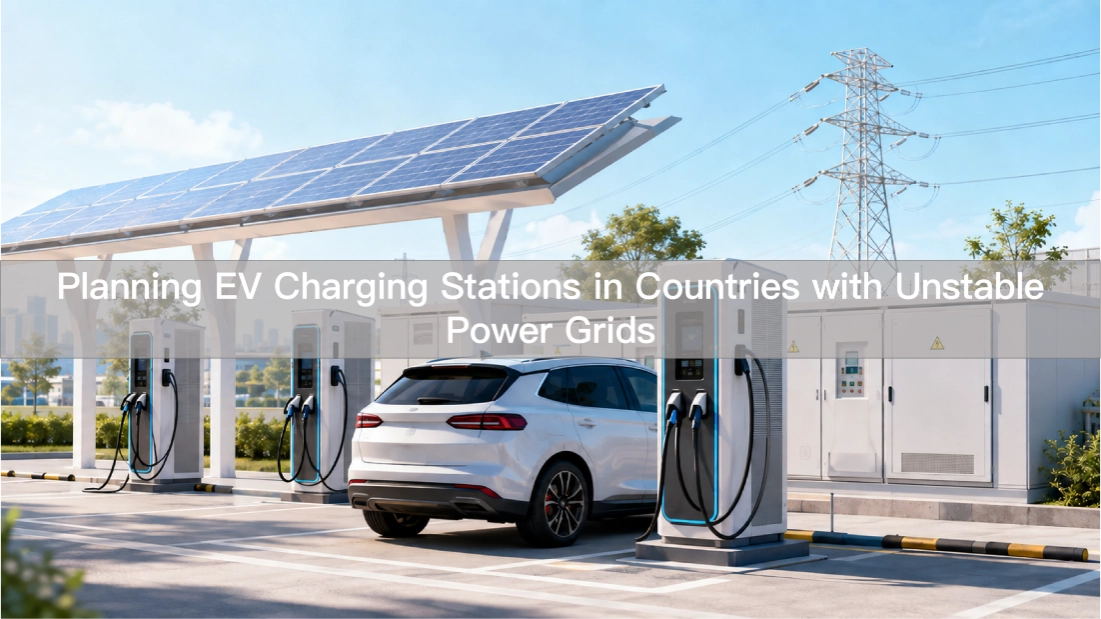
A charging station costs hundreds of thousands of dollars. On day two, the grid voltage drops from 400 V to 320 V, three DC fast chargers trip at once, and drivers leave one-star reviews. In a country with a stable grid, that is an incident. In a country with an unstable grid, it is a normal Tuesday.
In Nigeria, Pakistan, Bangladesh, and Uzbekistan, the first variable in planning an EV charging station is not “how many chargers do I install.” It is “how much power can the grid reliably deliver.” You can buy the best chargers on the market, but the electricity is not yours. The grid decides. This article explains how to plan a station that keeps running when the grid does not.
1. First Diagnose: Grid Instability Is Four Different Problems
“Unstable grid” is a vague phrase. On the engineering side, there are four separate problems, and each one needs a different fix.
Voltage sag and swell. When a large motor starts or a heavy load switches, voltage drops below 90 percent of nominal or spikes above 110 percent for anywhere from tens of milliseconds to a few seconds. The power modules in a DC charger are sensitive to input voltage, and a narrow-tolerance module will trip on this kind of fluctuation.
Brownout. During peak hours the network is overloaded and voltage gets pulled down to 340 V or 320 V and stays there for an hour or two. This is not a momentary blip. The charger either derates or shuts down.
Blackout and load shedding. The utility cuts power to neighborhoods on a rotating schedule. It might be two hours a day or half a day at a time. This is the worst kind, because there is no buffer time.
Frequency drift and phase loss. Frequency drifts more than 1 percent from 50 Hz (or 60 Hz), or one phase of the three-phase supply drops out. Phase loss is especially dangerous. It can burn out a power module.
The diagnostic is simple. Put a power quality logger at the site you are considering and record voltage, frequency, phase balance, and outages for a week. That step costs a few hundred dollars and saves you hundreds of thousands in rework later.
2. Step One: Treat Grid Capacity as the First Constraint, Not Parking Spaces
The standard planning logic is: 20 parking spaces, so 20 chargers. In a country with an unstable grid, that logic is backwards.
The right order is: check how much spare capacity the transformer has left, then decide how many chargers you can run and at what power.
Do the math. A 120 kW DC charger at full load draws roughly 150 kVA of apparent power, once you account for power factor and safety margin. If the transformer has only 400 kVA to spare, you can run two 120 kW chargers. Push it to four and the transformer overloads. Either it trips, or the utility fines you.
At that point, you have three options: upgrade the connection, add energy storage, or do load management. A utility upgrade costs money and time, and it only works if the grid has power to give you in the first place. For most sites, the answer is storage plus load management, not waiting on the utility.
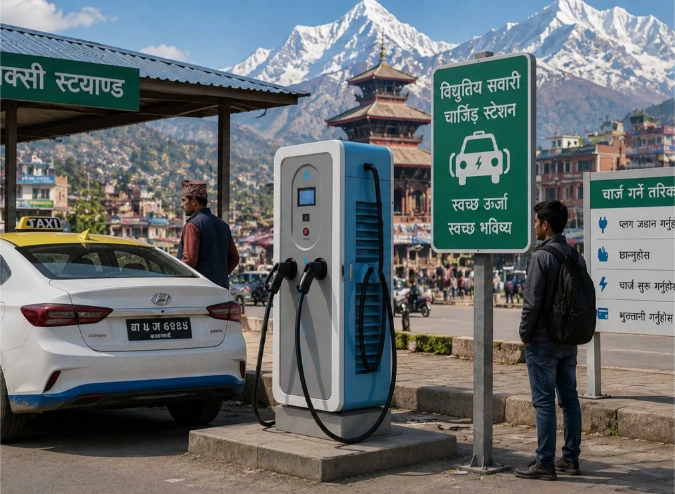
60-240kW Commercial Fast DC EV Charging Station in Nepal
3. Equipment: Check Input Voltage Range Before Power
In a country with a stable grid, you pick a charger by power and charging speed. In a country with an unstable grid, you check a more basic spec first: input voltage range.
A DC charger’s power modules run directly on three-phase power. The input voltage tolerance decides whether the charger derates and keeps charging during a sag, or trips outright. A wide-voltage design (say, 380 V plus or minus 20 percent) keeps charging at reduced power even when voltage falls to 320 V. A narrow-tolerance charger may stop at 350 V.
Look at three things:
• Input voltage range. The wider, the better. It directly sets how well the charger rides out fluctuations.
• Active power factor correction (PFC). Keeps power output stable during voltage swings instead of wobbling with the grid.
• Module-level derating. When voltage is low or temperature is high, the module steps down power instead of shutting off to protect itself. Derating and keeping charging, versus tripping and stopping, are two very different experiences for a driver.
Add a voltage regulator (AVR), surge protection, and lightning protection. One line to remember: in an unstable-grid country, a charger’s ability to ride out fluctuations is worth more than its peak power.
4. Architecture: Energy Storage Is the Buffer Layer
Storage is not a nice-to-have in unstable-grid markets. It is a requirement. It does three jobs.
Peak shaving. A charging station is a classic peak load. A few chargers at full power push the peak right up against the transformer limit. Storage discharges at the peak and charges in the valley, flattening that spike. It saves two things: the risk of transformer overload, and the demand charge the utility bills you on your peak.
Blackout bridging. When the grid drops, storage takes over and the chargers stay live. How long it lasts depends on capacity. Take 120 kWh of storage with a 60 kW bidirectional inverter. During an outage, it can keep a few chargers running at reduced power and ride out a two-hour load-shedding window.
Load smoothing. Storage filters the choppy grid input so the chargers see cleaner power, which reduces module wear.
How much storage? The core parameter is how long the outages last, which engineers call autonomy hours. Two hours of daily outages and eight hours of daily outages mean a fourfold difference in storage sizing. Do not guess. Get the site’s outage record first, then do the math.
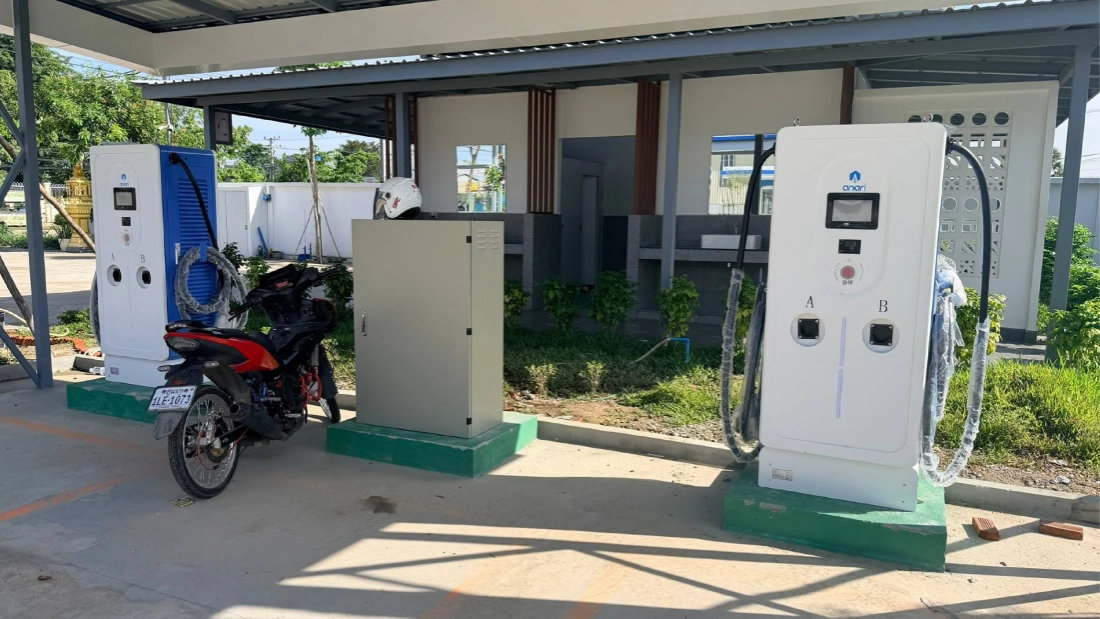
Anari Energy Powers Cambodia’s National Highway with Cost-Economy DC Fast Charging
5. Solar Plus Storage Plus Charging: The Full Answer for Weak and Off-Grid Sites
In some places the grid is too weak to use at all: remote highways, mine sites, islands. That is where solar plus storage plus charging is the standard answer.
During the day, solar feeds the chargers directly and any surplus goes into the battery. At night the battery discharges. The whole site can run off-grid, or as a microgrid, without depending on grid stability at all.
But solar plus storage is not a magic bullet. Whether you add solar comes down to two numbers: local annual irradiation and the electricity price. Where irradiation is high and power is expensive, solar pays for itself in a few years. Where irradiation is low and power is cheap, solar is a drag. Add solar because the numbers work, not because the green label looks good.
6. Load Management: Use Limited Power Fully, Do Not Fight Over It
Limited grid capacity does not mean you have to install fewer chargers. The key is to stop chargers from pulling full power all at once.
Dynamic load balancing (DLB) does exactly this: a 200 kW grid feed can run four 120 kW chargers. The system watches total load in real time, and when one car is nearly full, it hands that charger’s power to the newly connected car. The driver never feels the throttle, but the grid never overloads.
Layer OCPP smart scheduling on top: charge more in the valley, less at the peak, and schedule around peak and off-peak electricity prices. The same amount of power serves more cars. That is what efficient actually means.
7. The Backup Plan: Diesel Hybrid Power, Unfashionable but Necessary
The worst grid case is seven or eight hours of daily outages, which even storage cannot cover. That is where a diesel generator plus storage hybrid is the backstop.
The diesel set covers long outages. Storage covers the second-level switchover and the short peaks. A diesel generator takes time to start, so the storage holds the line during the switchover instant to keep chargers from dropping and reconnecting. On cost, diesel is more expensive per kilowatt-hour than the grid, but it guarantees power always. Whether that is worth it depends on how much revenue one day of downtime costs your site.
8. One Table to Decide Whether You Need Storage, and How Much
Match your grid to one of these rows, then pick the architecture. Keep the order straight: outage records and voltage data first, then the design. Design first, then procurement.
Voltage swings but rare outages. Occasional. Urban commercial districts. Wide-voltage chargers plus voltage regulation (AVR). Fewer trips and fewer burned modules.
Peak-hour load shedding and high demand charges. Short and daily. Fleet depots. Chargers plus storage for peak shaving. Lower demand charges, no overload.
Daily outages of several hours. Daily. Mid-size cities and industrial zones. Chargers plus storage for bridging. Charging continues through outages.
Extremely weak or no grid. Constant. Remote highways, mine sites, islands. Solar plus storage plus charging. Off-grid self-sufficiency.
Long outages plus high load. Daily and long-duration. Heavy-load hubs. Chargers plus storage plus diesel. Round-the-clock availability.
In a country with an unstable grid, the core of planning an EV charging station is never “buy the best chargers.” It is “keep the chargers powered when the grid cannot.” The charger is an equipment problem. Electricity is a system problem. Treat the grid as the first constraint and you save yourself the cost of rework and the reputation damage of lost customers.
If your site sits in an unstable-grid region and you want a grid diagnostic and a configuration plan built for it, send over the basics: transformer capacity, outage frequency, and number of parking spaces. We will help you pin down the architecture.