



1. Introduction: The New Entrant Profile
A distinct cohort has emerged in the EV charging market over the past three years. They are not electrical contractors expanding into a new service line. They are not fleet managers solving an internal infrastructure problem. They are not fuel retailers defending a legacy business.
They are independent entrepreneurs building charging networks from zero.
The typical profile: 30 to 40 years old, with a background in technology, consulting, or finance. They have identified a structural gap in their local charging market — insufficient coverage, poor reliability, no player with a recognizable consumer brand — and have decided to fill it. They raise capital from personal networks, angel investors, or early-stage funds. They incorporate. They start looking for sites.
At this point, most of them hit the same wall.
2. The Problem Is Not Capital or Intelligence
Newcomer CPOs are often the most analytically capable operators in any given market. They understand unit economics. They can build a financial model. They know how to pitch investors and structure a cap table.
What they do not have is industry-specific knowledge: which suppliers are reliable, what a realistic grid connection timeline looks like, how to structure an equipment warranty, what site characteristics predict utilization, which payment integration approach works in their specific country, and what a competent installation looks like versus one that will generate maintenance calls for the next three years.
This knowledge exists. It is distributed across established operators, equipment manufacturers, engineering consultancies, and the scar tissue of failed projects. But it has not been systematically made available to new entrants — particularly those entering markets where the charging industry itself is nascent and reference cases are scarce.
The result is a predictable failure pattern.
3. The First-Site Failure Cascade
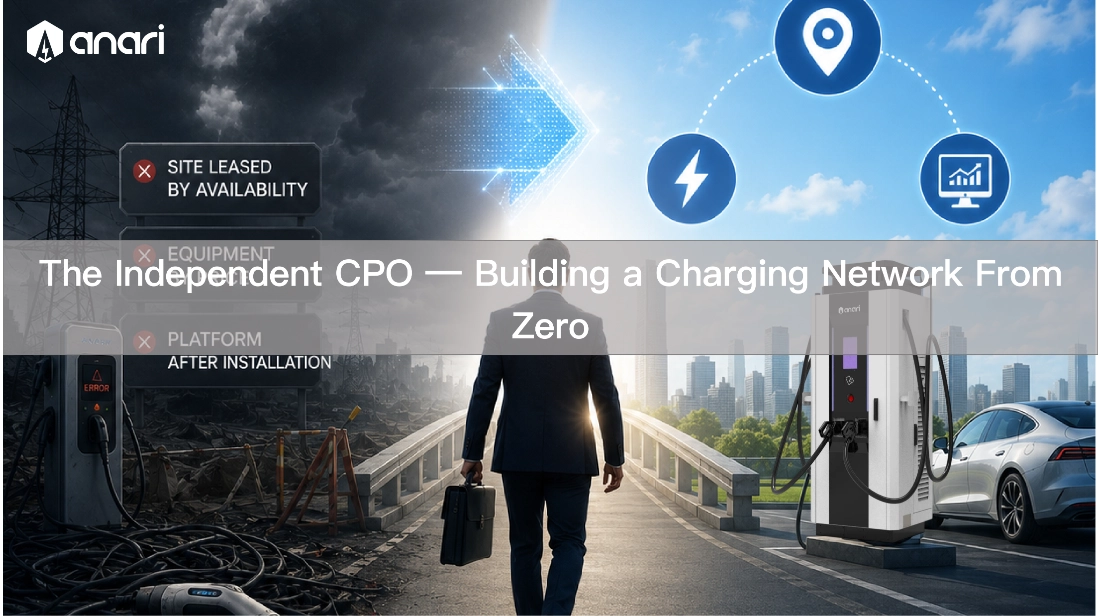
An independent CPO raises capital, leases a site, orders equipment from an offshore supplier, hires a local electrical contractor for installation, and expects to be operational within six months. Twelve months later, the site is not yet live. The charger firmware is incompatible with the local payment gateway. The grid connection approval has been delayed twice. The electrical contractor, competent at wiring buildings, has never terminated a DC charging cable and the first attempt caused a ground fault. The investor is asking about milestones.
This sequence is common enough that it deserves analysis as a structural risk, not a series of individual mistakes.
Root cause 1: Site selection by availability, not suitability. New entrants lease sites based on what is available — a parking lot owned by a friend, a commercial property with a willing landlord — rather than sites selected against multi-variable criteria: traffic density, grid capacity, competition radius, vehicle dwell patterns, and projected utilization. A site that is cheap to lease and expensive to underutilize is a worse financial outcome than a site that is expensive to lease and fully utilized.
Root cause 2: Equipment procurement treated as a commodity transaction. A 120kW DC charger from supplier A is not the same product as a 120kW DC charger from supplier B. Differences in power module architecture, cooling design, control board firmware, and regional certification status create downstream effects on uptime, serviceability, and total cost of ownership. New entrants, lacking supplier evaluation frameworks, default to purchase price comparison — which is the variable least correlated with five-year operating cost.
Root cause 3: Grid connection treated as a permitting step rather than a project phase. The time between submitting a grid connection application and receiving approval can range from weeks to months depending on the utility, the transformer’s available capacity, and the regulatory jurisdiction. Ordering equipment before the grid study is complete is the single most expensive timing error in CPO project management.
Root cause 4: Installation quality dependent on a contractor with no charging-specific experience. General electrical contractors can install chargers. The question is whether they can install them correctly the first time — grounding, cable management, weather sealing, firmware configuration, network connectivity — or whether the CPO will discover the gaps through fault calls over the following 18 months.
Root cause 5: No operational layer planned before the first charger goes live. Many new entrants treat the charging management platform as something to figure out after installation. In practice, the platform determines the revenue model: how pricing works, how customers authenticate, how sessions are monitored, how faults are diagnosed. A charger without a platform is a piece of electrical equipment. A charger with a platform is a business.
4. Anari Energy’s Turnkey EV Charging Station Solution
4.1 M1: Site Selection as a Disciplined Process
The single largest determinant of a charging station’s financial performance is its location, and the single largest source of location risk for new entrants is selection bias toward available rather than optimal sites.
M1 replaces availability-driven site selection with a structured, multi-variable assessment. Inputs include traffic data at the specific intersection, grid capacity at the specific transformer serving the candidate site, competitor density within a defined radius, and land cost. The output is a ranked set of options with projected utilization ranges attached to each. The projections are not predictions — utilization depends on variables beyond any model’s scope — but they establish a defensible basis for comparing sites that is categorically superior to leasing the first available parking lot.
For an entrepreneur deploying investor capital, this is not optional. A site selection error in a $120,000 project is not a learning experience. It is a conversation with an investor that the founder will not enjoy having.
4.2 M2: Design That Matches Reality
A first-time CPO’s instinct is to maximize charger count. More chargers equals more revenue potential. This instinct is wrong in the specific case of a first site.
An underutilized station with four chargers loses money faster than a fully utilized station with two, because the fixed costs — grid connection, civil works, platform licensing — do not scale down with charger count. M2 designs the station for the actual projected demand at the actual specific site, not for the capacity the entrepreneur hopes to sell in year three.
Design parameters include charger count, power level per unit, physical layout for vehicle flow, and future expansion provisions. The expansion provisions matter: pouring a concrete pad sized for six chargers while installing two costs marginally more than a two-charger pad and prevents the station from requiring demolition if demand materializes faster than projected.
4.3 M3: Equipment Selection With a Five-Year Lens
M3 provides access to a pre-qualified global equipment pool. The qualification criteria are not limited to spec sheet data. They include field failure rates from existing deployments, serviceability characteristics (modular vs. monolithic architecture, module swap time, local parts availability), regional certification status, and compatibility with the target market’s connector standards and payment infrastructure.
For a new entrant with no supplier relationships, this is the equivalent of a procurement function. It substitutes a structured evaluation for the default approach — searching an online marketplace, sorting by price, and hoping.
4.4 M4: Compliance Without the Discovery Process
Every market has a unique regulatory path to legal operation. Discovering that path through trial and error — submitting incomplete applications, learning requirements through rejections, locating the correct permitting offices through word of mouth — adds months to the project timeline.
M4 provides the regulatory map: which permits are required, in what sequence, from which agencies, with what typical processing times. The CPO still does the filing — local entrepreneurs will always know their local bureaucracy better than an outside partner — but they file the correct documents the first time, for the correct applications, in the correct order.
4.5 M5: A Platform From Day One
The most consequential operational decision a new CPO makes is the choice of charging management platform. Switching platforms after deployment is expensive — it involves firmware reconfiguration, payment integration rework, and potential downtime across every charger in the network.
ANARI OS provides OCPP 1.6J and 2.0.1 compatibility, payment gateway integration, remote monitoring, and utilization analytics. For a CPO building their first site, this means the operational layer is functional before the first customer plugs in — not retrofitted after problems accumulate.
4.6 M6: Technical Support as a Competency Loan
A first-time CPO has no charging maintenance team. They have an entrepreneur who can read a technical manual and a local electrician who can follow wiring diagrams. Neither can diagnose a firmware incompatibility, a ground fault in a DC power module, or a communication failure between the charger and the backend.
M6 provides a 7×24 technical support function — remote diagnostics, fault identification, repair procedure guidance, and parts dispatch coordination. For a startup, this is not a support service. It is the organization’s charging competency, delivered on demand, available within minutes rather than built over years.
4.7 M7: Customer Acquisition for a Brand Nobody Knows
An established fuel retailer has a 20-foot canopy visible from the highway. An independent CPO has a charger in a parking lot that nobody is looking for.
M7 addresses the customer acquisition problem through digital channel management: platform listing optimization, pricing strategy, fleet outreach. For a startup, customer acquisition is not a marketing activity. It is a survival activity — the difference between a station operating at 12% utilization and one covering its debt service — and it needs to begin before the first charger is energized.
5. The Entrepreneur’s Calculation
Building a charging network from zero is not harder than building any other asset-heavy, regulated, location-dependent business. The difficulty comes from the number of independent variables that must all resolve correctly for the first site to work: site, grid, equipment, permits, installation, platform, customers. A failure in any one of these variables can delay or disable the entire project.
The entrepreneurs who succeed are not necessarily the ones with the most capital or the best technology background. They are the ones who recognize that industry knowledge — supplier evaluation, project sequencing, regulatory navigation, operational planning — is the scarce resource, and who solve for that scarcity through partnership rather than trial and error.