


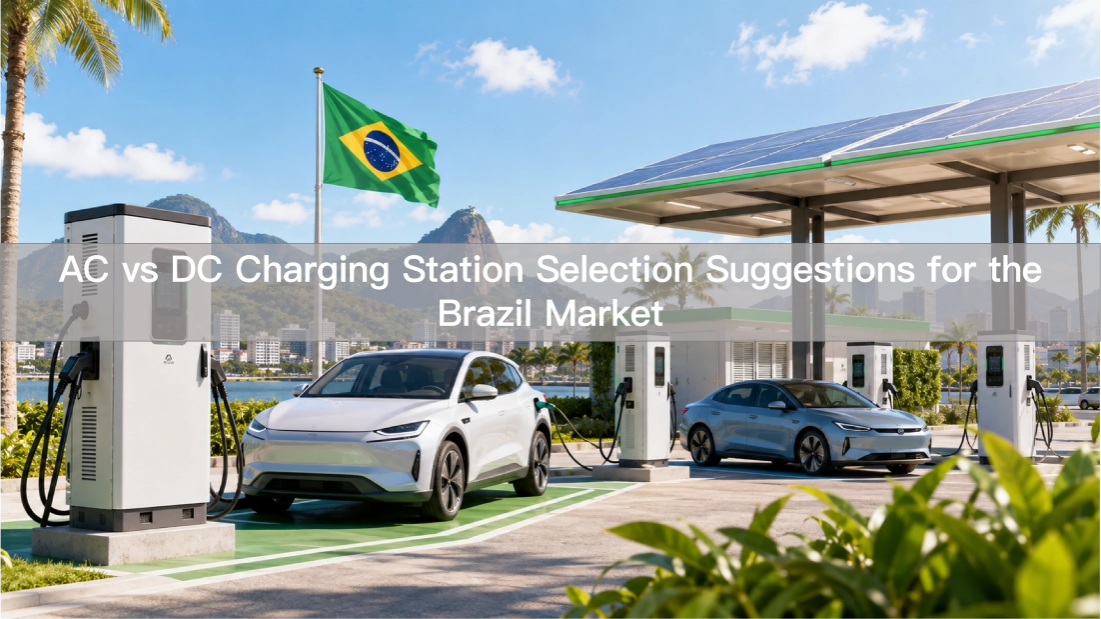
Brazil is one of Latin America’s most promising EV markets. Sales keep climbing at a compound annual rate above 40%. By 2025, the country passed 150,000 registered electric and plug-in hybrid vehicles. Government incentives help. So does a grid that runs on over 80% hydroelectric power. For small and medium charging operators, the timing looks right.
But the hardware decision is not obvious. AC or DC? This guide gives practical charging station selection suggestions for the Brazilian context. It maps to your business model, your target audience, and your growth plan.
1. Start With the Brazilian EV Landscape
Your hardware choice starts with the market around it. Brazil’s EV mix is not like Europe’s.
Most EVs are still plug-in hybrids. Many carry small batteries in the 20–40 kWh range. Entry-level models like the Fiat Fastback E-Rev and Renault K-ZE lead that segment. These cars charge fine on AC. If you serve this segment, AC covers most of your demand.
Full BEVs are arriving fast. The BYD Atto 3, GWM Ora, and Tesla Model 3 are gaining traction. They appear across São Paulo, Rio de Janeiro, and Curitiba. These cars want faster power.
and Regulatory Context. Brazil’s National Electric Energy Agency (ANEEL) established Resolution 1000/2021. It created the “Geração Distribuída” framework for EV charging stations. Operators connect under specific tariff regimes. Some states offer reduced commercial rates off-peak. Check your local distribution concessionaire’s tariff before you calculate operating cost. See our [EV charging infrastructure overview](https://www.anariev.com/why-global-businesses-choose-anari-energy-for-ev-charging-infrastructure/) for the full context.
Urban and rural demand differ. Dense cities mean short trips and frequent AC top-ups. Intercity corridors like BR-101 and BR-116 need DC fast charging for long-distance drivers.
2. AC Charging: The Low-Barrier Entry
AC (Level 2) chargers deliver 3.7 to 22 kW. A full charge takes 4–8 hours, depending on battery size and onboard charger. For small and medium operators, AC is the cheapest way in.
2.1 Where AC Wins
Commercial parking facilities. Shopping malls, offices, hotels, and residential complexes across Brazil’s big cities are prime AC sites. The average Brazilian commuter drives under 30 km a day. A Level 2 charger refills that overnight or during a workday. Pair AC with parking revenue models like hourly fees or subscriptions. You get a diversified income stream. For site layouts, see our AC EV charging stations.
Fleet depots and corporate campuses. Brazilian fleets are starting to electrify. Loggi and iFood already pilot electric delivery vehicles. These fleets return to one depot daily. That makes overnight AC charging highly efficient. Fleet contracts bring predictable utilization and steady revenue.
Cost and ROI. AC units run BRL 3,000–15,000 in Brazil. DC units run BRL 50,000–250,000+. Installation is cheaper too. Most commercial buildings need minimal electrical upgrades for AC. With limited capital, you hit break-even faster and spread units across more sites.
2.2 AC Watch-Outs
• AC underperforms at high-turnover sites where cars park 1–2 hours.
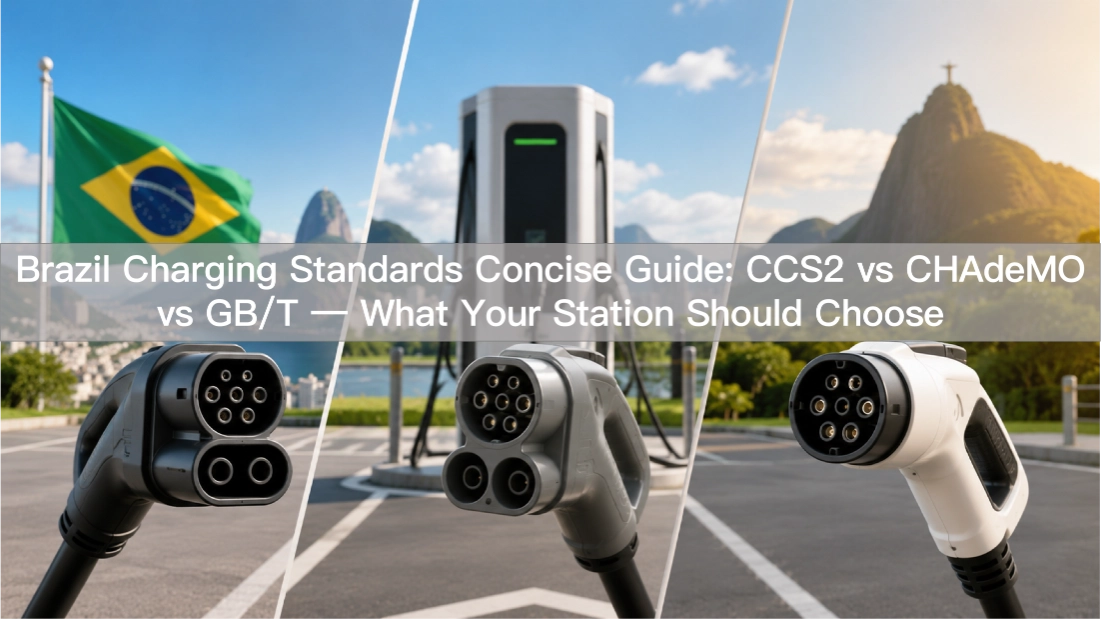
• Pick units with the **Type 2 (Mennekes)** connector. It is the dominant standard in Brazil. Some Chinese-made vehicles need GB/T adapters.
• Bigger batteries (50–80 kWh) are coming. They charge slower on AC. Price accordingly.
See our commercial EV charging solutions for AC deployment patterns. Operators building mixed networks also use our fleet charger selection guide.
3. DC Fast Charging: Strategic Deployment
DC chargers bypass the onboard charger and feed the battery directly. Output ranges from 50 kW to 350 kW. A 50 kW unit delivers an 80% charge in 20–30 minutes on most current EVs.
3.1 Where DC Wins
High-traffic corridors and highway stops. Brazil’s intercity travel creates real demand. The São Paulo–Rio de Janeiro corridor alone sees millions of trips a year. Operators who lock in permits and land at strategic highway sites capture long-distance travelers. That segment grows as BEV range improves. Range anxiety fades with every new fast-charging hub.
Public networks and ride-hailing hubs. 99 and Uber push EV incentives in Brazilian cities. Income-dependent drivers need fast turnover between trips. DC units near pickup zones, taxi stands, or logistics hubs serve this high-utilization segment.
Premium commercial destinations. High-end retail, airports, and tourist spots are installing DC chargers. Think Florianópolis, Gramado, and Fernando de Noronha. These sites tolerate higher per-kWh pricing and shorter dwell times.
3.2 DC Cost Reality
DC needs serious upfront capital. Electrical upgrades alone can add BRL 50,000–150,000 to installation in Brazil. Revenue per session is higher, though. A well-located 50 kW DC unit can generate BRL 8,000–20,000 per port per year. Exact figures depend on utilization.
Watch demand charges. Brazilian tariffs include demand-based charges (potência contratada). Several DC units running at once can spike peak demand fees. Smart load management systems reduce that risk and lift ROI. Pairing DC with storage cuts peak draw further. See our battery energy storage system solution for details.
3.3 DC Watch-Outs
• Apply for grid connection early. ANEEL-authorized distributors move slowly, especially outside the Southeast.
• Consider modular DC units. Start at 2× 30 kW, upgrade as demand grows.
• Choose CCS2. It is the standard for most global brands selling in Brazil, including Volkswagen, BMW, and Tesla (via adapter).
Need a specific DC configuration? Review our 60–240 kW commercial fast DC charging station. For higher-power corridor builds, see our super power charging solution. Common questions are answered in our FAQ.
4. AC vs DC: The Fast Comparison
| Factor | AC (Level 2) | DC Fast Charging |
| Power | 3.7–22 kW | 60–480 kW |
| Charge time (80%) | 4–8 hours | 20–30 minutes |
| Hardware cost | BRL 3,000–15,000 | BRL 50,000–250,000+ |
| Install + grid cost | Low | BRL 50,000–150,000+ |
| Best dwell time | 2+ hours | Under 1 hour |
| Best sites | Malls, offices, fleets, homes | Highways, ride-hailing, retail |
| Connector | Type 2 (Mennekes) | CCS2 |
| 5-yr TCO per port | BRL 20,000–60,000 | BRL 150,000–400,000+ |
| Viable utilization | 10–15% | 15–25% |
5. A Practical Framework: How to Decide
These five steps turn the choice into a process. They work for any operator, at any scale.
Step 1. Define your target customer. Daily commuters? Fleet operators? Ride-hailing drivers? Long-distance travelers? Each segment has different speed needs and dwell patterns. This one answer filters most of the hardware options.
Step 2. Audit your site’s electrical capacity. Get a real electrical audit. A site with an existing 3-phase industrial connection handles DC more easily. A site with only single-phase residential service should start with AC.
Step 3. Calculate total cost of ownership. Include hardware, installation, grid upgrades, tariffs, maintenance, and software fees. Use the TCO ranges in the table above as your baseline. Then adjust for your site.
Step 4. Project utilization and revenue. Study foot traffic, nearby EV density, and competitor chargers. In Brazil, 10–15% utilization works for AC. DC needs 15–25% to be viable.
Step 5. Plan for scalability. The most successful Brazilian operators start hybrid. They deploy AC across multiple locations, then add one or two strategic DC sites. That balances cash flow with market positioning.
These charging station selection suggestions keep your capital aligned with real demand. Run them before you sign any hardware order.
6. Final Suggestion: Start, Measure, Scale
There is no one-size-fits-all charger. Brazil’s market is still early. Early movers who deploy the right mix of AC and DC capture outsized share.
Start with a handful of AC units at a commercial site. Or invest in one flagship DC station on a busy corridor. Either way, the sequence matters: start strategically, collect utilization data, then scale.
Combine thoughtful hardware with a robust software platform and clean customer experience. That combination wins in Brazil’s maturing market.
Need help with your mix? Our team builds AC and DC networks for operators in Brazil and beyond. Contact us for site-specific charging station selection suggestions, or browse the full product range .
Anari Energy. EV charging infrastructure, engineered for global markets. OCPP-native hardware, 20–960 kW coverage, and full deployment support.