



1. The Decision That Locks You In for a Decade
Every charging connector on your station is a bet on which vehicles will plug into it five years from now. Choose wrong, and you’re not buying an adapter — you’re paying for idle hardware while the charger across the street, with the right connector, captures your customers.
Brazil doesn’t have a single national DC connector mandate. This is both a freedom and a trap. The freedom is that CPOs can deploy the standard that makes economic sense. The trap is that without a mandate, it’s easy to buy hardware optimized for yesterday’s fleet instead of tomorrow’s.
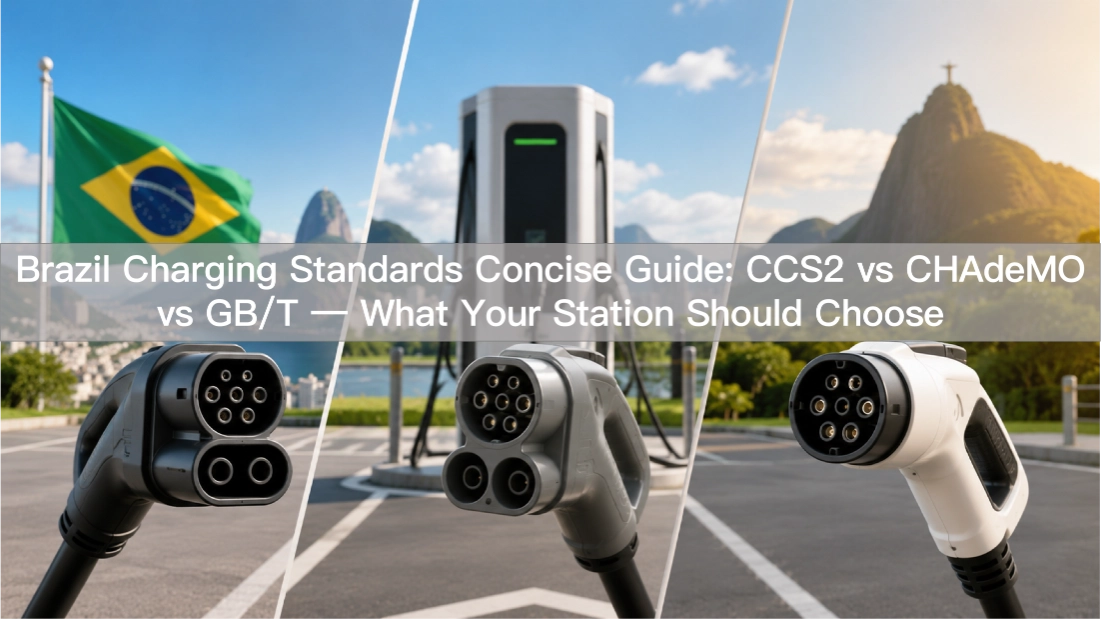
This guide covers the three DC fast-charging standards present in Brazil, which one is winning, and how to build a station that stays relevant through 2035.
2. The Three Standards at a Glance
| Standard | Origin | Max Power | Primary Vehicles in Brazil | Status in 2026 |
| CCS2 | Europe | 350 kW | All new European, American, and Korean EVs; majority of new Chinese EVs sold in Brazil | De facto standard for all new DC deployments |
| CHAdeMO | Japan | 62.5 kW (original); 400 kW (CHAdeMO 3.0 / ChaoJi, rare) | Nissan Leaf (pre-2025), older Mitsubishi Outlander PHEV, some legacy Japanese imports | Declining — being phased out of new installations |
| GB/T | China | 250 kW (DC GB/T 2020 | BYD electric buses, some Chinese commercial fleet vehicles | Commercial fleet only — not relevant for public passenger charging |
2.1 A Note on AC: Type 2
For AC charging, Brazil has effectively standardized on **Type 2 (Mennekes)** — the same connector used in Europe. Nearly every new EV sold in Brazil since 2022 uses Type 2 for AC charging. If you’re deploying AC chargers (7–22 kW) for destination charging at malls, hotels, or office buildings, Type 2 is the only sensible choice. This guide focuses on DC fast charging, where the connector decision has higher stakes.
2. CCS2: The Winner, and Here’s Why
CCS2 is not winning by accident. It’s winning because every global automaker selling EVs in Brazil — Volkswagen, BMW, Mercedes, Volvo, Hyundai, Kia, BYD, GWM, GAC — ships vehicles with CCS2 inlets for the Brazilian market.
The math is straightforward:
• BYD alone commands **59% of Brazil’s EV market** (2025). Every BYD passenger EV sold in Brazil — Dolphin, Yuan Plus, Seal, Song — uses CCS2 for DC fast charging.
• The Brazilian branch of the 3rd National Electric Mobility Yearbook projects the public charging network to continue expanding on CCS2.
• ABB, the Graal Group, and Raizen (in partnership with BYD) are building the country’s highway charging corridors — all CCS2.
2.1 If You Deploy CCS2 Today
• You can serve **every new EV sold in Brazil in 2026**, plus the vast majority sold since 2022.
• Your station is compatible with the national charging corridors being built now.
• You have a competitive supply base — CCS2 DC charger manufacturers exist across China, Europe, and North America.
2.2 The One Thing to Verify
“CCS2” on a spec sheet is necessary but not sufficient. Two CCS2 chargers can behave very differently:
What communication protocol runs on the CCS2 connector? CCS2 is the physical connector. The digital communication between charger and vehicle runs on ISO 15118 or DIN 70121. Most current vehicles use DIN 70121 (basic DC charging). ISO 15118 adds Plug & Charge capability — the vehicle authenticates automatically, no app or RFID card needed. Ask your supplier: “Does your charger support ISO 15118 Plug & Charge, or only DIN 70121?”** — and be clear about which your station strategy requires.
What charging voltages does it support? Some CCS2 chargers max out at 500V DC output. Newer 800V-platform vehicles (Hyundai Ioniq 5/6, Kia EV6, Porsche Taycan) need chargers that can deliver 920V+. If your station serves highway corridors where premium EVs travel, specify **200–1000V DC output range.
3. CHAdeMO: Handle With Care
CHAdeMO is not dead. It’s on a long, slow decline that will last another 5–8 years — and that creates a specific, calculable business decision for CPOs.
3.1 The Case for Including One CHAdeMO Gun
If your station is in a metropolitan area with a known concentration of older Nissan Leafs or Mitsubishi Outlander PHEVs, a single CHAdeMO connector might earn its keep for 3–5 years. The logic is purely marginal: if 5–8% of the EVs in your catchment area still use CHAdeMO, and deploying one CHAdeMO gun costs you less than the revenue those vehicles generate, it’s a net positive.
• No new vehicles sold in Brazil use CHAdeMO. Nissan switched the Leaf to CCS2 in 2025. Mitsubishi is phasing out the Outlander PHEV. Every CHAdeMO vehicle on Brazilian roads is already at least 2 years old and aging out.
• CHAdeMO stations globally are being converted to CCS2 or decommissioned. CHAdeMO Association infrastructure: ~18,000 points worldwide in 2024. CCS2: hundreds of thousands and growing.
• The UK’s £950 million Rapid Charging Fund explicitly excluded CHAdeMO from funding eligibility, designating CCS as “the primary standard for public rapid charging.” Brazil doesn’t have a similar policy yet, but the market direction is unmistakable.
3.2 The Practical Recommendation
For a new station being planned today:
• If 6+ guns: Consider one dual-gun charger with CCS2 + CHAdeMO on one unit. The marginal cost is low. When CHAdeMO demand drops below breakeven, you still have a functioning CCS2 gun on that charger.
• If 4 guns or fewer: Go all CCS2. The opportunity cost of dedicating one of four guns to a declining standard exceeds the revenue it captures.
• Fleet depots: If your station serves known fleet vehicles with CHAdeMO inlets, the calculation changes — deploy what your fleet uses. But for public-access stations, follow the market.
4. GB/T: Not Your Problem (Unless You’re BYD’s Fleet Partner)
GB/T DC is China’s national DC fast-charging standard. In Brazil, it appears on Chinese-manufactured commercial vehicles — primarily BYD electric buses and some heavy-duty electric trucks.
For a public passenger charging station: zero GB/T guns. No passenger EV sold in Brazil uses GB/T for DC charging.
For a fleet depot serving BYD buses or Chinese electric trucks: deploy GB/T DC chargers that match the fleet’s inlet configuration. This is a captive-fleet decision, not a public-charging decision. The rest of this guide does not apply.
5. Beyond the Connector: The OCPP Decision
Choosing the right connector matters. Choosing the right communication protocol matters more — because it determines whether you can switch management software, integrate with roaming platforms, and avoid vendor lock-in.
5.1 What OCPP Does
OCPP (Open Charge Point Protocol) is the language your charger speaks to your management platform. Without it, your charger can only talk to the manufacturer’s own software. If you ever want to switch to a different platform — because it’s cheaper, has better analytics, or integrates with your fleet management system — a charger without proper OCPP support becomes a brick.
5.2 What to Require in Brazil
At minimum: OCPP 1.6J with Smart Charging + Firmware Management + Local Auth List profiles.
Why these three:
• Smart Charging (TxProfile): Brazil’s grid constraints — particularly outside major urban centers — mean you will need to dynamically adjust charging power across multiple chargers to stay within your connection limit. Smart Charging does this automatically.
• Firmware Management: Remote firmware updates. Without this, every vehicle compatibility update requires a technician with a laptop.
• Local Auth List: If the internet drops — and on Brazilian highways, it will — the charger must still authorize drivers and start sessions. Local Auth List stores approved driver credentials on the charger itself.
5.3 OCPP 2.0.1: Wait — But Prepare
OCPP 2.0.1 adds ISO 15118 Plug & Charge support, improved security, and better diagnostics. It is the future. But as of 2026, most Brazilian CSMS platforms still run on 1.6J. Deploying 2.0.1 hardware doesn’t hurt — it’s backward compatible — but don’t pay a premium for it unless your CSMS specifically requires 2.0.1 features.
6. The Station Configuration Matrix
Here is the recommended connector mix for three common Brazilian station scenarios:
Scenario A: Urban Public Charging — Shopping Mall / Supermarket / Parking Garage
| Connector | Guns | Rationale |
| CCS2 DC (60–180kW) | 2–4 | Core capacity. Serves all modern EVs |
| Type 2 AC (22kW) | 2–4 | For destination charging during 1–2 hour visits |
| CHAdeMO | 0 | Not needed. Urban Leaf owners charge at home or at dedicated CHAdeMO stations |
Scenario B: Highway Corridor — Service Station / Rest Stop
| Connector | Guns | Rationale |
| CCS2 DC (180–240kW) | 4–6 | High-power, high-throughput. Drivers need 20–40 minute sessions |
| CCS2 DC (60–120kW) | 2 | Backup capacity. Also serves vehicles that can’t accept >120kW |
| CHAdeMO | 1 | Captures legacy vehicles on long-distance routes. One is enough |
Scenario C: Fleet Depot — Delivery Vans / Ride-Hailing / Company Cars
| Connector | Guns | Rationale |
| CCS2 DC (60–120kW) | As many as fleet size requires | Fleet vehicles are increasingly CCS2. BYD, GWM, and JAC fleets all use CCS2 |
| Type 2 AC (22kW) | 1 per overnight bay | For overnight charging where speed doesn’t matter. |
| CHAdeMO / GB/T | Only if the fleet has those vehicles | Do not deploy for “future compatibility” — deploy only for known vehicles |
6. Three Mistakes Brazilian CPOs Make When Buying Hardware
6.1 Mistake 1: Buying the Cheapest CCS2 Charger Without Checking the CCS2 Implementation
CCS2 is the connector. Inside the charger, the communication stack matters equally. A charger that implements only the minimum DIN 70121 handshake will charge cars. It will not support Plug & Charge, vehicle-to-grid (V2G), or advanced diagnostics. When those features become table stakes in 2028, your charger is already obsolete.
The fix: Ask for the CCS2 implementation spec sheet, not just “CCS2 compatible” on the brochure.
6.2 Mistake 2: Ignoring Input Voltage Tolerance
Brazil’s grid is not uniform. A charger spec’d for European grid stability (±10% voltage) will trip protection circuits on Brazilian feeders — particularly during peak demand hours when voltage sags are common. Every trip is a session interruption. Every session interruption is a driver who leaves.
The fix: Specify ±15% input voltage tolerance minimum. Test with the supplier: “Show me the charger’s behavior at 187V AC input.” If they can’t produce that data, they haven’t tested for Brazil.
6.3Mistake 3: Deploying CHAdeMO Because “A Competitor Has One”
A competitor’s station with a CHAdeMO gun might serve 2–3 sessions per week. On paper, the revenue covers the marginal hardware cost. In practice, those 2–3 sessions keep a gun occupied that could be serving CCS2 vehicles — and the station appears “full” on apps, sending CCS2 drivers elsewhere.
The fix: Calculate CHAdeMO utilization separately from your CCS2 guns. If a CHAdeMO gun falls below 5% utilization over a quarter, decommission it and convert the bay to CCS2. Don’t let a legacy connector cannibalize your primary revenue stream.
The Bottom Line
Brazil’s DC fast-charging standard is CCS2. The transition is already underway, and betting against it is betting that every global automaker will reverse their Brazilian product strategy.
Deploy CCS2 as your primary DC connector. Add one CHAdeMO only if your specific catchment area data justifies it. Ignore GB/T unless you operate a Chinese electric bus depot. Require OCPP 1.6J with at least Smart Charging, Firmware Management, and Local Auth List profiles. And always — always — verify the CCS2 implementation details, not just the connector label.
Anari Energy manufactures CCS2-native DC fast chargers (60–480kW) with OCPP 1.6J Smart Charging + Firmware Management + Local Auth List as standard. We support DIN 70121 and ISO 15118 (Plug & Charge ready). Input voltage tolerance: ±15%. Output voltage range: 200–1000V DC. Multi-gun configurations available, including CCS2 + CHAdeMO dual-gun options for stations that need legacy coverage.