



1. The Scale Challenge: Why Depot Charging Is Different
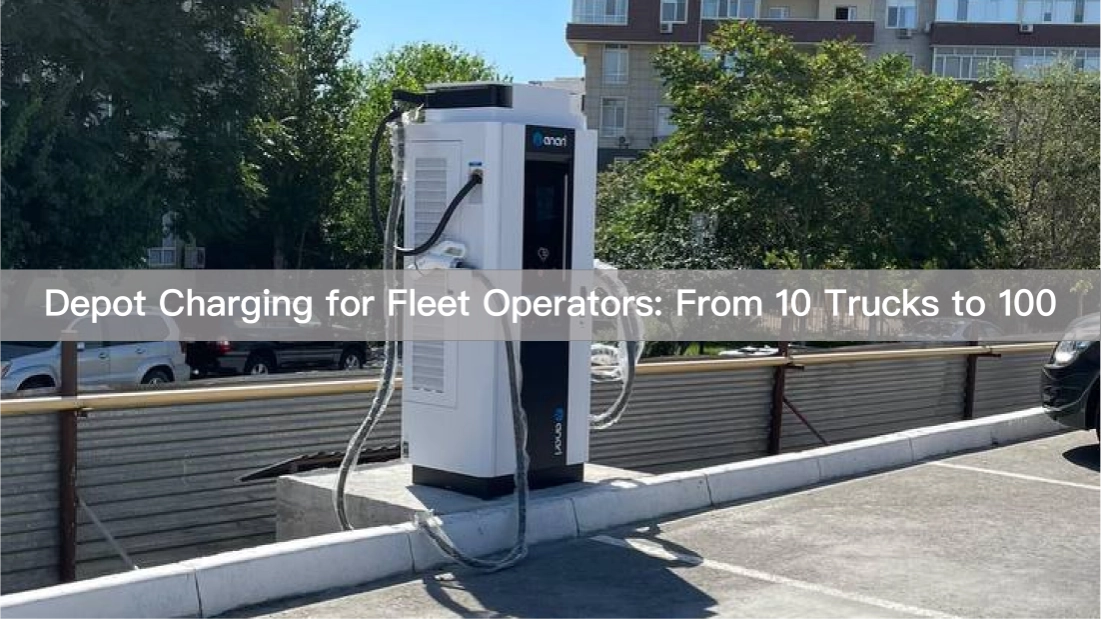
A logistics company in Turkey operates 12 electric delivery vans charging overnight at their warehouse depot. Expansion to 30 vehicles seemed straightforward-just add more chargers. But the existing 200kVA transformer couldn’t handle 30x 22kW AC chargers simultaneously. The utility demanded a $45,000 transformer upgrade. Even with the upgrade, charging 30 vehicles from empty to full overnight required 660kWh-more than the depot’s historical consumption pattern justified.
Scaling from 10 to 100 fleet vehicles isn’t linear. It requires rethinking infrastructure, charging strategies, and operational workflows. The depots that succeed treat charging as a system optimization problem-not just a hardware procurement exercise.
This guide examines depot charging design for fleet operators scaling from small operations (10-20 vehicles) through medium (20-50) to large (50-100+) fleets.
2. Understanding Fleet Charging Profiles
Unlike public fast charging with unpredictable arrival patterns, depot charging benefits from known variables:
Predictable return times. Fleet vehicles return to depot at consistent hours, creating defined charging windows.
Known state of charge. Dispatch systems track remaining range, enabling accurate charging session planning.
Fixed parking positions. Vehicles occupy designated spots, simplifying cable management and load balancing.
Controlled environment. Depots offer sheltered parking, reducing weather impacts on charging performance.
These advantages enable optimization strategies impossible at public stations.
3. Designing for 10-20 Vehicles: The Foundation Phase
Infrastructure requirements:
– Transformer: 100-200kVA (depending on vehicle count and charger power)
– Chargers: 10-20x 22kW AC or 2-4x 50kW DC (for larger vehicles)
– Total installed power: 220-440kW AC or 100-200kW DC
– Estimated nightly energy: 300-600kWh
Key design considerations:
Charger placement. Position chargers to minimize cable runs while ensuring all parking spots accessible. Overhead cable management systems reduce tripping hazards and cable damage.
Load management. Even at 10-20 vehicles, smart charging prevents transformer overload. Set maximum simultaneous charging power below transformer capacity.
Monitoring integration. Connect chargers to fleet management platform for real-time status, charging progress, and anomaly detection.
Future expansion planning. Design electrical infrastructure with 50% headroom for future growth. Conduit and tray space for additional circuits matters more than immediate transformer capacity.
Cost estimate: $80,000-150,000 for chargers, installation, and basic load management. Transformer upgrade (if needed): $20,000-50,000.
4. Scaling to 20-50 Vehicles: The Complexity Phase
At 20-50 vehicles, depot charging becomes a genuine engineering challenge. Random overnight charging can create 500-1,000kW peaks that overwhelm infrastructure.
Critical design elements:
Phased transformer upgrade. Instead of one massive upgrade, sequence capacity increases aligned with fleet growth. Install switchgear with spare bays for future transformers.
Dynamic load management. Implement systems that allocate power based on vehicle priorities, SOC requirements, and time constraints. A 50-vehicle depot might have 800kW available but only needs 600kW allocated due to staggered charging needs.
Schedule optimization. Analyze vehicle return patterns and charge sequences. Vehicles returning early can charge at higher power; late-returning vehicles may need prioritized charging to meet morning departure requirements.
Solar integration opportunity. Depot rooftops often provide 200-500kWp solar capacity. Daytime solar generation offsets charging costs and reduces grid dependency.
Battery storage option. For depots with high demand charges or grid constraints, 200-500kWh storage systems smooth charging peaks and enable off-peak charging window utilization.
Case study: Romanian bus depot
Fleet: 35 electric buses
Nightly requirement: 875kWh (25kWh/km × 35 buses × 100km daily)
Infrastructure: 500kVA transformer with 400kW dynamic load management
Strategy:
– Buses 1-20 charge 22:00-04:00 at 8kW each (160kW peak)
– Buses 21-35 charge 00:00-06:00 at 5kW each (75kW peak)
– Solar 150kWp covers daytime operations
– Battery 200kWh handles evening peak shaving
Result: Peak demand 235kW vs. 700kW unmanaged-67% reduction. Annual demand charge savings $42,000. Total system TCO $185,000 vs. $267,000 without optimization.
5. Scaling to 50-100+ Vehicles: The Enterprise Phase
Large depots require enterprise-grade solutions:
Infrastructure scale:
– Multiple transformers (1,000-2,500kVA total)
– 50-100+ charging positions
– Advanced load management with machine learning optimization
– Potential on-site generation (solar, fuel cell backup)
– Energy storage systems (500kWh-2MWh)
Operational considerations:
Zoning and segmentation. Divide depot into zones served by separate transformers. Enables maintenance without full shutdown and isolates faults.
Redundancy planning. N+1 transformer configuration ensures continued operation if one unit fails. Critical for operations where vehicle downtime equals revenue loss.
Predictive maintenance. Monitor charger health, transformer temperature, and cable conditions. Replace components before failure rather than reactive emergency repairs.
Integration depth. Connect charging system with dispatch, maintenance, and finance platforms. Automated workflows reduce administrative burden.
Utility relationship management. Large depots often qualify for custom tariffs, demand response programs, and grid services revenue. Engage utility early in planning.
6. The Economics: Total Cost of Ownership
Capital costs by fleet size:
| Fleet Size | Chargers | Transformer | Storage | Total CapEx |
| 10-20 | $40-80K | $20-50K | Optional | $60-130K |
| 20-50 | $100-200K | $50-120K | $50-150K | $200-470K |
| 50-100 | $250-500K | $150-400K | $150-500K | $550-1,400K |
Operating cost savings with optimization:
– Demand charge reduction: 40-60%
– Electricity cost reduction (off-peak charging): 20-30%
– Maintenance cost reduction (predictive): 15-25%
– Total OPEX savings: 25-40%
ROI timeline:
– Small depots (10-20 vehicles): 3-5 years
– Medium depots (20-50 vehicles): 4-6 years
– Large depots (50+ vehicles): 5-7 years
Larger depots benefit from economies of scale and greater optimization potential, but also face more complex infrastructure and operational challenges.
7. Common Pitfalls to Avoid
Pitfall 1: Undersizing for growth. Installing exactly enough capacity for current fleet without headroom forces expensive emergency upgrades when expansion accelerates.
Pitfall 2: Ignoring seasonal variation. Summer cooling loads and winter heating affect depot power budgets. Design for worst-case combined loads.
Pitfall 3: Overlooking cable management. Poor cable routing creates maintenance nightmares and safety hazards. Invest in proper overhead systems or underground conduits.
Pitfall 4: Single-vendor lock-in. Proprietary charging systems create dependency. Standardize on OCPP-compatible equipment for flexibility.
Pitfall 5: Neglecting driver feedback. Operators know which charging patterns work and which create frustration. Regular feedback loops improve system design.
8. The Anari Turnkey Approach
Anari’s Turnkey deployment for fleet depots includes:
– Site assessment. Electrical infrastructure evaluation and expansion planning
– Charger selection. Matching power levels and connector types to fleet requirements
– Load management design. Dynamic allocation algorithms optimized for depot operations
– Installation coordination. Project management from permit to commissioning
– Platform integration. ANARI OS connection with existing fleet management systems
– Training and support. Operational handover and ongoing technical assistance
For depots scaling from 10 to 100 vehicles, Anari provides phased deployment支持-starting with core infrastructure and adding capacity as fleet grows.
9. Conclusion
Depot charging evolution from 10 to 100 vehicles represents a journey from simple plug-in operations to sophisticated energy management systems. The depots that succeed treat charging infrastructure as strategic asset requiring careful planning, scalable design, and continuous optimization.
Start with solid fundamentals-adequate transformer capacity, smart load management, and proper cable management. Scale deliberately, learning from each phase. And never lose sight of the ultimate goal: keeping fleet vehicles charged, reliable, and ready for their routes.
The difference between a depot that struggles with charging and one that optimizes it often determines whether electric fleet transition succeeds or stalls.