



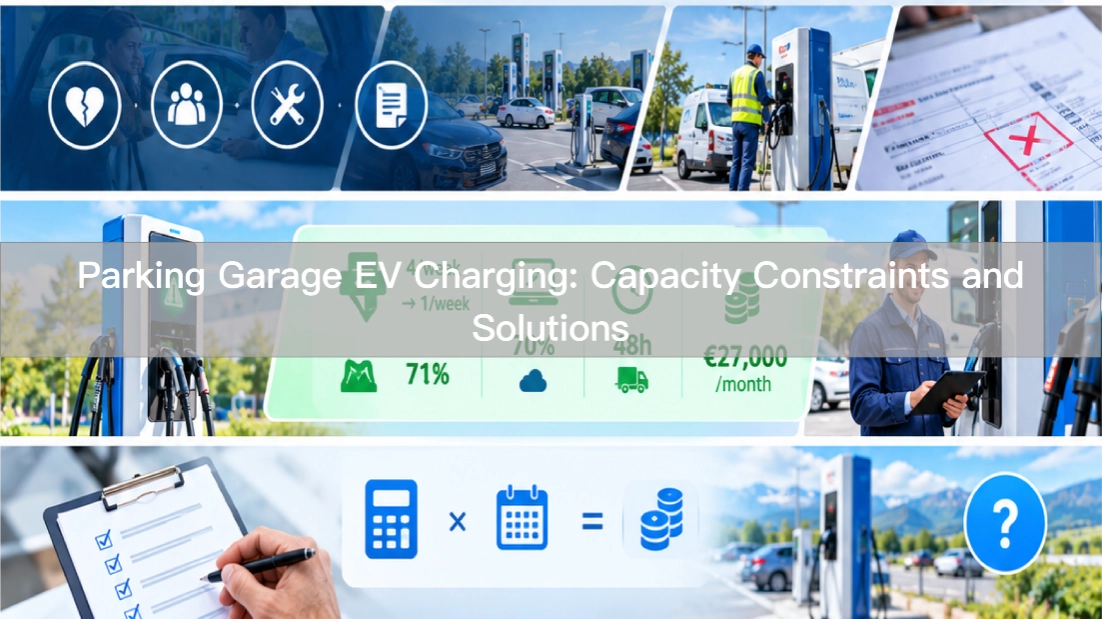
1. The Parking Garage Paradox
A shopping mall in Istanbul added 20 EV chargers to its underground parking garage. Within three months, the building’s main transformer tripped repeatedly during peak shopping hours. The mall had invested heavily in EV infrastructure marketing, but the electrical system couldn’t support the load. Solution? Partial charger shutdown during peak hours-undermining the very value proposition they’d marketed.
Parking garages present unique EV charging challenges that differ significantly from surface lots or standalone stations:
– Limited electrical capacity. Existing buildings rarely have surplus capacity for 50-200kW charging loads
– Complex ownership structures. Condominiums, multiple tenants, and shared facilities complicate decision-making
– Cable routing constraints. Multiple floors, structural columns, and fire codes limit charging cable paths
– Ventilation requirements. Battery charging generates heat; garages need adequate ventilation
– User experience expectations. Garage users expect reliable, convenient charging-failures damage reputation quickly
This guide examines capacity constraints and practical solutions for parking garage EV charging deployment.
2. Understanding the Capacity Challenge
Typical parking garage electrical profiles:
| Building Type | Original Design Load | Available Headroom | EV Charging Potential |
| Office (1990s) | 10-15 W/sq ft | 10-20% | Limited |
| Retail (2000s) | 15-20 W/sq ft | 15-30% | Moderate |
| Mixed-use (2010s) | 20-25 W/sq ft | 20-40% | Good |
| New construction | Designed for EV | 50%+ | Excellent |
Older buildings built before EV expectations have minimal headroom. A 1990s office building designed for 500kW total load with 450kW currently used has only 50kW spare-enough for perhaps 2-3 Level 2 chargers, not the 20+ owners expect.
The math that matters: Each 7.2kW Level 2 charger draws approximately 30A at 240V. Ten chargers simultaneously active consume 72kW-equivalent to 20-30 conventional parking spaces in electrical load. Multiply by 20 chargers and you’re looking at 144kW additional demand, often exceeding available capacity.
Solution 1: Load Management and Smart Charging
The most effective capacity solution is intelligent power allocation rather than infrastructure expansion:
Dynamic load balancing. Smart systems monitor total available capacity and distribute power across connected chargers. If 20 chargers are available but only 100kW capacity exists, the system might allocate 5kW per charger-sufficient for overnight charging without overloading the building.
Time-based scheduling. Pre-program charging windows during low-demand periods. Overnight (22:00-06:00) typically offers lowest building loads and utility rates.
Priority queuing. For shared parking, prioritize long-stay vehicles (residents, employees) over short-term visitors who might occupy spots while trickle-charging.
Real-world example: A Singapore office tower with 80 underground parking spaces installed 16 EV chargers with smart load management. Original capacity: 120kW building load, 20kW EV allowance. System allocates maximum 40kW to charging-2.5kW per active charger during peak building hours, ramping to 5kW during off-peak. Result: 16 chargers serve 80 spaces without transformer upgrade.
Solution 2: Phased Infrastructure Expansion
When load management alone insufficient, plan systematic capacity expansion:
Phase 1: Audit and plan. Engage electrical engineer to assess existing infrastructure, identify upgrade points, and develop expansion roadmap.
Phase 2: Sub-panel installation. Install dedicated EV charging sub-panels fed from main distribution. This isolates charging load and enables independent monitoring.
Phase 3: Transformer upgrade. If main transformer saturated, plan replacement or addition. Cost: $30,000-100,000 depending on size and accessibility.
Phase 4: Circuit expansion. Run new circuits from sub-panels to parking spaces. Use conduit pathways designed during initial construction.
Cost-benefit analysis: Transformer upgrade ($60,000) + panel installation ($20,000) + circuit running ($30,000) = $110,000 total. Enable 30x 7.2kW chargers. At $0.15/kWh margin and 30% utilization, generates $4,750/month revenue-payback in 19 months.
Solution 3: Alternative Power Sources
When grid extension impossible or prohibitively expensive:
On-site solar + storage. Rooftop solar (50-200kWp) with battery storage (100-500kWh) creates semi-independent charging ecosystem. Reduces grid dependency and demand charges.
Generator backup. Diesel or natural gas generators provide peak shaving capacity. Useful for events or grid reliability issues-but operating costs typically exceed grid electricity.
Vehicle-to-building (V2B). Emerging technology allowing EVs to discharge back to building during peak demand. Still experimental for parking garage applications but promising for future deployments.
Solution 4: Design for New Construction
New parking structures offer ideal EV charging integration:
Conduit provision. Install empty conduits to every parking space during construction-minimal cost now, enormous value later.
Room for expansion. Design electrical rooms with 50% spare capacity for future transformer and switchgear additions.
Standardized layouts. Uniform parking space dimensions and electrical layouts simplify future charger installation.
Smart infrastructure first. Install load management systems and monitoring infrastructure even before chargers deployed-technology readiness enables rapid deployment when demand materializes.
Building code compliance. Many markets now require EV-ready construction. California, Netherlands, and Norway mandate EV infrastructure in new buildings. Design to exceed minimum requirements for future-proofing.
3. The Financial Model: ROI Calculation
Revenue assumptions:
– Charging margin: $0.15-0.25/kWh
– Utilization: 20-40% for garage chargers (lower than highway fast charging)
– Session length: 2-4 hours (longer dwell vs. fast charging)
Cost structure:
– Hardware: $800-2,000 per Level 2 charger
– Installation: $1,500-5,000 per charger (varies by distance from panel)
– Load management system: $5,000-20,000
– Electrical upgrades: $30,000-150,000 (if needed)
Break-even analysis:
– 10 chargers at $1,500 install each = $15,000 total
– 30% utilization, $0.20/kWh margin, 40kWh/session = $24/day revenue
– Annual revenue: $8,760
– Payback: 21 months (hardware only)
– With electrical upgrades ($50,000): payback extends to 57 months
Optimization levers:
– Higher utilization through marketing and member incentives
– Premium pricing for guaranteed parking spots
– Time-of-use rate optimization
– Demand charge reduction through load management
4. Operational Considerations
User communication. Clearly communicate charging policies-session limits, pricing, availability. Frustration from unexpected fees or occupied-but-not-charging vehicles damages system perception.
Maintenance access. Ensure chargers accessible for service without disrupting parking operations. Overhead cable management reduces trip hazards and cable damage.
Monitoring and support. Real-time monitoring detects faults quickly. Remote diagnostics enable resolution without site visits for software issues.
Insurance and liability. Verify insurance coverage for EV charging operations. Some policies exclude electric vehicle incidents-confirm coverage before deployment.
5. The Future: Beyond Capacity Constraints
Emerging technologies and trends address parking garage charging limitations:
Wireless charging. Inductive charging pads eliminate cable management issues. Still expensive ($10,000-20,000 per pad) but improving.
Automated parking systems. Robotic parking structures enable denser vehicle storage and centralized charging-solving both space and capacity challenges.
Grid services participation. Aggregated parking garage chargers can provide demand response and grid stabilization services, creating additional revenue streams.
Standardization. Industry push toward universal connector standards and OCPP compliance reduces integration complexity and cost.
6. Conclusion
Parking garage EV charging capacity constraints are real but solvable. Smart load management often eliminates need for expensive infrastructure upgrades. When upgrades necessary, phased approaches spread costs over time while delivering immediate value.
The operators who succeed treat garage charging as integrated building system-not bolt-on afterthought. Plan capacity, design for growth, and leverage technology to maximize limited resources.
In dense urban environments where parking garages dominate EV infrastructure deployment, thoughtful capacity management separates profitable operations from stranded assets.