The leading EV charging station manufacturer. We are commited to providing convenien,efficient,reliable, and customized charging solutions tomeet all your needs.
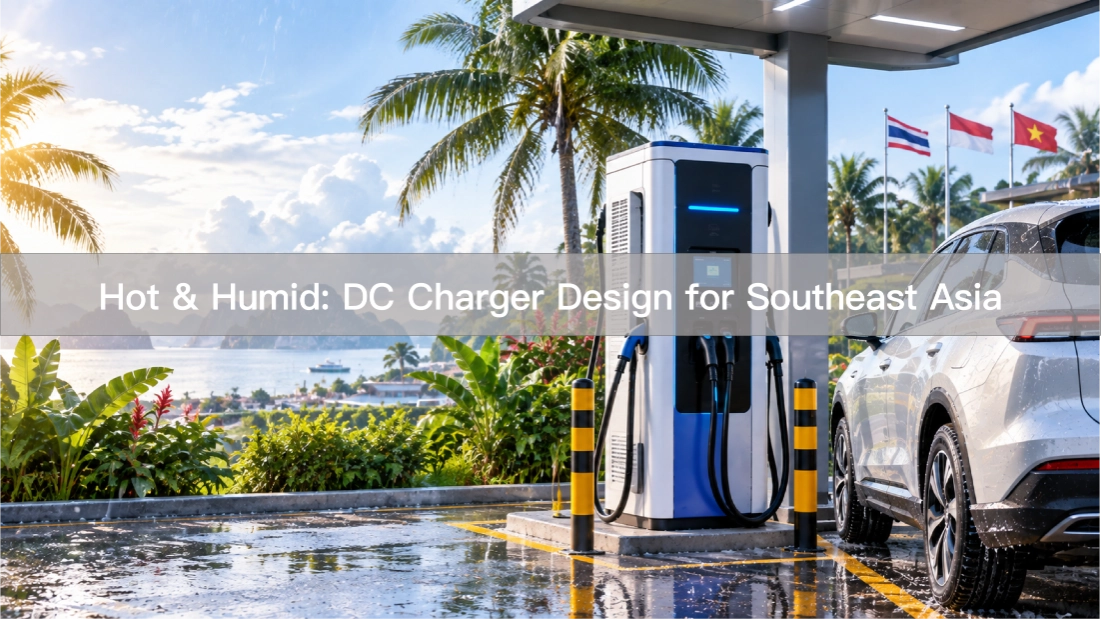
Southeast Asia’s tropical climate — high temperature, high humidity, monsoon rainfall — creates unique challenges for DC fast chargers. This guide explains which design features and certifications matter for reliable operation in Thailand, Indonesia, and Vietnam.
The Southeast Asian Climate Challenge
Southeast Asia presents a different thermal and humidity profile than the Middle East or Latin America. The region shares three climatic characteristics that affect EV charging infrastructure:
High ambient temperature year-round — Average temperatures range from 27℃ to 32℃ across Thailand, Indonesia, and Vietnam, with peak temperatures reaching 35–40℃ in urban areas. Unlike the Middle East, where extreme heat is seasonal, Southeast Asian heat is constant, meaning chargers operate at elevated temperatures throughout the year.
High relative humidity — Relative humidity frequently exceeds 80% in coastal and lowland areas. Humidity accelerates corrosion on electrical contacts, connectors, and internal circuitry. Conformal coating on PCBs and sealed connector interfaces become critical design factors.
Monsoon rainfall — Heavy rainfall during monsoon seasons creates temporary flooding risk and sustained moisture exposure. Chargers installed in open-air stations must withstand periodic water immersion and sustained high humidity without degradation.
These conditions differ from the Middle East’s dry heat and Latin America’s variable climate. Chargers engineered for Gulf or Andean conditions may not perform optimally in Southeast Asian environments without specific design adaptations.
Thailand: TIS Standards and EV Targets
Thailand has established the most structured EV charging regulatory framework in Southeast Asia, driven by its ambition to produce 650,000 electric motorcycles by 2030 and position itself as a regional EV manufacturing hub.
Thai Industrial Standards (TIS) for EV charging:
TIS 61851 Part 1-2567 (2024): Electric Vehicle Conductive Charging System – Part 1: General Requirements, aligned with IEC 61851-1 Edition 3.0
TIS 61851 Part 23-2567 (2024): Electric Vehicle Conductive Charging System – Part 23: DC Electric Vehicle Supply Equipment, aligned with IEC 61851-23 Edition 2.0
TIS 62752-2567 (2024): In-Cable Control and Protection Device (IC-CPD) for Mode 2 Charging, aligned with IEC 62752 Edition 2.0
Regulatory developments (2024–2025): Thailand published draft Ministerial Regulations mandating compliance with TIS standards for Mode 2, Mode 3, and Mode 4 charging equipment. The regulations reference IEC international standards, creating a pathway for internationally certified equipment to gain Thai market access through TIS conformity assessment.
Market incentives: Thailand offers tax exemptions and reductions for EV consumers and producers, import duty reductions on EV components, and excise tax waivers. Companies investing over 5 billion baht (approximately USD 140 million) locally are eligible for eight-year corporate tax exemptions. Battery manufacturers receive up to 90% tax exemption on raw material imports.
What this means for suppliers: Thailand’s TIS alignment with IEC standards creates a relatively straightforward certification pathway for internationally compliant equipment. Suppliers with IEC 61851-1 and IEC 61851-23 certification can typically obtain TIS recognition through conformity assessment procedures.
Indonesia: SNI Standards and Roaming Requirements
Indonesia has introduced national standards for EV charging through SNI (Standar Nasional Indonesia) certification, aligned with IEC standards.
Indonesian standards:
SNI 8872: EV charging equipment standards
SNI 8613:2018: Battery standards aligned with IEC 62660
SNI 8614-1:2018: Charging system standards
Minister of Energy and Mineral Resources Regulation No. 1 of 2023: This regulation governs the provision of electric charging infrastructure for battery-based electric motor vehicles. Article 14 requires each SPKLU (public EV charging station) operator to have an online application for recharging that is interoperable with other operators’ applications. The system must integrate with the single gateway managed by the Directorate General of the Ministry of Energy and Mineral Resources. Integration must be completed within one year of the regulation’s promulgation.
Roaming challenges: Currently, EV drivers in Indonesia can only access charging stations belonging to their registered operator. There is no agreed-upon roaming protocol among SPKLU operators. The government regulation requires interoperability, but implementation remains in progress.
What this means for suppliers: Indonesian SNI certification is required for market access. The interoperability requirement means chargers must support OCPP protocol with backend integration capabilities. Suppliers should verify that their OCPP implementation supports the messaging requirements for the national roaming gateway.
Vietnam: TCVN Standards and Import Regulations
Vietnam has developed national technical regulations for EV charging equipment through TCVN (Vietnamese National Standards) alignment with IEC standards.
Vietnamese standards:
TCVN 13078-1:2020: Electric vehicle conductive charging system – Part 1: General requirements, aligned with IUC 61851-1:2017
QCVN 91:2019/BCT: National technical regulation on EV charging equipment safety requirements
QCVN 90:2019/BTNMT: Environmental requirements for EV charging equipment
Draft national technical regulation (2025): Vietnam notified a draft national technical regulation on EV conductive supply equipment to the WTO, with a proposed adoption date of April 28, 2025, and entry into force of June 15, 2025. The regulation covers safety requirements for EV charging equipment with rated supply voltage up to 1,000V AC or 1,500V DC.
HS code classification: EV charging posts are classified under HS code 85044090, as prescribed in Circular No. 31/2022/TTBTC.
What this means for suppliers: Vietnam’s regulatory framework is still evolving. The 2025 draft regulation indicates a move toward mandatory safety certification. Suppliers should monitor TCVN standard finalization and prepare for potential certification requirements.
Climate-Resistant Design Features
Southeast Asian operators should specify these design features when procuring DC fast chargers:
Corrosion-resistant materials:
Stainless steel or powder-coated aluminum enclosures
Gold-plated or nickel-plated electrical contacts
Conformal coating on all PCBs (IPC Class 3 recommended)
Sealants and gaskets rated for UV and ozone exposure
Thermal management:
Natural convection cooling preferred over forced air (eliminates fan failure mode)
If forced air is used, IP66-rated filters with easy access for cleaning
Power module derating curves published at 40°C and 45°C ambient
Operating temperature range: -10°C to +55°C (covers extreme conditions)
Moisture protection:
IP65 minimum rating; IP66 preferred for open-air installations
Drainage channels in enclosure design to prevent water accumulation
Humidity-resistant connector interfaces with sealed mating surfaces
Desiccant packs or breathable valves for enclosed spaces
Monsoon resilience:
Foundation design accounting for potential flooding (elevated mounting recommended)
Cable entry points sealed against water ingress from multiple directions
Ground fault protection with rapid response (<30ms) for wet conditions
Connector Standards in Southeast Asia
Country
Primary DC Connector
AC Connector
Notes
Thailand
CCS2
Type 2
TIS alignment with IEC 62196-2
Indonesia
CCS2
Type 2
SNI alignment with IEC standards
Vietnam
CCS2
Type 2
TCVN alignment with IEC standards
Regional consensus: CCS2 (Combo 2) is the dominant DC fast charging connector across Southeast Asia, aligned with European IEC 62196-2 standards. All three countries follow the same connector path, simplifying regional product strategies.
Procurement Checklist for Southeast Asia
Requirement
Thailand
Indonesia
Vietnam
Product certification
TIS conformity assessment
SNI certification
TCVN compliance (emerging)
Protocol standard
OCPP 1.6J or 2.0.1
OCPP 1.6J or 2.0.1 + roaming gateway integration
OCPP 1.6J or 2.0.1
Language localization
Thai or English
Indonesian
Vietnamese or English
Climate specification
IP66, 45°C+ operating range
IP66, humidity-resistant
IP65 minimum, monsoon-rated
Grid connection
DED approval required
Distribution company study
EVNC/EVN approval
Market Entry Strategy
Southeast Asia offers three distinct market entry paths:
Thailand (most straightforward): TIS alignment with IEC standards creates a clear certification pathway. Thailand’s established EV manufacturing ecosystem and incentive programs make it the region’s most attractive market for international suppliers.
Indonesia (medium complexity): SNI certification is required, and the roaming interoperability mandate adds backend integration complexity. Indonesia’s large population and growing EV adoption create significant volume opportunity.
Vietnam (emerging): Regulatory framework is still evolving. Early movers can establish relationships with Vietnamese distributors and prepare for impending certification requirements. Vietnam’s rapid EV adoption trajectory makes it a high-potential market.
Regional approach: A single CCS2-oriented product line with IP66 rating, 45°C+ thermal performance, and OCPP 2.0.1 native support can serve all three markets with minimal localization modifications. The key differentiator is language support and backend integration capabilities for Indonesia’s roaming requirements.
Data sources:
Thailand TIS standards publications;
Indonesian Minister of ESDM Regulation No. 1/2023;
Vietnam TCVN standards and WTO TBT notifications;
Energy Transition Partnership standards development reports. Regulatory information current as of September 2026.