



1. The Difference Between “Supports OCPP” and “OCPP 2.0.1 Certified
A supplier can claim “OCPP support” on a product page without implementing a single line of the protocol correctly. The open source specification is freely available. Anyone can read it. Implementing it faithfully requires engineering investment, test lab validation, and ongoing maintenance as the specification evolves.
“OCPP 2.0.1 certified” means something very different. It means the charger model has been tested against the official OCPP 2.0.1 conformance suite by an accredited laboratory and found to comply with the specification’s requirements for message exchange, security implementation, and profile support.
For a CPO, the distinction between these two claims is the difference between a charger that integrates with your management platform on the first attempt and a charger that requires months of custom integration work, third-party consultancy, and delayed revenue while technical teams resolve compatibility gaps.
2. OCPP 2.0.1 vs 1.6J: The Practical Differences
The gap between OCPP 1.6J and OCPP 2.0.1 is not merely version numbering. It represents fundamental architectural differences that affect how your charging infrastructure operates day to day.
Security architecture. OCPP 1.6J uses username and password authentication for communication between the charger and central system. This is vulnerable to credential theft, man-in-the-middle attacks, and unauthorized access. OCPP 2.0.1 introduces certificate-based authentication using X.509 certificates, which is significantly more secure and aligns with emerging cybersecurity requirements in the EU. Chargers limited to 1.6J authentication cannot meet these standards.
Smart charging capabilities. OCPP 1.6J includes a Smart Charging profile, but its implementation is limited and inconsistent across manufacturers. OCPP 2.0.1 expands smart charging significantly, including detailed charging schedule exchange, real-time power negotiation between the central system and multiple vehicles simultaneously, and dynamic load management that adjusts power allocation based on grid conditions, energy prices, or station demand patterns. These capabilities are foundational for operators who want to participate in demand response programs or optimize charging costs across multiple vehicles at a site.
Data model sophistication. OCPP 2.0.1 introduces a more granular data model for transaction information, event reporting, and meter value collection. This enables more precise billing, better operational analytics, and more accurate detection of charging anomalies. The earlier protocol’s data model was adequate for basic transaction tracking but lacked the detail needed for sophisticated fleet management and cost allocation.
Vehicle-to-grid readiness. While OCPP 2.0.1 does not fully specify V2G messaging — that requirement belongs to ISO 15118-20 — it provides the communication framework that V2G operations will build upon. The protocol includes message types for bidirectional power negotiation and the data structures necessary for V2G session management. Chargers limited to OCPP 1.6J lack this foundation entirely and cannot be upgraded to support V2G without significant hardware modifications.
Diagnostic depth. OCPP 2.0.1 includes enhanced diagnostic capabilities, allowing operators to query detailed charger health status, request specific diagnostic reports, and receive more granular fault notifications. This reduces the time between fault detection and resolution, which is directly correlated with uptime improvement.
3. The Regulatory Driver: Why This Matters Now
OCPP 1.6J has served the industry well. It is widely implemented, broadly supported, and sufficient for basic charging operations. But it was designed for a simpler ecosystem. It lacks native support for several capabilities that are becoming standard requirements:
Certificate-based security. OCPP 1.6J relies on username and password authentication for central system communication. OCPP 2.0.1 introduces certificate-based authentication, which is significantly more secure and required by evolving cybersecurity regulations in the EU. A charger that only supports 1.6J authentication cannot meet emerging security compliance standards.
Smart charging profiles. OCPP 1.6J includes a Smart Charging profile, but its implementation is limited. OCPP 2.0.1 expands smart charging capabilities significantly, including detailed charging schedule exchange, real-time power negotiation, and dynamic load management across multiple vehicles. These capabilities are foundational for demand response participation and renewable energy optimization.
Improved data model. OCPP 2.0.1 introduces a more sophisticated data model for transaction information, event reporting, and meter values. This enables more granular billing, better analytics, and more precise operational insights.
V2G communication foundation. While OCPP 2.0.1 does not fully specify V2G messaging — that requires ISO 15118-20 — it provides the communication framework that V2G operations will build upon. Chargers limited to 1.6J lack this foundation entirely.
4. The Regulatory Driver: AFIR and the 2026 Deadline
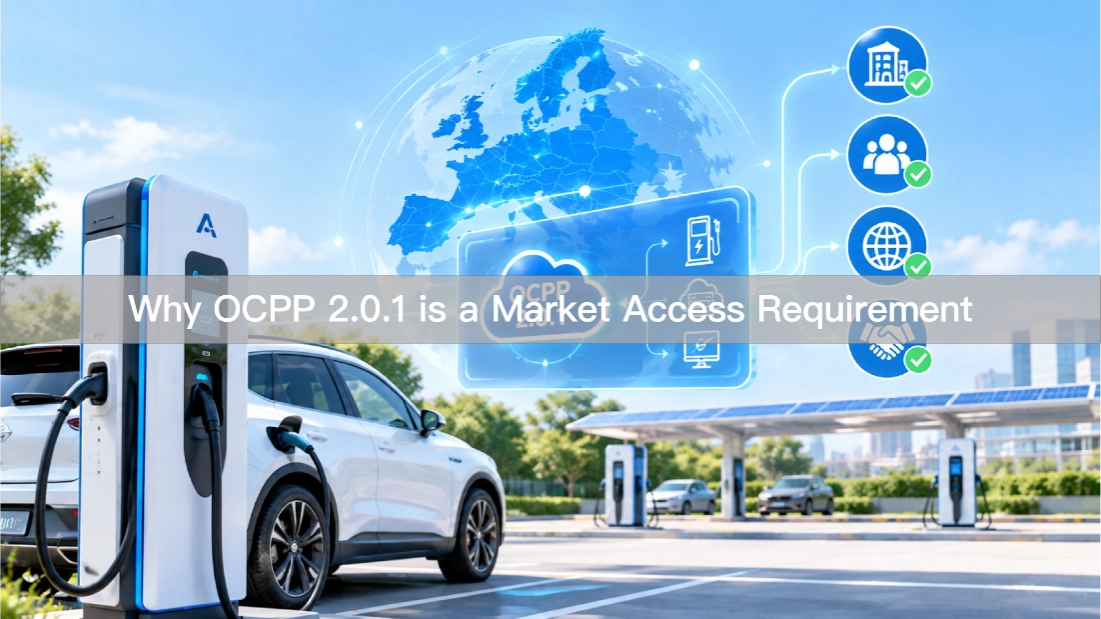
The EU’s Alternative Fuels Infrastructure Regulation (AFIR) mandates that all new publicly accessible charging points installed on TEN-T corridors by 2026 must support OCPP 2.0.1 or later. This is not a voluntary standard. It is a legal requirement with enforcement mechanisms.
CPOs deploying on these corridors must specify OCPP 2.0.1-certified hardware. Chargers certified only to 1.6J will not meet compliance requirements for new installations. The regulation does not grandfather existing deployments, but it does apply prospectively to all new charging points.
Even for deployments outside TEN-T corridors, OCPP 2.0.1 certification is becoming a de facto standard. Major CSMS platforms are updating their compatibility matrices to prioritize 2.0.1-certified chargers. Suppliers who have not invested in 2.0.1 certification will find their products excluded from the largest and fastest-growing segment of the European charging market.
5. The Lock-In Risk of Uncertified Implementation
A charger claiming OCPP 2.0.1 support without independent certification carries a specific risk: the implementation may be incomplete or non-compliant. The charger may pass basic connectivity tests but fail when integrated with diverse CSMS platforms or under real-world operational conditions.
The exit cost from a non-compliant implementation is high. Switching CSMS platforms is difficult enough with compliant hardware. Switching platforms with non-compliant hardware that has been partially integrated into your operations is exponentially more expensive. You may need to replace hardware, rewrite integrations, and absorb downtime during migration.
OCPP 2.0.1 certification eliminates this risk by providing third-party validation that the charger communicates correctly with any compliant central system. The certification is your insurance against vendor lock-in and integration failure.
6. The Procurement Decision
Specifying OCPP 2.0.1-certified hardware is no longer optional for CPOs planning European deployments. It is a compliance requirement with a narrowing implementation window. The limited certification pool means that procurement decisions made today will determine which suppliers you can work with for the foreseeable future.
Verify certification through accredited test laboratories. Confirm scope coverage for your specific models. Do not accept “OCPP 2.0.1 ready” or “OCPP 2.0.1 in development” as substitutes for active certification. The regulatory clock is ticking, and the certification gap is not closing fast enough for delay to be a rational strategy.
Data note: OCPP 2.0.1 certification count reflects publicly available records as of 2026. AFIR requirements cited from EU Regulation 2023/1804.