



1. What OCPP Is, and Why CPOs Must Care
OCPP (Open Charge Point Protocol) is the communication standard between charging stations and a Central System Management System (CSMS). It defines how a charger reports status to the platform, how it receives remote commands, how it handles payment authorization, and how it reports faults. In short: it determines whether your charging network is open or locked to a single supplier.
Two things every CPO must understand:
First, OCPP is an open standard. It is maintained by the Open Charge Alliance (OCA) and belongs to no single hardware manufacturer or software platform. An OCPP-compliant charger can communicate with any OCPP-compliant CSMS. This means you are not vendor-locked at the hardware level — if you want to switch platform providers in three years, or bring another manufacturer’s chargers into the same network, the migration cost is near zero as long as both sides support OCPP.
Second, OCPP is not OCPI. OCPI (Open Charge Point Interface) handles roaming and settlement between different charging networks — for example, an EV driver using Network A’s app to charge at a Network B station. OCPP handles communication between a charger and its own management platform. They solve different problems. This guide covers OCPP.
2. What OCPP 1.6 Achieved — and Where It Falls Short
OCPP 1.6 (released 2015, updated to 1.6J in 2017) is the most widely deployed charging protocol version worldwide. It fulfilled OCPP’s foundational mission: standardizing the basic workflows for charging session management, remote start/stop, data reporting, and firmware updates.
However, 1.6 has three structural limitations:
1. No standardized device data model. OCPP 1.6 does not define a uniform data model for charger variables. Each manufacturer represents “charging power,” “temperature sensor,” and “fault code” differently. When a CPO manages a multi-brand charging network, the same parameter may use entirely different field names, units, and value ranges across different charger brands. This makes unified monitoring and diagnostics difficult.
2. Security is optional, not mandatory. OCPP 1.6’s security specifications are optional add-ons. TLS encryption, certificate management, and secure firmware updates exist in 1.6 — but are not required. Many real-world deployments run on unencrypted WebSocket connections or use self-signed certificates. By 2026, this is no longer acceptable for an operational system handling payment data and user privacy information.
3. Smart charging support is thin. OCPP 1.6’s Smart Charging feature set can apply charging profiles (power limits, time windows), but it lacks native support for dynamic load management, renewable energy integration, and V2G bidirectional charging. These are not future use cases in 2026 — they are operational requirements being deployed at scale.
3. OCPP 2.0.1: Key Improvements From a CPO’s Perspective
OCPP 2.0.1 (released 2020, first certification testing completed 2023) is not an incremental update to OCPP 1.6. It is an architectural rewrite. Below are the five changes that matter most to CPOs.
3.1 Improvement 1: Device Model — A Unified Management Language
OCPP 2.0.1 introduces a standardized device model. All configurable parameters, monitoring variables, and diagnostic information on a charger are organized into a unified, hierarchical data structure. Each parameter has a standardized name, data type, value range, access permissions, and an indicator of whether changing it requires a reboot.
Practical impact for CPOs: in a multi-brand charging network, you can now read temperature, power output, fault codes, and firmware versions from all chargers using the same interface. The CSMS no longer needs to maintain a separate field-mapping table for each manufacturer. The larger your network, the more significant this advantage becomes.
3.2 Improvement 2: Security Architecture — TLS and Certificate Management Become Mandatory
OCPP 2.0.1 elevates the following security capabilities from optional to mandatory:
• TLS 1.2 (or higher) encryption: All communication between charger and CSMS must be encrypted. Plaintext WebSocket connections are no longer permitted.
• X.509 certificate management: 2.0.1 defines the full lifecycle management of charger certificates — installation, renewal, and revocation. This allows CPOs to establish certificate-based trust chains, preventing man-in-the-middle attacks and unauthorized access.
• Secure firmware updates: Firmware packages must be digitally signed, and the charger must verify the signature before installation. This prevents malicious firmware injection — a known attack surface in 1.6 deployments.
• Security log: Chargers record all security-relevant events (authentication failures, configuration changes, firmware operations), and the CSMS can actively collect and analyze these logs.
For charging networks that accept credit card payments or process user personal data, these security requirements are a compliance baseline, not an option.
3.3 Improvement 3: Smart Charging — From Static Limits to Dynamic Coordination
OCPP 1.6’s Smart Charging is essentially a static tool: you set a charging profile (power cap, time window), and the charger executes it. It has no awareness of dynamic grid conditions, on-site solar generation, or BESS charge/discharge states.
OCPP 2.0.1 introduces richer Smart Charging primitives:
• Composite Schedule: Chargers can report their planned power consumption across time periods, and the CSMS can adjust each charger’s schedule based on total site load.
• External Energy Management System integration: 2.0.1 natively supports interfaces with external EMS (Energy Management Systems), enabling charging stations to respond to price signals or grid dispatch commands.
• ISO 15118 integration: Supports smart charging communication with the vehicle — the vehicle can tell the charger its battery state, target SOC, and expected departure time, and the charger optimizes the charging curve accordingly.
Practical impact for CPOs: if your site has solar or storage, or your market uses time-of-use electricity pricing, 2.0.1’s smart charging capabilities translate directly into operating cost reduction. This is not a future feature — it is available on current hardware and requires only protocol-level support.
3.4 Improvement 4: Transaction Handling — More Reliable Billing
OCPP 2.0.1 redesigns the transaction processing flow and introduces a more precise billing event model. Key improvements include:
• Offline transaction support: When communication between charger and CSMS is interrupted, the charger can cache transaction data locally and upload it in bulk when the connection is restored. In regions with unstable network infrastructure, this directly impacts revenue integrity.
• Billing event granularity: 1.6 bills at the session level. 2.0.1 supports multiple billing segments within a single session — for example, one rate for the first 30 minutes, another rate thereafter. This enables more flexible pricing strategies.
• Tax and surcharge support: Transaction data can include tax breakdowns, simplifying multi-jurisdiction tax compliance.
3.5 Improvement 5: Display Messages and User Experience
OCPP 2.0.1 standardizes the message format for charger display screens. The CSMS can push structured messages — pricing information, charging progress, fault notifications — and the charger presents them to the user in a consistent format. For public charging networks, this improves UX consistency: regardless of which brand of charger the driver uses, the on-screen information follows the same format.
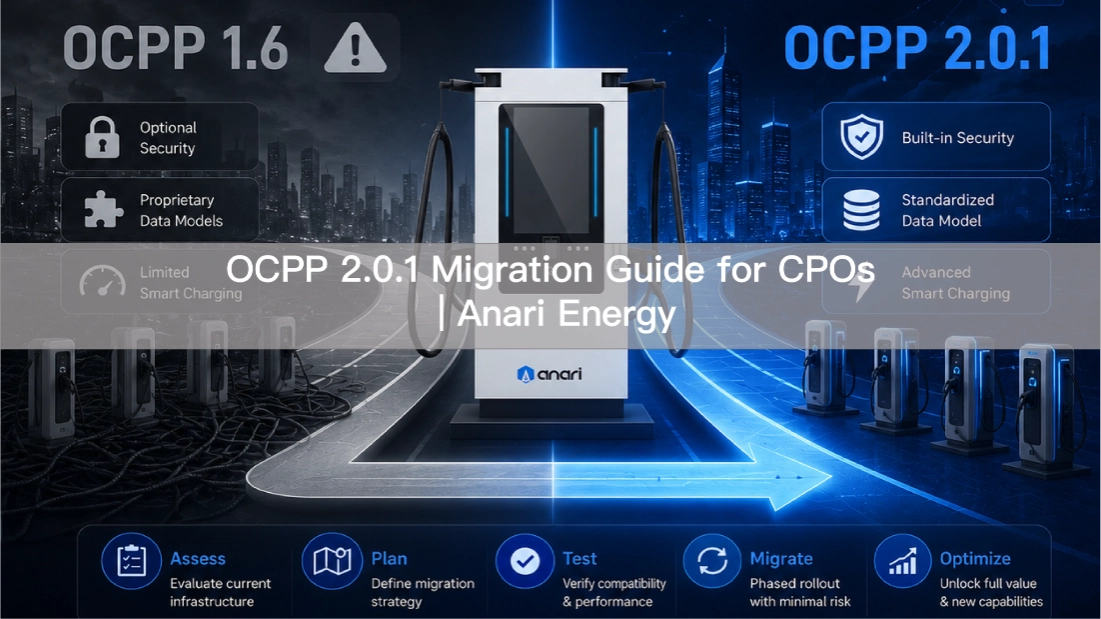
4. Migration Path: From 1.6 to 2.0.1
Migrating to OCPP 2.0.1 is not a “firmware upgrade.” It is a project involving hardware, platform, and operational processes. Below is the phased migration path.
4.1 Phase 1: Assessment (1–2 Weeks)
Step 1: Hardware compatibility audit. OCPP 2.0.1 has minimum hardware requirements. Older charger controllers may lack the processing power, memory, or TLS hardware acceleration needed to run the 2.0.1 protocol stack. Contact your charger manufacturer and confirm, for each model, whether it supports OCPP 2.0.1 — and to what extent (full 2.0.1 or partial feature subset).
Key information to obtain: processor model, available memory, TLS hardware support, and the upgrade path from the current firmware version.
Step 2: CSMS compatibility confirmation. Does your management platform support OCPP 2.0.1? If so, is it full support or a partial feature subset? Supporting 2.0.1 typically requires significant development work on the platform side — this is not a configuration toggle.
Step 3: Feature prioritization. Not all 2.0.1 features are equally important to your operation. If you run a public fast-charging network, security enhancements and transaction improvements may be the highest priority. If you run a fleet depot with on-site solar and storage, smart charging capabilities may come first. Define your priorities explicitly — do not attempt to enable everything at once.
4.2 Phase 2: Planning (2–4 Weeks)
Step 4: Choose a deployment strategy. Three strategies are available:
• Greenfield: Deploy OCPP 2.0.1 directly on new sites. This is the cleanest path and avoids future migration costs.
• Parallel Run: Select 1–2 existing sites as pilots. Migrate a subset of chargers to 2.0.1 while keeping the rest on 1.6. The CSMS must support both protocol versions simultaneously.
• Big Bang: Upgrade the entire network at once. Suitable only for small networks (<20 chargers), or where hardware and platform compatibility have been thoroughly validated.
Step 5: Develop a rollback plan. Every migration requires a validated rollback path. Before starting batch migration, verify the complete process of downgrading from 2.0.1 back to 1.6 on a single test charger. Rollback should be a planned step — not an emergency measure.
4.3 Phase 3: Execution (Duration Varies by Scale)
Step 6: Test environment validation. Complete the following tests in an isolated environment:
• 2.0.1 connection establishment and maintenance between charger and CSMS
• Complete charging session lifecycle (start/stop, billing, data reporting)
• TLS certificate installation, renewal, and expiry handling
• Security log reporting and analysis
• Fault simulation (communication loss, invalid certificate, firmware signature verification failure)
Step 7: Production pilot. Select a low-risk site — lower traffic, manageable fault impact — for the first migration batch. Monitor for at least two weeks and confirm that the following metrics match pre-migration baselines: charging success rate, billing accuracy, mean fault response time, user payment success rate.
Step 8: Staged rollout. After each batch migration, allow at least one week of observation before starting the next batch. Do not migrate more than 20% of your chargers in a single maintenance window — if issues arise, the blast radius remains controllable.
4.4 Phase 4: Validation and Optimization (Ongoing)
After migration, continuously monitor the following metrics against pre-migration baselines:
• Charging session success rate
• Communication interruption frequency and recovery time
• Security event count and type distribution
• Transaction data integrity and billing accuracy
• New feature adoption and effectiveness (e.g., peak load reduction from smart charging)
5. Common Mistakes and How to Avoid Them
The following are high-frequency errors observed in real migration projects.
Mistake 1: Ignoring hardware limitations. The most expensive error is assuming existing hardware can support OCPP 2.0.1, then discovering during migration that the controller is underpowered — chargers experience latency spikes during TLS handshakes, degrading user experience. Complete the hardware audit during the assessment phase to avoid this.
Mistake 2: Starting migration with incomplete platform support. Some CSMS vendors claim “OCPP 2.0.1 support” but have only implemented the core message set, missing advanced features like smart charging or security logging. Before migration, require your vendor to provide a feature-by-feature list of their OCPP 2.0.1 implementation — do not accept “we support it” as an answer. Demand specificity down to the message type.
Mistake 3: Skipping the test environment. Running migration tests on production-connected chargers is equivalent to experimenting in a live environment. Allocate dedicated hardware for testing — even a single charger — and validate the full process in an isolated network environment.
Mistake 4: Migrating the entire network simultaneously. Regardless of network size, staged migration with batch validation and rollback windows is the only safe path. The maximum migration scope within a single maintenance window is determined by your operations team’s response capacity in a fault scenario.
Mistake 5: Tracking only technical metrics, ignoring operational ones. Migration success is not defined as “the charger is communicating.” It is defined as “operational data matches or exceeds pre-migration baselines.” Billing accuracy, payment success rate, and user complaint volume must be part of the migration completion criteria — not just technical validation.
6. Security White Paper Summary
OCPP 2.0.1’s security architecture is built on the following principles:
Defense in Depth: Security does not rely on a single mechanism. TLS encryption protects the transport layer. Certificate management protects identity and authentication. Firmware signing protects code integrity. Security logging provides audit trails. The failure of any single layer should not collapse the overall security posture.
Least Privilege: Chargers are granted only the minimum permissions needed to perform their function. 2.0.1’s certificate and role management supports fine-grained access control — a read-only monitoring system should not have firmware update or configuration modification privileges.
Security Lifecycle Management: Certificates have expiry dates. Firmware signing keys can be rotated. Security logs are automatically purged after their retention period. Security is not a one-time configuration — it is a lifecycle process requiring ongoing operational attention.
What this means for CPOs in practice: Deploying OCPP 2.0.1 does not automatically make you secure. You need to configure TLS certificates, manage certificate lifecycles, monitor security logs, and handle certificate expiry and revocation events. 2.0.1 provides the security capabilities — converting those capabilities into an actual security posture remains the operator’s responsibility.
7. OCPP vs. Proprietary Protocols: The CPO’s Long-Term Risk
Some charger manufacturers still use proprietary communication protocols. These may offer specific differentiated features, but the long-term risk to the CPO is structural:
Vendor lock-in. A proprietary protocol means your charging network can only operate with a specific manufacturer’s specific platform. If you become dissatisfied with equipment performance, pricing, or service, the cost of switching suppliers equals rebuilding your entire network’s communication layer. The cost and timeline of such a migration typically exceeds any savings from the initial equipment purchase.
Security audit obstruction. The security properties of a proprietary protocol are opaque. Independent third-party security audits cannot verify the correctness of encryption implementation, the robustness of key management, or the security of firmware update mechanisms in an undisclosed protocol. You can only rely on the manufacturer’s self-declaration.
Interoperability loss. In the future, you may want to integrate new hardware suppliers or platform capabilities — for example, connecting your charging station to a virtual power plant’s dispatch system. If the underlying protocol is proprietary, every integration is a custom development project. If the underlying protocol is OCPP 2.0.1, integration is configuration work against a published standard.
The industry direction is clear. OCA’s certification program is driving OCPP 2.0.1 conformance testing. Major platform and hardware vendors have completed or are completing their 2.0.1 implementations. If you are making procurement decisions today, requiring OCPP 2.0.1 support is not future-proofing — it is the baseline for current technical evaluation.
8. CPO Action Checklist
If you are currently operating an OCPP 1.6 network:
1. Request OCPP 2.0.1 compatibility statements for each charger model from your hardware supplier (not marketing materials — technical specifications)
2. Request a feature-by-feature list of OCPP 2.0.1 support from your CSMS vendor
3. Identify 1–2 low-risk sites and develop a pilot migration plan
4. Include OCPP 2.0.1 support in the technical requirements for all new equipment procurement
If you are procuring new equipment and building new sites:
1. Explicitly require OCPP 2.0.1 support (full version, not a subset) in tender documents
2. Require suppliers to provide OCA certification or equivalent third-party conformance test reports
3. Require the CSMS to support both OCPP 1.6 and 2.0.1 — this preserves compatibility for future 1.6 equipment additions
4. Include full functional verification of the OCPP 2.0.1 message set in acceptance testing