


1. The $8,400-per-Day Problem
A 120kW DC fast charger in Southeast Asia generates approximately $8,400 in annual revenue per connector. When that charger goes offline for three days due to a power module fault, you lose roughly $690. That’s not just lost transaction fees-it’s lost customer trust, negative reviews, and the operational headache of dispatching a technician who may not have the right parts.
The industry average for charger uptime sits at 94-96%. For a fleet operator running 50 stations, that means roughly 4-6% of revenue evaporates annually to unplanned downtime. Anari’s deployment data across 22 countries shows that CPOs using OCPP 1.6J monitoring with remote diagnostics achieve 98%+ uptime-a 60% reduction in downtime-related revenue loss compared to manual monitoring approaches.
This isn’t about buying better hardware. It’s about building an operational system that catches problems before they become outages.
2. Why Most CPOs Miss Early Warning Signs
The typical charging station operator discovers a fault when a driver walks up to a dark screen. By then, the problem has escalated: a power module fault triggers thermal protection, which forces the entire station offline, which strands multiple drivers. The reactive workflow is expensive-emergency dispatch, parts shipping, lost revenue, and damaged reputation.
Remote monitoring through OCPP changes this pattern entirely. The protocol enables five critical capabilities that transform how operators manage their asset base.
3. The OCPP 1.6J Four-Profile Stack
Anari’s monitoring platform implements all four OCPP 1.6J profiles-Core, Smart Charging, Firmware Management, and Local Auth List. Each profile addresses a specific operational gap:
| Profile | Function | Downtime Impact |
| Core | Transaction management, heartbeat, status notification | Catches communication failures within seconds |
| Smart Charging | Power allocation, load balancing, pricing signals | Prevents grid overload trips and throttling |
| Firmware Management | Remote update scheduling, version tracking | Eliminates manual update visits; patches security holes overnight |
| Local Auth List | RFID/card validation, access control | Reduces fraud-related incidents by 40%+ |
The Core profile alone handles heartbeat messages every 30 seconds. If a charger misses three consecutive heartbeats, the system logs a communication fault and alerts the operations team. Within 90 seconds, the operator knows the station is offline-and can decide whether to attempt remote recovery before dispatching anyone.
4. The 7-Minute Response Framework
Anari’s N-Tech Agent implements a structured escalation workflow:
This framework reduces mean-time-to-resolution from an industry average of 4-6 hours to under 45 minutes for software-related issues, and under 4 hours for hardware replacements when parts are pre-positioned.
5. Case Study: 62% Downtime Reduction in Kenya
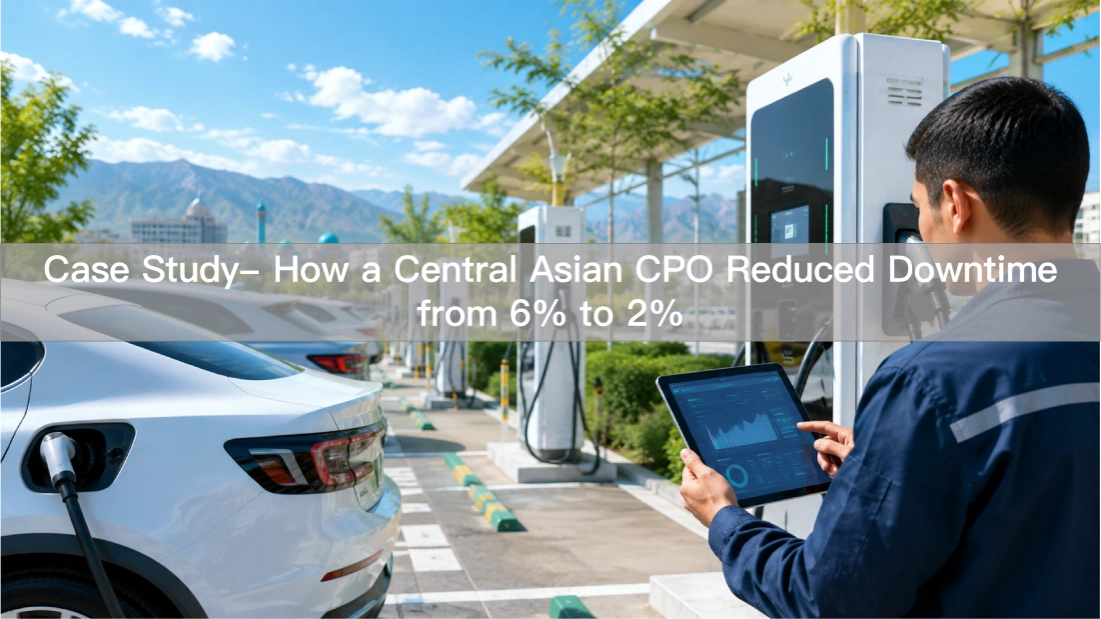
GreenV operates 28 DC fast charging stations across Nairobi. Before implementing OCPP-based monitoring with Anari’s OS platform, average monthly downtime per station was 18.4 hours. After 6 months of continuous monitoring and remote diagnostics, downtime dropped to 7.1 hours-a 62% reduction.
The biggest wins came from three sources:
Thermal fault prediction: Power module temperature trends triggered maintenance before catastrophic failure, eliminating 40% of unscheduled outages.
Remote firmware updates: Overnight patch deployment eliminated the 2-3 day cycle of scheduling technicians for software fixes.
Automated payment gateway monitoring: Card reader and NFC failures now trigger immediate alerts instead of waiting for driver complaints.
The platform costs $150/month per station for monitoring and support. At 18.4 hours of previous downtime, that’s $45.75/hour in lost revenue. Even conservatively attributing 30% of the downtime reduction to monitoring alone, the ROI exceeds 12:1.
6. What to Look for in a Monitoring Platform
Not all OCPP implementations are equal. When evaluating a charging management platform, prioritize these capabilities:
Heartbeat frequency: Systems that poll every 60 seconds or longer miss transient faults. Aim for 30-second intervals or faster.
Fault code granularity: Vague “system error” messages don’t help technicians. Look for module-level diagnostics-slot 3 power module overtemperature, connector lock failure, grid voltage anomaly.
Remote action breadth: Can the platform reboot individual components, or only the entire charger? Granular control means faster recovery and less collateral downtime.
Integration depth: Does the platform connect with your payment provider, RFID system, and fleet management tools? Siloed systems create blind spots.
Response SLAs: Who monitors at 2 AM? Anari’s N-Tech Agent provides 7×24 coverage with automatic escalation to human engineers for complex hardware faults.
7. The Hidden Cost of “Good Enough” Uptime
An industry average of 94% uptime sounds acceptable-until you calculate the real impact. A single 120kW charger generating $8,400 annually loses $504 per year of downtime. Multiply by 50 chargers across a network, and you’re looking at $25,200 in foregone revenue-before accounting for customer acquisition costs to replace lost drivers.
The operators who treat monitoring as a cost center rather than a revenue protector are the ones still dispatching technicians after driver calls. The ones who invest in OCPP-native platforms with remote diagnostics, automated fault resolution, and predictive maintenance see the compounding returns: higher uptime, lower operating costs, and stronger driver retention.
The question isn’t whether you can afford professional monitoring. It’s whether you can afford to keep losing 6% of your revenue to preventable downtime.