


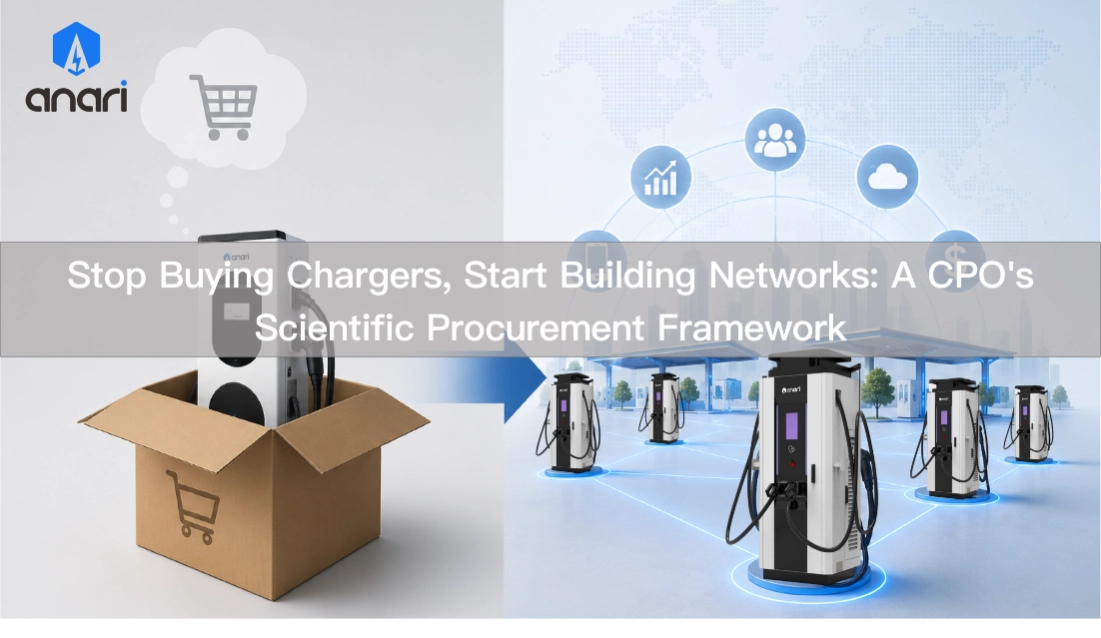
Most first-time CPOs enter this market through the same door: browsing charger specs. Power output. Connector types. IP ratings. Price per kilowatt.
That is like evaluating a restaurant by reading the kitchen equipment catalog. The fryer matters. But it won’t tell you whether the place fills tables.
A charging network is an operational business, not a hardware procurement project. The chargers are necessary. They are not sufficient. This post lays out what goes into building a station that actually works — from site selection through driver acquisition — and why the industry’s default model of “sell the box and walk away” leaves CPOs holding risks they didn’t sign up for.
1. The Box vs. The Business
The traditional procurement path looks like this: you contact three manufacturers, compare datasheets, negotiate on per-unit pricing, place an order, receive containers, find a local contractor for civil works and electrical installation, commission the units, figure out a management platform, and start operating.
On paper, this works. In practice, three things break.
First, the integration gap. The manufacturer ships hardware. The contractor pours concrete and pulls cable. The platform vendor provides software. Nobody owns the space between them. When a charger faults at 2 AM and the contractor says “it’s a software issue” and the platform vendor says “it’s a hardware fault,” the CPO — who is not an electrical engineer — is the one who has to diagnose the problem, coordinate the response, and absorb the downtime cost.
Second, the regulatory blind spot. Grid compliance, local permitting, certification acceptance — these vary by country, by province, sometimes by municipality. A charger with CE marking may still require additional testing for the local utility to approve grid interconnection. A site that looks perfect on Google Maps may fail the actual grid capacity assessment. These are not “nice to have” considerations — they are go/no-go conditions for station operation.
Third, the demand-side problem. Building a station does not guarantee utilization. A charger in a location nobody knows about generates zero revenue regardless of how good the hardware is. Driver acquisition — getting EV owners to actually use your station — is a marketing and operational problem that no hardware specification sheet addresses.
Turnkey, done right, means a single entity owns all three layers: equipment selection, deployment execution, and ongoing operation. Not “we’ll sell you the charger and recommend an installer.” Not “we’ll ship the hardware and you figure out the rest.” A single throat to choke.
2. Seven Things That Have to Go Right
At Anari, we break a charging station deployment into seven modules. This is not marketing taxonomy — it’s the actual project plan that runs on every site, and we’ve learned over deployments across 22 countries which ones create the most friction.
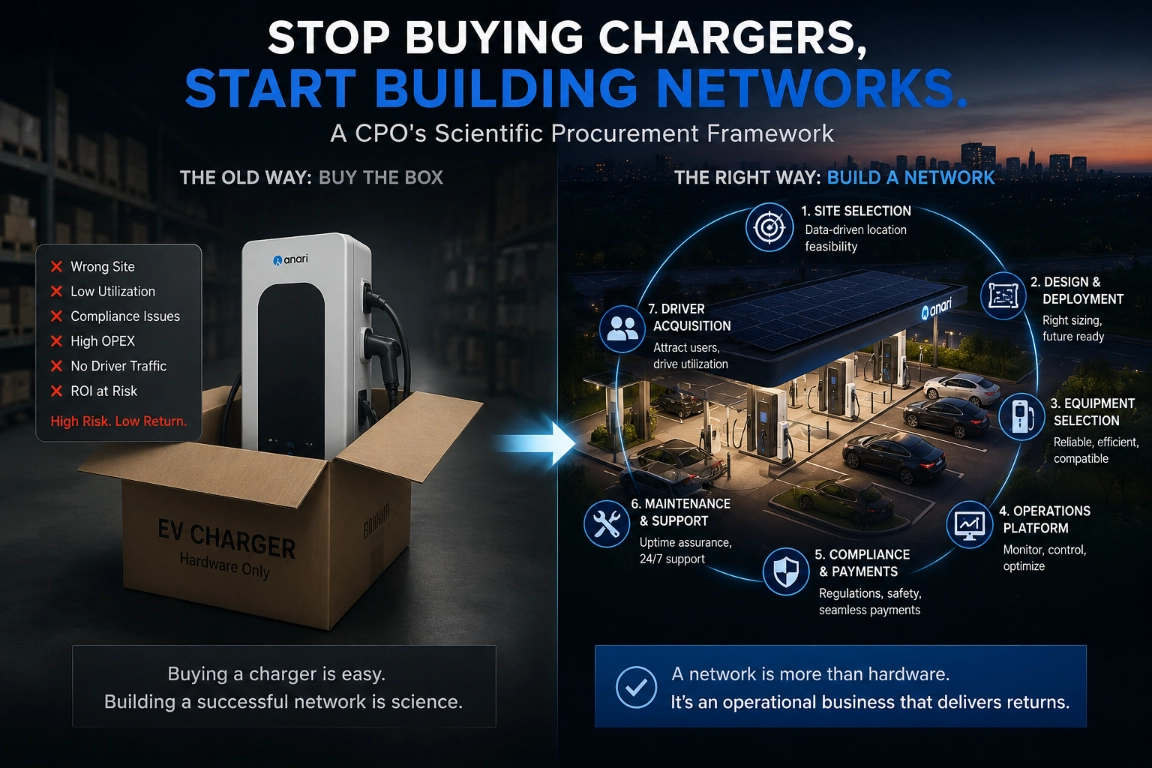
2.1 M1: Site Selection
You can fix bad equipment. You cannot fix a bad location.
Site selection is a grid capacity problem, a traffic flow problem, and a land-use regulation problem wrapped into one. The site needs sufficient grid capacity — not just for today’s planned charger count, but for the expansion you’ll want in 18 months. It needs to sit on a traffic pattern that puts it within 5–10 minutes of a driver’s normal route, not 20 minutes off the highway. And it needs to be zoned for commercial electrical infrastructure, which is not the same thing as “zoned for commercial use.”
We run grid proximity analysis, traffic density modeling, and regulatory zoning checks before a single charger is specified. This takes 1–2 weeks and costs nothing compared to finding out after construction that the transformer can’t support more than two DC units, or that the site sits on a road nobody uses after 7 PM.
2.2 M2: System Design
Once the site is confirmed, the system architecture gets specified: charger count and power tier, transformer sizing, cable routing, civil works scope, and future expansion. The output is not a spec sheet — it’s a construction-ready electrical single-line diagram that a local contractor can bid against.
The most common mistake we see: sites designed for “current demand” with no expansion. Adding a second DC unit three years later requires re-trenching and re-permitting because the original cable sizing can’t handle the additional load. The marginal cost of oversizing conduit and cable at initial construction is trivial. The cost of re-trenching later is not.
2.3 M3: Equipment Selection
This is the part most CPOs think is step one — and it is the part where over-analysis creates the least value.
The charger lineup needs to match the use case, not the brochure. A highway rest stop needs 240–480 kW with liquid-cooled cables and CCS2 connectors. A fleet depot servicing last-mile delivery vans overnight needs 20–40 kW wall-mounted units with scheduled charging integration. A public station in a market with mixed vehicle imports needs dual-standard support — CCS2 and GB/T, or CCS2 and CHAdeMO — on the same unit.
Anari’s DC portfolio spans 20 kW to 960 kW across five product lines:
Aquila: 60-240kW Dual Guns DC Fast Charging Advertising Station
Vulco: 60-480kW Integrated Floor-Mounted DC EV Charging Station Dual / Three Guns For Commercial Use
Pales: 60-240kW Commercial Fast DC EV Charging Station
Castor: 20-40kW Single/Dual Gun Wallbox EV Rapid Charger
All running OCPP 2.0.1 natively with backward compatibility to OCPP 1.6J. The hardware is modular — you don’t pay for 480 kW if your site needs 120, and you don’t lock yourself into a single protocol ecosystem.
2.4 M4: Regulatory Navigation
Every market has its own compliance stack. CE marking covers the European baseline, but individual EU member states may impose additional requirements. CB certification provides a shortcut for certain emerging markets that accept IEC-based test reports. GCC countries have their own certification framework (G-mark). Georgia requires EMC compliance per local utility standards. Uzbekistan has specific grid interconnection procedures.
This module is not a “service” — it is a go/no-go condition. A charger that cannot be legally connected to the grid is not a charger. It’s a paperweight in a container.
We maintain an active regulatory database covering the markets we operate in, updated as requirements change. For CPOs entering a new market, this is the module that determines whether the timeline is 3 months or 18 months.
2.5 M5: ANARI OS — The Operating Layer
Hardware without software is a collection of metal boxes. ANARI OS is the CPMS (Charge Point Management System) + EMS (Energy Management System) layer that runs the network.
It handles the expected functions: remote monitoring, session management, billing integration, fault alerting, and firmware OTA. It also handles the functions that become critical at scale: dynamic load management across multiple chargers on a constrained grid connection, solar + storage integration with charge/discharge scheduling, and OCPP dual-protocol support — running 1.6J and 2.0.1 chargers in the same network without requiring all hardware to upgrade simultaneously.
The platform is API-first. If a CPO already has a preferred billing provider, ANARI OS integrates with it. If a fleet operator needs charging data pushed to their existing dispatch system, the API supports that. The operating layer should conform to the operator’s workflow, not the other way around.
2.6 M6: N-Tech — After-Sales as a Product
The standard after-sales model in this industry is reactive: the charger faults, the CPO emails the manufacturer, the manufacturer dispatches a technician — eventually. Mean time to resolution in emerging markets, where authorized service partners may be hours away, routinely runs 4+ hours.
N-Tech is our AI diagnostic pipeline. When a charger reports a fault, the system analyzes the error signature against a database of known failure patterns and generates a diagnosis with recommended remediation steps — before a human technician reviews it. First response lands in under 90 seconds. In cases where the fault can be resolved remotely (configuration errors, protocol mismatches, software glitches), resolution happens without dispatching anyone. For hardware faults requiring on-site work, the diagnosis is precise enough that the technician arrives with the correct part and a defined procedure — no “show up, diagnose, order part, come back next week.”
The operational metric that matters is not “response time.” It is uptime — the percentage of hours in a month that a charger is available to generate revenue. N-Tech is designed to move that number upward by compressing the diagnosis-to-resolution window.
2.7 M7: N-SDR — Solving the Empty Station Problem
This is the module that doesn’t exist in any hardware manufacturer’s offering.
A station with zero utilization is not a business — it’s a liability with a power bill. Driver acquisition — getting EV owners to know your station exists, trust it, and choose it over alternatives — is a marketing and network-effects problem.
N-SDR (Nautilus Station Demand Response) is our AI-driven driver acquisition system. It maps EV density in the station’s catchment area, identifies high-value driver segments (rideshare, delivery fleet, daily commuters), and executes targeted acquisition campaigns — localized pricing incentives, platform integration (adding the station to navigation and charging apps), and usage-based loyalty programs. For fleet operators, it integrates directly with dispatch systems to route vehicles to the station during optimized charging windows.
No other charging infrastructure provider offers ongoing driver acquisition support. This is not a differentiator we claim lightly — it is, as of 2026, structurally absent from the industry’s standard operating model.
3. Commercial, Fleet, and Public: One Platform, Three Configurations
The same M1–M7 framework serves three fundamentally different use cases. The modules stay the same. The configuration changes.
Commercial public charging — highway rest stops, retail parking, urban charging hubs — prioritizes high throughput, dual-standard connector support, driver payment flexibility, and visibility on navigation platforms. Charger power tier sits at 120–480 kW. Utilization is driven by casual and long-distance traffic.
Fleet depot charging — last-mile delivery, logistics, bus depots — prioritizes scheduled charging, depot-level load management, and dispatch system integration. Charger power tier sits at 20–120 kW, with overnight charging windows. The key metric is not peak throughput per charger — it’s total fleet uptime per day.
Mixed-use commercial — office buildings, shopping centers, mixed-use developments — combines public access with reserved fleet or tenant charging. The system design needs to handle both use cases without one cannibalizing the other.
All three run on ANARI OS. All three get N-Tech monitoring. All three can activate N-SDR driver acquisition. The hardware and software stack is the same — what changes is the operational configuration, which is defined during M2 system design.
4. Why the Old Model Breaks in Emerging Markets
Most of the global EV charging equipment industry was built to serve developed markets: Western Europe, North America, Northeast Asia. In these markets, the assumption is that the grid is stable, the regulatory framework is settled, certified installers are available, and EV adoption is already underway.
Emerging markets invert every one of those assumptions. Grid capacity is uncertain. Regulatory frameworks are in flux — interconnection requirements may change between project planning and project execution. Certified EV charger installers may not exist locally. EV adoption is not a given — it is something the station itself must help create.
This is where the traditional “sell the box” model fails structurally. A hardware manufacturer in Shenzhen or Stuttgart cannot solve a grid interconnection problem in Tbilisi. A platform vendor in Amsterdam cannot train local technicians in Tashkent. A procurement agent cannot run driver acquisition campaigns in Amman.
The Nautilus framework — named after the submarine in *Twenty Thousand Leagues Under the Sea*, because it operates below the surface where the actual work happens — was built specifically for this environment. It wraps the full M1–M7 deployment pipeline around a single accountable entity, supported by 18 AI agents handling site analysis, regulatory mapping, fault diagnostics, and driver acquisition. The AI layer is not a marketing feature — it is how a relatively small team delivers infrastructure projects across multiple countries simultaneously without scaling headcount linearly with project count.
5. The Real TCO Question
When CPOs ask about total cost of ownership, they are usually asking about charger price, installation cost, and electricity rates. Those numbers are easy to get.
The harder number — the one that determines whether the business works — is the cost of “not” having each module covered.
What does an extra 90 days of regulatory delay cost in lost revenue and idle capital? What does 3% lower uptime cost across a 10-charger station over three years? What does a station running at 15% utilization instead of 40% cost in EBITDA margin?
Turnkey is not about bundling hardware with installation to increase the invoice line item. It is about eliminating the gaps between procurement, deployment, and operation — the gaps where costs accumulate silently and accountability evaporates.