



1. A bus depot is a factory with a timetable
Most charging projects are judged on energy delivered per day. A bus depot is judged on something harder: whether the vehicle scheduled to leave at 06:40 left at 06:40 with enough charge to complete its block.
That distinction changes everything downstream, from how many chargers a site needs to what the tariff looks like to which specification actually matters in February. Twelve dual-gun 120kW DC fast chargers were ordered for a Czech commercial bus site in May 2026 and energised in July 2026. This is the reasoning behind that configuration, written from the operator’s side of the table.
2. The constraint that is not on the spec sheet
A depot’s load profile is spiky by design. For most of the day a handful of vehicles charge. Before the morning and afternoon peaks, a dozen or more need energy inside a narrow window, and every one of them has a published departure time.
Three ways to handle that, and two of them fail.
- Size for average demand. Cheapest on paper. Produces a site that fails precisely when it is needed, because average demand is not what a depot presents at 05:30.
- Size for the peak without sharing. Technically correct, commercially difficult. Two dozen dedicated high-power bays means a grid connection the operator cannot justify for the other twenty hours of the day, plus a distribution network application whose timeline sits outside anyone’s control.
- Size for the peak with sharing. Fewer cabinets, more connectors, output allocated by the cabinet rather than fixed by the cable. This is what was built.
There is a fourth constraint that never appears in a tender document but always appears in the operating budget: at a bus depot a failed charge is not a lost fuel margin, it is a cancelled service and a passenger complaint. The cost of downtime at a depot is an order of magnitude above the cost of downtime at a retail charger.
3. Twelve cabinets, twenty-four bays
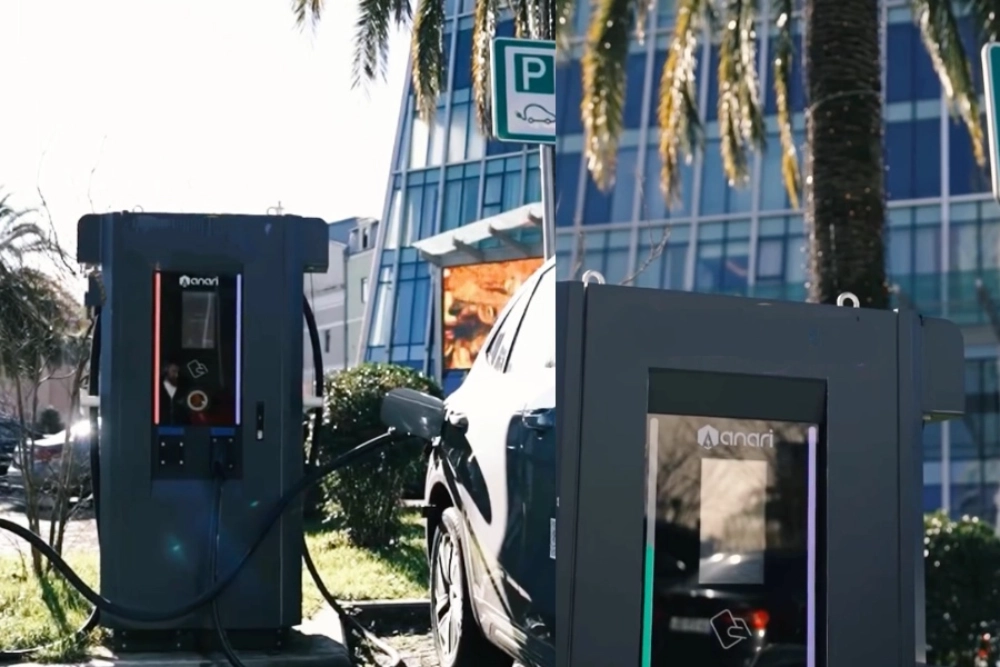
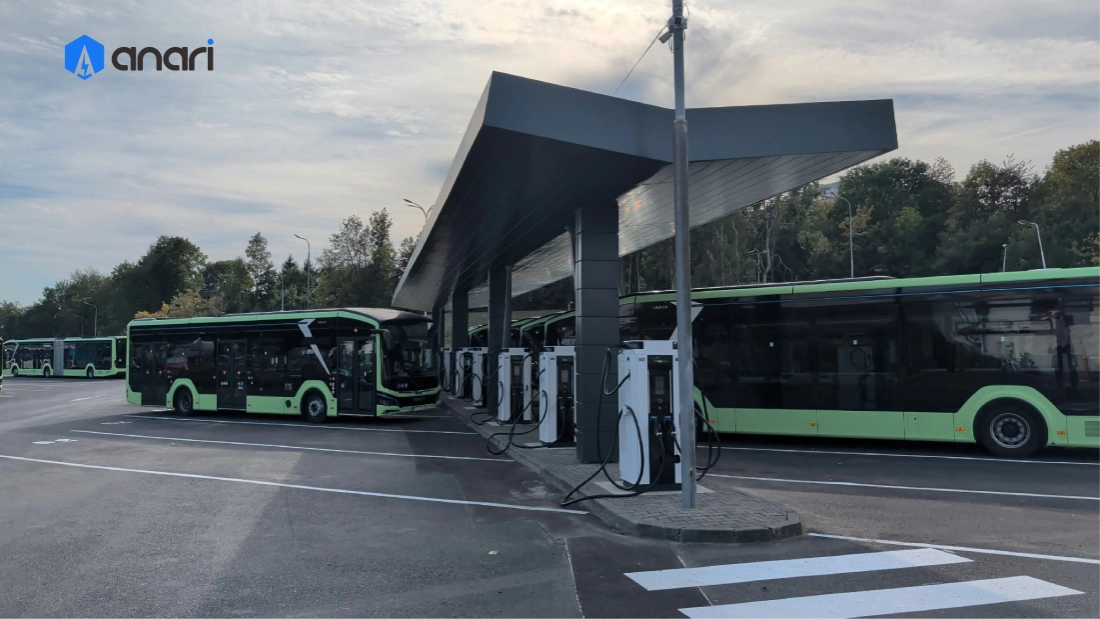
The site is a bus station serving scheduled services, run by a commercial operator. The order is twelve Vulco 120kW units, dual-gun, giving twenty-four DC connectors.
- Why 120kW and not 240kW. A bus that returns with 30 percent state of charge and departs four hours later does not need the fastest possible charge. It needs enough energy inside its dwell window at a price the timetable can carry. Higher power would have bought speed the schedule cannot use, at a connection cost the site would have to fund. At 120kW shared across two bays, the site covers its peak with a supply it can actually obtain.
- Why dual-gun rather than single. Each cabinet serves two vehicles, allocating output between them. Where one bus needs the full rate it takes all 120kW; where two dwell together the cabinet splits. Twenty-four service points from twelve supplies is the arithmetic that makes the site viable, and the allocation follows the schedule rather than a fixed bay assignment.
- Why the specification matters in February. The Vulco platform is rated from minus 30 to plus 70 degrees Celsius, with output reducing above 50. Enclosure is IP54 with an IK08 impact rating, cooling is forced air, and peak efficiency is 96 percent or higher. Czech winters in the interior routinely fall below minus 10, and chargers mounted in unheated bays sit in that for weeks. A cabinet that starts and holds rated output in January is the difference between a timetable that survives winter and a fleet availability problem.
- Why OCPP 1.6J from day one. The operator runs the site on its own management system, sets tariffs against its own energy contract, and can change back-end providers without replacing hardware. At twelve cabinets, a closed protocol is a twelve-unit lock-in.
4. The seventy days between order and power-on
Order in May, energisation in July. Four stages, and only one of them is about the equipment.
- Configuration lock. Connector type, gun count and communication settings fixed against the vehicle mix and back-end before the order is released. Errors caught here cost a document revision; the same errors found on site cost a week.
- Site works and the connection. The operator’s electrical contractor handles civil works, cable routes and the connection to the site’s distribution board. This is the stage most likely to consume calendar time, because it sits with the local installer and the utility rather than the supplier.
- Installation in blocks. Twelve cabinets at one site is a sequence, not an event. Units are mounted, cabled and energised in groups so the depot keeps operating while the site is rebuilt.
- Commissioning and handover. Insulation and earthing, rated output at load, meter accuracy, OCPP connectivity, connector lock, emergency stop. Handover completes when the operator’s own back-end shows live sessions and correct energy readings, not when the cabinet powers on.
Seventy days from purchase order to commissioned site is a useful planning benchmark: short enough to fit a single budget cycle, long enough that the grid works, not the hardware, is the item to schedule first.
5. What the site cost, and what it has to earn
A depot is a cost-avoidance asset more than a revenue asset. It replaces purchased diesel and contracted charging with self-delivered energy, so the payback argument is different from a public site.
| Cost layer | What belongs in it | Who controls it |
|---|---|---|
| Hardware | 12 cabinets, 24 connectors | Anari quotation |
| Grid and make-ready | Connection, transformer if required, distribution board, cabling, civils | Operator and local contractor |
| Installation | Labour, testing, handover | Local installer |
| Energy | kWh at the depot’s commercial tariff, in koruna, including demand charges | Operator’s contract |
| Network and software | OCPP back-end, connectivity, driver or staff authentication | Operator’s provider |
| Maintenance | Preventive service, spares, warranty beyond year 2 | Anari service agreement |
Four variables move the answer.
- Demand charges. A depot concentrates load by definition. Where the tariff includes a capacity component, the peak the site presents is a monthly cost, and load sharing inside each cabinet lowers it. This is often a larger lever than the equipment price, and it is invisible in a per-kWh comparison.
- Utilisation per connector. A depot charger serving four vehicles a day is a different asset from one serving ten. The relevant figure is energy delivered per connector per night, not the site total.
- Diesel displacement value. The comparison a fleet board actually makes is against the cost of the fuel the depot no longer buys. In koruna per kilometre, that number is easier to defend than a charging revenue forecast, because it is already in the accounts.
- Uptime. A charger unavailable five percent of the time does not lose five percent of revenue at a depot; it loses the departures that could not be reassigned.
Payback (months) = Total CAPEX / (Monthly energy value delivered − Monthly energy cost − Monthly OPEX)
Run it at plus and minus 30 percent utilisation. If payback moves by more than a year across that band, the risk sits in the fleet’s electrification pace rather than in the hardware, and the site should be built in phases rather than at full size.
6. Czechia’s corridor is being built; the depot comes first
Two pressures are moving at once in the Czech market, and they point in different directions.
The first is regulatory. Under the EU Alternative Fuels Infrastructure Regulation, member states must deliver fast charging at defined intervals along the TEN-T network, and Czechia sits on the north-south corridor linking Germany, Austria, Poland and Slovakia. Corridor charging is arriving as public infrastructure, funded by utilities and infrastructure capital.
The second is fleet-level and much quieter. As reported in August 2026, Czechia has roughly 7,700 public charging points against about 73,500 registered battery electric vehicles and 45,000 plug-in hybrids. Across the EU the public charging base passed about 1.1 million points by the end of 2025, roughly five times the 2020 figure. A country with a dense vehicle fleet and a comparatively thin public charging base is a country where private and fleet-owned charging carries the load.
That is why depots electrify first. A city bus covers a predictable daily distance, returns to a base the operator already controls, and charges overnight when the tariff is cheapest. The combination closes without subsidy, which cannot be said of a highway hub.
For Anari, the Czech project is a reference in an EU member state with an active regulatory timetable and a fleet operator willing to publish its commissioning date. That is the reference a fleet manager in Poland, Slovakia or Austria asks for, because it is the one that resembles their own problem: a timetable, a fixed site, and a winter.
Sources
- Regulation (EU) 2023/1804 on the deployment of alternative fuels infrastructure, TEN-T fast charging requirements.
- Transport & Environment, EU public charging point count at the end of 2025.
- Prague Morning, Czech public charging point and EV registration figures, August 2026.
- Anari Energy product specification, Vulco DC series.
- Deployment record: Anari Energy, project data verified Q4 2026.
Related reading: ·Vulco DC series specifications · Fleet depot charging: how to build your own without breaking operations · Depot charging from 10 trucks to 100