


Three numbers that explain why this site exists
- 2024. Ethiopia becomes the first country in the world to stop permitting imports of petrol and diesel cars.
- April 2025. Two operational ultra-fast charging stations in Addis Ababa, capable of charging up to 32 vehicles at once.
- October 2026. Three 180kW dual-gun chargers commissioned at one commercial site in Ethiopia. Six connectors. 540kW installed.
Read those three lines in order and the case makes itself. A government closed the door on combustion imports before the charging network existed to serve what came through it. What follows is not a story about a charger sale. It is a story about where the first real fast-charging capacity in a country gets built, and who gets to build it.
1. A country that stopped importing petrol cars
Ethiopia’s import restriction on internal combustion vehicles, introduced in 2024, is the most aggressive electrification policy any government has enacted. It was extended in 2025. The logic behind it is energy economics: the country generates the overwhelming majority of its electricity from hydro, and spends scarce foreign currency on imported fuel. Replacing imported diesel with domestic electricity is a national balance-of-payments decision as much as an environmental one.
That reasoning is sound at the level of a ministry. At the level of a driver, it creates an immediate problem. Vehicles are arriving, and the places to charge them are not.
The US International Trade Administration’s market analysis, published in July 2025, put the position plainly: as of April 2025, Addis Ababa had two operational ultra-fast charging stations, capable of charging up to 32 vehicles simultaneously. Two stations, in a capital of several million people, serving a national fleet that is being forced to electrify by policy.
2. The charging map has two dots on it
For an operator, that map is the entire commercial thesis. In a mature market you compete for share against a dozen networks. In Ethiopia you are not competing for demand, you are building the only place a vehicle can charge at speed on a given corridor.
The operator behind this project is a parking business. That matters, because it defines what they already had before Anari arrived: land, traffic, and an electrical connection. What they did not have was a way to turn a parking bay into an energy sale. A car parked for two hours earns a parking fee. A car that charges for twenty-five minutes at 180kW earns a parking fee plus six times the energy of a slow charger, and it leaves the bay available for the next vehicle.
The site is a commercial parking facility with public access. Vehicles arrive without a booking. There is no fleet schedule to plan around and no reservation system to smooth the peaks. Whatever capacity is installed has to serve whoever turns up.
3. What three units do that two stations cannot
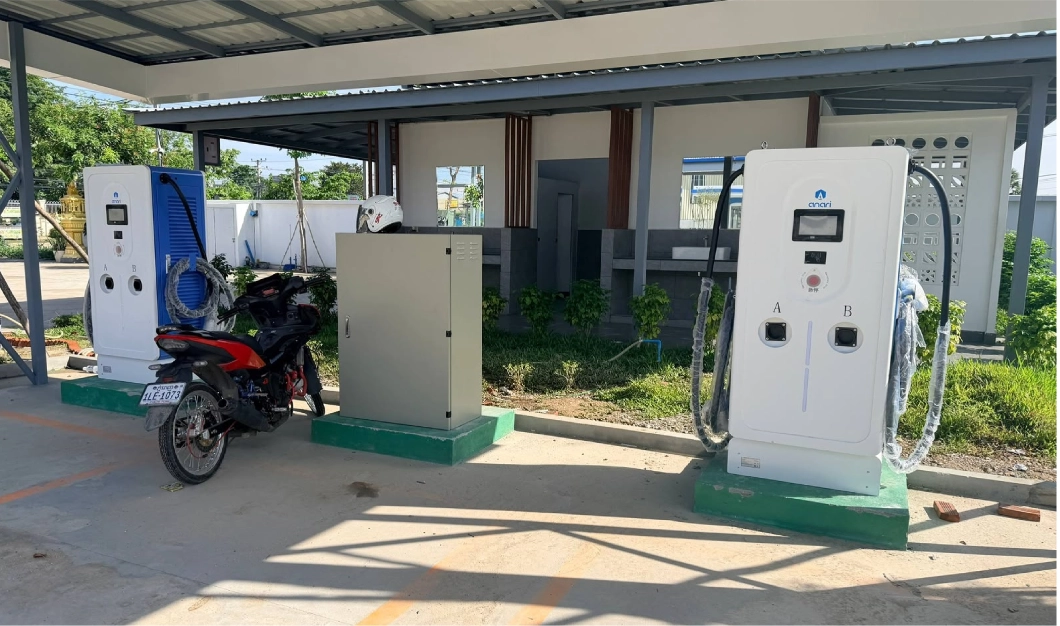
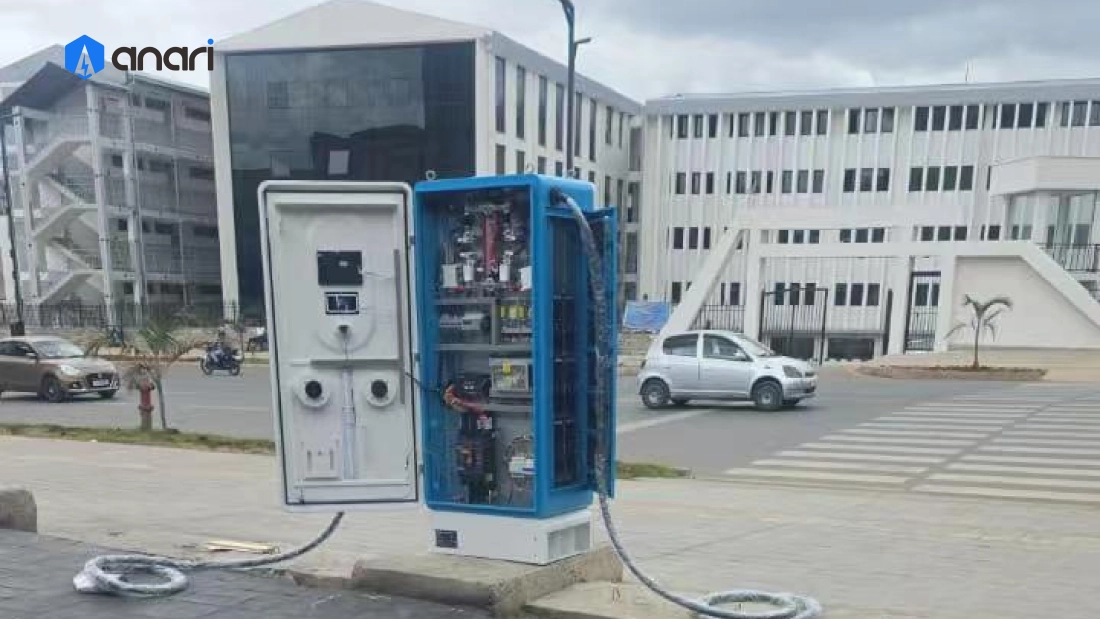
Three Vulco 180kW dual-gun cabinets, six DC connectors, 540kW of installed DC capacity. The configuration is the argument.
180kW is the useful point on the curve, not the impressive one. A passenger EV with a roughly 60kWh usable pack takes on the majority of a charge in about twenty minutes at 180kW. That is long enough for a meal and short enough that a driver does not plan the journey around it. A 240kW unit would cost more, demand more from the site’s connection, and deliver a gain that most vehicles on Ethiopian roads cannot yet accept. A 60kW unit would turn a stop into an afternoon. At this stage of a market, 180kW is where the economics land.
Dual gun, shared output, half the grid connections. Each cabinet serves two vehicles and allocates output between them. Three cabinets therefore give six service points from three supplies. In a market where a new high-capacity connection is a negotiation rather than a transaction, that halving is the difference between a site that gets built this year and one that stays on a drawing.
Specifications chosen for the operating environment, not the datasheet headline. The Vulco platform is rated from minus 30 to plus 70 degrees Celsius, with output reducing above 50. Enclosure is IP54 with an IK08 impact rating. Cooling is forced air. Peak efficiency is 96 percent or higher. Two of those matter more in Ethiopia than they would in Rotterdam: at 2,300 metres the air is thinner and carries less heat, and a forced-air design has fewer sealed fluid circuits to fail in a place where the nearest specialist technician may be a flight away.
OCPP 1.6J, deliberately. The operator runs the site on a management platform it can source and support locally, sets its own tariffs, and changes providers without replacing hardware. In a market where the software layer is the weakest link in the chain, an open protocol is risk control rather than a feature.
4. One month, six connectors
The order was placed in September 2026. The site was energised in October 2026. One month, from purchase order to six live connectors.
At a three-unit site, that calendar is achievable only because the electrical work ran in parallel with shipping. Foundation, cable routes and protection devices were installed while the cabinets were in transit. Where local fabrication capacity is limited, this stage is the one that decides the date, not the equipment.
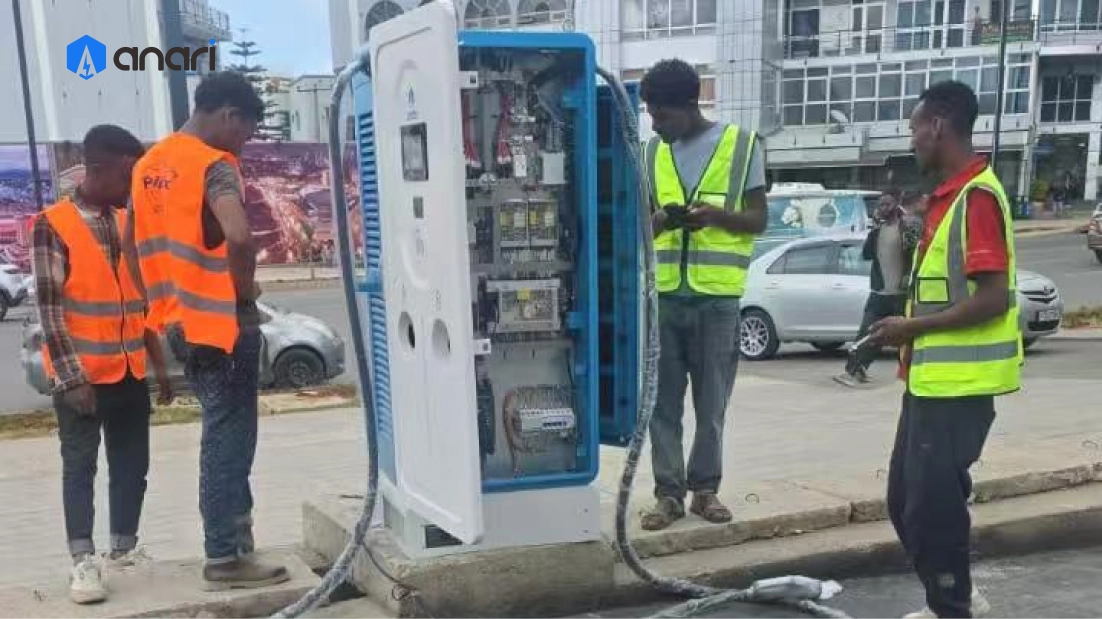
Commissioning was staged rather than simultaneous. Each cabinet was verified in sequence: insulation and earthing, rated output at load, meter accuracy, OCPP connectivity to the operator’s platform, connector lock behaviour, emergency stop. The point of staging is not caution for its own sake. At a three-unit site there is no redundancy, so a fault found on cabinet one should never be discovered again on cabinet three.
Handover included operator training on session start and stop, connector handling, and first-line fault response, plus a documented service route. In a market where a technician may be days away, the site’s own staff are the first response layer, and handover is not complete until they can run the system without a call.
5. The operator’s arithmetic
Three units is a scale where fixed costs are shared but not yet diluted. The model below is the one that decides whether a site of this size works.
| Cost layer | What belongs in it | What to watch in Ethiopia |
|---|---|---|
| Hardware | 3 cabinets, 6 connectors, 540kW | Anari quotation |
| Grid and make-ready | Connection works, protection, cabling, civils | Usually the largest single line item |
| Installation | Labour, testing, handover | Local capability affects cost and schedule |
| Energy | kWh at the site’s tariff, in birr | Check generation mix and any capacity charge |
| Network and software | OCPP back-end, payment, connectivity | Local provider availability varies |
| Maintenance | Preventive service, spares, warranty beyond year 2 | Stock critical spares at commissioning |
| Landed cost | Import duties, freight, foreign exchange | The variable that moves most |
Two sensitivities dominate, and neither is the equipment price.
Sessions per connector per day. At 180kW, one session per connector per day is a meaningful energy volume. Six connectors need roughly six sessions a day between them to look healthy. That is a function of where the site sits, not of which charger was bought.
Landed cost under a stressed exchange rate. In a market with foreign currency constraints, the cost of getting equipment into the country can move more than the equipment price itself. A model built on one exchange rate is fragile. Run it at a stressed rate as well, and check whether the payback still clears.
Payback (months) = Total CAPEX / (Monthly energy revenue − Monthly energy cost − Monthly OPEX)
Monthly energy revenue here is connectors, multiplied by sessions per connector per day, multiplied by average kWh per session, multiplied by 30, multiplied by the operator’s price per kWh. The honest stress case is not a 30 percent swing in utilisation, it is half the planned utilisation for the first year plus a few percent of hours lost to grid interruption.
6. What this means for East Africa
Ethiopia is running an experiment no other country has run: closing the combustion import channel before the charging network exists. The national bet is defensible, because the generation base is overwhelmingly renewable and the fuel import bill is a genuine constraint on the economy. At the site level, that bet creates a specific commercial situation that repeats across the region.
Demand is not the constraint. Supply is. Operators in mature markets spend on marketing to fill connectors. In Ethiopia, vehicles are arriving under a policy that leaves them no alternative, and the constraint is where they can plug in. A site that commissions six DC connectors is not competing for demand, it is meeting a queue.
The first sites set the price reference. Where fast charging is scarce, the first operators establish what a session costs and how long it should take. That position is worth more than the equipment margin, and it is available only to those who build before the market clears.
Local capability compounds. Every charger installed today creates demand for service capability that does not yet exist at scale. Operators who train their own staff and specify equipment maintainable with general electrical skills, rather than specialist fluid systems, will hold a cost advantage that widens every year.
For Anari, Ethiopia is a reference in the most supply-constrained EV market in the world, and the hardest available test of the platform’s temperature, ingress and protocol specifications under real conditions. Three units at 180kW in a country with two ultra-fast stations is a contribution an operator in Kenya, Uganda or Tanzania can go and look at, and that is worth more than any specification table.
Sources
- The Guardian, reporting on Ethiopia’s ban on imports of petrol and diesel cars and the country’s EV transition, September 2025.
- US International Trade Administration, Ethiopia automotive market intelligence, July 2025 (two operational ultra-fast charging stations in Addis Ababa as of April 2025).
- IEA, Global EV Outlook 2025, charging infrastructure context.
- Anari Energy product specification, Vulco DC series.
- Deployment record: Anari Energy, project data verified Q4 2026.
Related reading: