


1. Why Unit Price Is the Wrong Starting Point
A procurement team receives quotes from five Chinese DC fast charger manufacturers. The specs look identical: 120kW, OCPP 1.6J, CE certified, 30-day lead time. The prices range from $4,800 to $7,200 per unit. The natural instinct is to negotiate the lowest price.
This instinct is expensive.
At 5-12% average utilization in emerging markets, the unit price is the smallest component of total cost of ownership. A $2600 price difference per charger matters far less than whether the charger actually delivers 120kW at your site, whether replacement modules arrive within days instead of weeks, whether the OCPP implementation actually works with your platform, and whether support responds during your business hours.
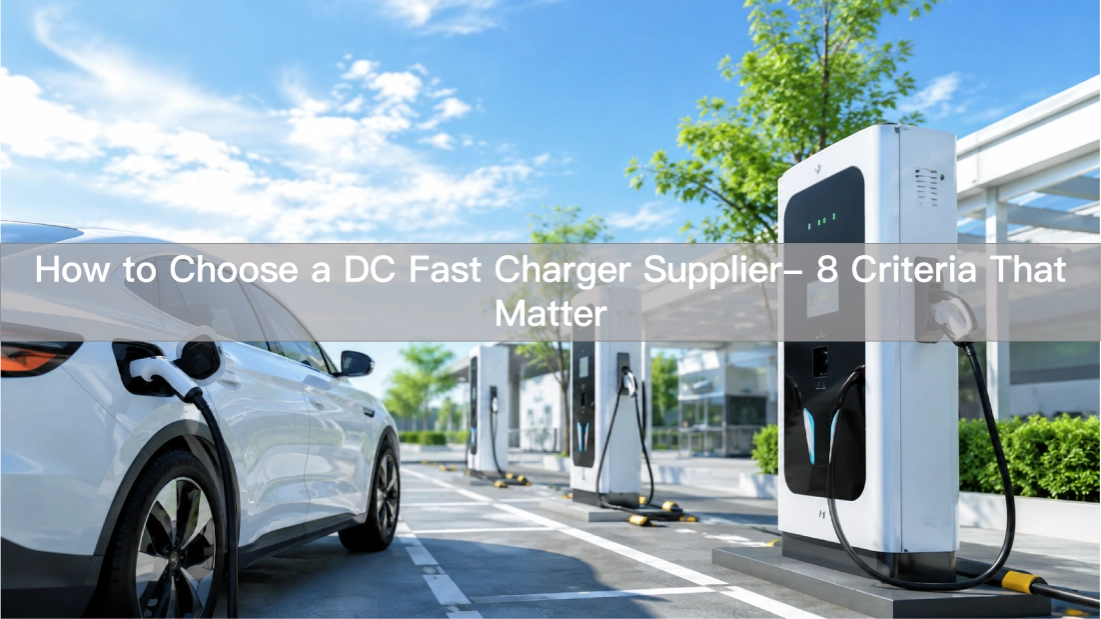
The supplier you choose today will be your partner for five to seven years. The procurement questions you skip now become operational problems later. Below are eight criteria that matter more than price.
2. Criterion 1: OCPP Implementation Quality
“OCPP 1.6J compatible” appears on every spec sheet. What it means in practice varies enormously.
OCPP has four profiles: Core, Local Auth List, Smart Charging, and Firmware Update. A supplier that implements only Core claims “OCPP support” but cannot do remote diagnostics, scheduled charging, or over-the-air updates. A supplier that implements all four profiles enables the full range of remote management capabilities.
The real test is conformance. Ask suppliers to share their OCPP conformance test report from an independent lab. If they cannot produce one, they may be self-certifying or testing internally without third-party validation. Conformance testing catches interoperability issues that only surface when your charger connects to your CSMS — and fixing those issues after deployment is costly.
The question: Can you share your OCPP conformance test report? Which profiles are implemented? Have you tested with CSMS platform name?
3. Criterion 2: Power Module Architecture and Availability
A charger with sealed, non-replaceable power modules is a ticking time bomb. When a module fails, the entire unit goes offline until a factory-rebuilt replacement arrives — which can take weeks in emerging markets.
Modular architecture changes the economics. A 120kW charger built from four 30kW plug-in modules can continue operating at 90kW if one module fails. The failed module can be swapped on-site in 20 minutes with a spare from your inventory. No truck roll, no waiting, no revenue loss beyond the 20 minutes of downtime.
The question: Are your power modules plug-in and field-replaceable? Do you stock spare modules in regional warehouses? What is your average module replacement lead time?
Anari’s modular design uses 20kW, 30kW, and 40kW mainstream modules alongside 60kW and 80kW newer-generation units. A 120kW unit with four 30kW modules can deliver 90kW with one module failed. Spare modules are kept in regional distribution centers across Asia, the Middle East, and Latin America.
4. Criterion 3: Certification Credibility
CE marking on a Chinese charger often means self-declaration, not notification body certification. The difference matters at customs, at insurance audits, and when local market surveillance authorities conduct routine checks.
TÜV Rheinland certification from an actual notified body carries significantly more weight. It means an independent third party has assessed your product against the relevant standards, not just your marketing team.
Individual model certification versus company-level certification also matters. A certificate covering only the company, not specific models, leaves you exposed if a particular model fails inspection or is recalled.
The question: Which certification body issued your CE mark? Is it self-declared or notified body certified? Are individual models certified, or is it company-level only?
Anari holds company-level CE and TÜV certification through self-developed testing. The Aquila DC series has individual model certification. The Pales DC model operates under company-level coverage. This distinction affects your ability to pass local market surveillance and your insurance coverage in the event of an incident.
5. Criterion 4: Thermal Performance at Your Climate
A charger rated at 96% efficiency at 25°C ambient may drop to 88% at 45°C. In hot markets — the Middle East, Southeast Asia, parts of Africa and South America — thermal derating is not an edge case. It is the operating condition for much of the year. When a charger derates, it loses revenue at the exact time when demand peaks.
The question: What is the sustained output at 45°C ambient? Is there a published thermal derating curve? What cooling system is used?
Standard Anari specifications cite ≥96% efficiency at normal output power. For hot-climate deployments, request the derating curve before signing. A 6% efficiency gap across a year of sales is thousands of dollars in lost margin that never appears on any repair invoice.
6. Criterion 5: Support Response Time and Time Zone Coverage
A charger failing at 2am local time needs a response team that is awake and available. Many Chinese suppliers operate on China Standard Time (CST, UTC+8). If your site is in GMT+3 (Middle East) or GMT+5 (Central Asia), a 9am-6pm CST support window maps to 3am-12pm your time — and the overnight failures fall outside it.
The question: What are your support hours in my time zone? Do you have local partners or third-party service contracts in my region? What is the SLA for remote diagnosis versus on-site dispatch?
Anari’s team communicates directly with operators — no ticketing system middleman. For emerging market CPOs, having a supplier who responds within hours, not days, is often the difference between a two-hour downtime and a two-week one.
7. Criterion 6: Payment Terms and Risk Allocation
TT prepaid is the standard for Chinese manufacturing. But the terms you negotiate at PO sign-off determine how much risk you carry during the deployment phase. A deposit structure that puts 50% upfront with no performance milestone leaves you exposed if the hardware arrives non-compliant.
The question: What is the payment schedule? Are there milestones tied to shipping documents, arrival inspection, or commissioning? What happens if the units fail acceptance testing?
For pilots and first-time buyers, Anari typically structures terms that align risk — a portion on shipment, a portion on arrival, and flexibility for LC payment in markets where TT is difficult. The goal is to match payment to your cash flow reality, not just the supplier’s.
8. Criterion 7: Platform Compatibility and Vendor Lock-In
Proprietary charging platforms are the quiet trap in EV infrastructure. A supplier who bundles hardware and software together creates a dependency that becomes expensive to exit. When the platform raises subscription fees, changes its API, or shuts down, migrating your fleet becomes a multi-month project with real costs.
The question: Does the charger require your proprietary platform, or does it support open standards? Can I use my existing CSMS? What happens to my data if I switch platforms?
Anari chargers support OCPP 1.6J natively and are not locked to any specific platform. This means you choose your management software independently, and switching costs are limited to configuration time, not hardware replacement.
9. Criterion 8: Real-World Uptime Data
Spec sheets show ideal conditions. Field data shows reality. A supplier that can share anonymized uptime statistics from actual deployments — especially from your region — gives you a signal that spec sheets cannot.
The question: Can you share uptime data from sites similar to mine? What is your mean time between failures? How many sites do you operate in my region currently?
Published field data shows a consistent gap between operator-reported uptime (95-98%) and real-world functional availability (73-80%) for DC fast chargers. This gap exists because dashboards track “connected” status, not “charging successfully” status. A charger that powers on but cannot initiate a charge session is worse than useless — it wastes driver trust.
10. How to Use This Checklist
Print this list. Send it to shortlisted suppliers with a request for documented answers, not bullet-point responses. Use each criterion as a bargaining lever during negotiation. Track the same eight criteria quarterly after delivery — supply relationships degrade, and supplier A today may not be supplier A in year three.
The chargers you install today will still be operating in year five. The procurement questions you skip now become operational problems later. Eight questions take 30 minutes. The wrong answer takes years to fix.
———
*Data note: UC Berkeley field study on DC fast charger functional availability (Human Factors, 2023; San Francisco Bay Area data, 2022). Certification and product specifications are Anari Energy company claims, verified against internal documentation. All other claims reflect operational experience from deployment support across 30+ countries.*