



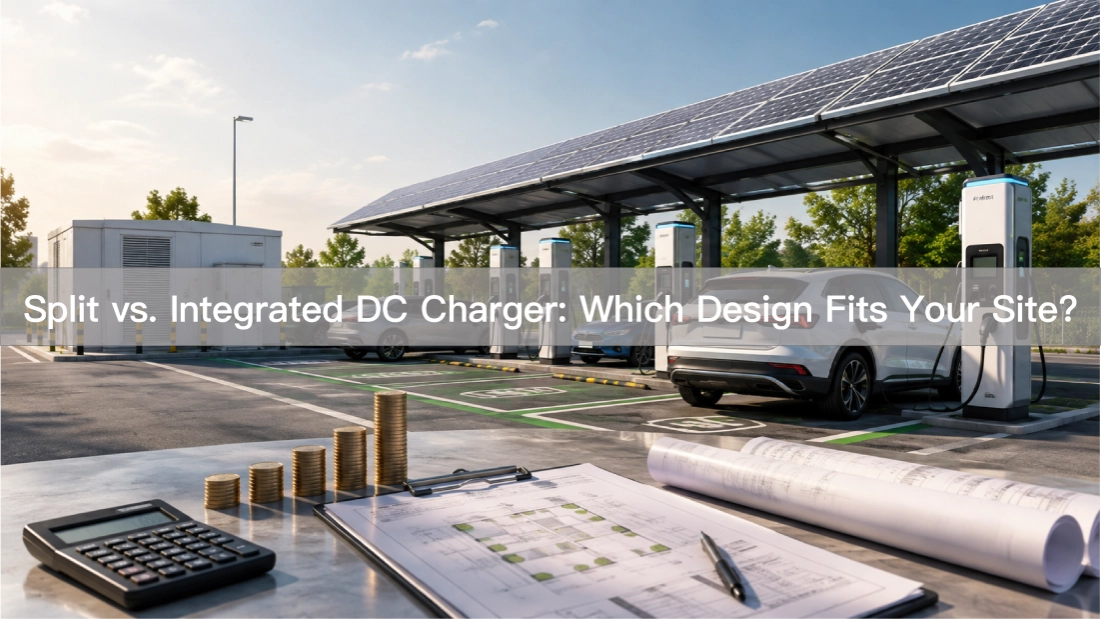
Split and integrated DC fast chargers serve different site conditions. This guide explains when each architecture makes sense — from grid capacity constraints to deployment scale to future expansion plans.
1. The Problem: One Size Does Not Fit All
A CPO in Southeast Asia commissioned ten 120kW integrated DC fast chargers at a new station. Two months after opening, the local utility issued a demand charge notice that doubled the monthly electricity bill. The chargers were drawing peak power simultaneously, pushing the site’s transformer past its rated capacity. Retrofitting the transformer would cost more than the chargers themselves.
This is the classic mistake of choosing charger architecture based on unit price alone, without modeling the site’s electrical infrastructure. The same CPO could have installed five 360kW split systems on the existing transformer, delivering equivalent or greater total power with far lower peak demand.
Split and integrated DC fast chargers are not alternatives for the same site. They are solutions for different site constraints. Understanding which constraint dominates — grid capacity, deployment scale, expansion plans, or simplicity — determines which architecture wins.
2. What Is an Integrated DC Fast Charger?
An integrated DC fast charger combines all components — power modules, control system, display, payment terminal, and charging Guns — into a single enclosure. It is a self-contained unit that connects to AC input and delivers DC output directly to the vehicle.
2.1 Typical Specifications
- Power range: 30kW to 240kW per unit
- Configuration: Fixed power output (a 120kW unit delivers 120kW, no more)
- Installation: Single-point connection — AC input, DC output, communication
- Modularity: Internal power modules are field-replaceable but the unit’s total capacity is fixed
- Display: Built-in touchscreen with payment and session management
2.2 When Integrated Makes Sense
Integrated chargers are ideal when:
- Grid capacity is sufficient — the site’s transformer can handle the simultaneous peak draw of all installed units
- Deployment is small to medium — 2-10 units at a single location
- Simplicity is prioritized — fewer components, single vendor, straightforward installation
- Budget is constrained — lower upfront cost per kW compared to split systems
- Aesthetic integration matters — compact units fit retail, parking garage, and urban environments
2.3 Limitations of Integrated Design
- Fixed capacity — you cannot add power to an existing unit. If demand grows, you must install additional units.
- Single point of failure — if the control system fails, the entire unit is offline (though power modules may continue operating at reduced capacity depending on design).
- Transformer upgrade risk — adding integrated units to an already loaded circuit requires transformer assessment and potentially costly upgrades.
- Less flexible power distribution — each unit delivers its rated power independently. There is no dynamic sharing between units.
3. What Is a Split DC Fast Charging System?
A split DC fast charging system separates the power conversion equipment from the charging interface. The power cabinet (containing all power modules and control electronics) is installed separately from the charging Guns, which are connected via DC cables.
3.1 Typical Specifications
- Power range: 360kW to 960kW per power cabinet
- Configuration: One power cabinet serves multiple charging guns (typically 2-6 guns)
- Installation: Power cabinet requires dedicated space (indoor or outdoor enclosure); Guns are positioned at parking bays
- Modularity: Power capacity scales by adding or removing modules in the cabinet
- Intelligent power distribution: Dynamic allocation of available power across connected Guns based on real-time demand
3.2 How Intelligent Power Distribution Works
This is the key advantage of split systems. A 360kW power cabinet with three 150kW Guns does not deliver 450kW (3 × 150kW). It delivers 360kW total, shared dynamically:
- One vehicle charging: The single Gun receives a full 150kW (or up to 360kW if the Gun supports it)
- Two vehicles charging: Each receives ~180kW (360kW ÷ 2)
- Three vehicles charging: Each receives ~120kW (360kW ÷ 3)
- Four vehicles charging: Each receives ~90kW (360kW ÷ 4)
The power allocation is managed by the cabinet’s control system in real time. No manual intervention is required. This means you can serve more vehicles simultaneously with the same transformer capacity — at the cost of slightly longer charge times per vehicle during peak demand.
3.3 When Split Makes Sense
Split systems are ideal when:
- Grid capacity is constrained — the site cannot support the simultaneous peak draw of multiple high-power integrated units
- Future expansion is planned — the power cabinet can be upgraded by adding modules without replacing the entire system
- Multiple vehicles charge simultaneously — high-utilization sites (fleet depots, highway rest stops) benefit from dynamic power sharing
- Transformer upgrade cost is prohibitive — split systems extract more charging capacity from existing infrastructure
- Site layout allows separate equipment space — the power cabinet needs a dedicated enclosure, separate from the parking bays
3.4 Limitations of Split Design
- Higher upfront cost — power cabinets and multiple Guns cost more than equivalent-power integrated units
- More complex installation — requires separate power cabinet placement, cable runs from cabinet to each Gun, and potentially additional civil works
- More components to maintain — power cabinet, Gun cables, Gun heads are separate systems with separate failure modes
- Space requirement — the power cabinet needs a protected enclosure (indoor room or outdoor cabinet), which may not be available at all sites
4. Side-by-Side Comparison
| Factor | Integrated DC Charger | Split DC Charging System |
| Power range per unit | 30-240kW | 360-960kW (cabinet) |
| Grid demand per kW | 1:1 (unit draw = output) | <1:1 (shared across Guns) |
| Transformer requirement | Higher per kW of output | Lower per kW of output |
| Scalability | Add new units | Add modules to existing cabinet |
| Installation complexity | Low | Medium-high |
| Space requirement | Minimal (unit footprint) | Cabinet + Gun locations |
| Upfront cost | Lower per kW | Higher per kW |
| Long-term TCO | Higher if grid upgrade needed | Lower if grid is constrained |
| Best for | Small/medium sites, ample grid | Large sites, constrained grid, expansion plans |
5. Decision Framework: Which Architecture Fits Your Site?
Use this decision flow to determine the right architecture:
- Sufficient for target power → Integrated is fine. Proceed to Step 2.
- Constrained or unknown → Split is likely the better choice. The dynamic power sharing extracts more charging capacity from limited grid infrastructure.
- 1-2 vehicles → Integrated is simpler and cost-effective.
- 3+ vehicles regularly → Split’s power distribution becomes valuable. You serve more vehicles from the same grid connection.
- No expansion planned → Integrated. Simpler, lower upfront cost.
- Expansion likely → Split. Adding modules to the existing cabinet is cheaper than replacing the system or upgrading the transformer.
- Compact urban site, no equipment room → Integrated. No space for a separate power cabinet.
- Industrial/commercial site with equipment space → Split. The cabinet can be placed in a dedicated area.
- Lowest upfront cost → Integrated. Fewer components, simpler installation.
- Lowest TCO → Evaluate split if grid upgrade costs would exceed the split system premium. In many constrained-grid scenarios, split wins on TCO despite higher upfront cost.
6. Real-World Example: The Transformer Upgrade Trap
A CPO in Central Asia planned to install eight 120kW integrated DC fast chargers at a new highway rest stop. The site had a 500kVA transformer — sufficient on paper for eight 120kW units (960kW total DC output requires approximately 1,000kW AC input at 96% efficiency, so 500kVA was clearly insufficient). However, the CPO’s quote comparison focused on charger unit price, not transformer cost.
The transformer upgrade estimate came to $45,000. The eight integrated chargers cost $96,000. Total: $141,000.
Had the CPO chosen a split system instead — two 360kW power cabinets serving eight 150kW Guns — the same eight charging positions would have been covered with a total AC demand of approximately 720kW. The existing 500kVA transformer could have been upgraded to 800kVA for approximately $25,000. Total: $96,000 (chargers) + $25,000 (transformer) = $121,000.
The split system saved $20,000 in total project cost and provided 25% more headroom for future expansion. The difference was architectural choice, not hardware quality.
7. Anari’s Product Lines: Where Split and Integrated Fit
Anari offers both architectures across its product portfolio:
- Power range: 60kW, 120kW, 180kW, 240kW
- OCPP 1.6J with all four profiles
- Field-replaceable power modules (20kW/30kW/40kW/60kW/80kW)
- IP65 rated, -30°C to +55°C operating range
- Ideal for: retail parking, service stations, urban fast-charging stations
- Power range: 360kW, 480kW, 720kW, 960kW per cabinet
- Dynamic power distribution across 2-6 Guns
- Same OCPP 1.6J compliance and module architecture as Aquila
- Ideal for: highway corridors, fleet depots, high-utilization public stations
Both lines share the same modular power platform — 20kW, 30kW, 40kW, 60kW, and 80kW modules — ensuring that spare parts, training, and support are consistent across the portfolio.