



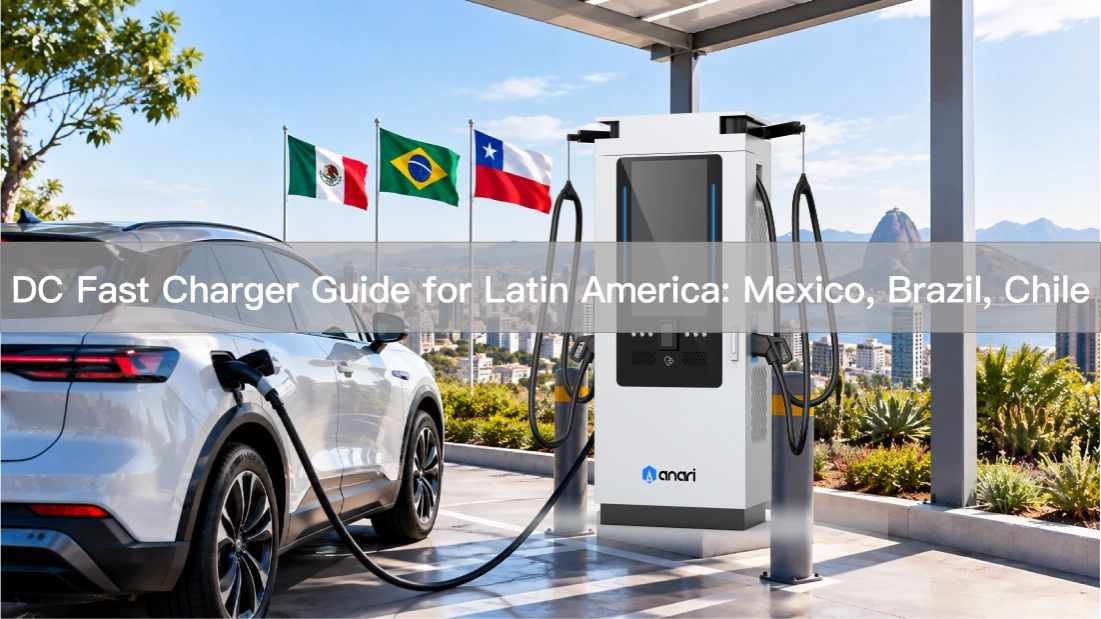
1. The Latin American Market: Three Distinct Landscapes
Latin America accounts for approximately 92% of the region’s 18,594 public charging points, with Brazil, Mexico, and Chile concentrated in a handful of countries. The market is fragmented — there is no single “Latin American standard.” Each country has its own regulatory authority, certification body, and grid connection requirements.
A charger that clears customs in Mexico may not meet Brazil’s INMETRO certification requirements. Equipment approved in Chile’s SEC system may require additional testing for Mexico’s CRE interconnection rules. Understanding these differences is critical for suppliers who want to serve the entire region without maintaining separate product lines.
2. Mexico: CRE Regulation and Grid Integration
Mexico’s Energy Regulatory Commission (CRE) published Agreement No. A/108/2024 in September 2024, establishing the general administrative provisions for electromobility and the integration of EV charging infrastructure into the National Electrical System (SEN).
Key regulatory requirements:
- EV charging stations must apply for a separate electricity supply service contract, independent of existing facility service
- Stations on highways or expressways must be Mode 3 or Mode 4 (DC fast charging)
- Distributed generation (solar, battery) can supplement grid supply for charging stations under the 0.5MW interconnection manual
- Smart charger interoperability functions may be required by CENACE (National Energy Control Center) based on connection studies
- The CRE will develop a digital electromobility platform for public information on charging infrastructure characteristics
Connector standards in Mexico: Mexico’s regulatory framework acknowledges multiple connector types including CCS Combo (CCS1 and CCS2), CHAdeMO, and Tesla NACS. The CRE’s 2024 agreement explicitly lists these connectors as compatible types for public charging stations.
Certification path: Mexico does not have a mandatory product certification regime equivalent to Brazil’s INMETRO or Chile’s SEC approval. However, equipment must comply with NOM (Norma Oficial Mexicana) standards for electrical safety, and the CRE requires technical documentation for grid interconnection studies.
3. Brazil: INMETRO Certification Is Mandatory
Brazil has the most structured certification requirement in Latin America. The Agência Nacional de Energia Elétrica (ANEEL) and the Instituto Nacional de Metrologia, Qualidade e Tecnologia (INMETRO) govern EV charging equipment compliance.
ANEEL regulatory framework:
- Normative Resolution No. 819/2018 first enabled commercial EV charging services
- Normative Resolution No. 1,000/2021 consolidated the regulatory framework, recognizing recharging as a permitted service at market prices
- Law No. 14,902/2024 strengthens the MOVER program with mandatory energy efficiency and recyclability targets from June 2025 through 2030–2031
INMETRO certification requirements: All EV charging equipment sold in Brazil must carry INMETRO certification, complying with ABNT NBR IEC 61851-1:2021. This is a mandatory product certification — not a voluntary conformity assessment. Equipment without INMETRO certification cannot be legally marketed or imported for commercial use.
The MOVER program impact: Law No. 14,902/2024 establishes technical requirements for the marketing and import of electric and hybrid vehicles, including specific requirements for charging infrastructure compatibility. Suppliers targeting Brazil should monitor MOVER implementation details for charging equipment specifications.
Tax incentives: Brazil’s MOVER program provides tax incentives for manufacturers and investors meeting low-emission and recyclability standards. The CAMEX/GECEX measure from 2023 regulates the gradual reintroduction of import taxes on electric vehicles after a period of exemption (2015–2023).
4. Chile: SEC Technical Specification RIC N°15
Chile has advanced specific technical regulations for EV charging infrastructure through the Superintendencia de Electricidad y Combustibles (SEC). The regulatory framework is among the most detailed in Latin America.
Key Chilean regulations:
- Technical Specification No. 15/2020 (SEC, 2024): Establishes minimum requirements for safety, design, electromagnetic compatibility, and electrical protection for public and private chargers
- Exempt Resolution No. 33,675 (2020): Requires all power supply systems and cables used in EV charging to have prior SEC approval
- Exempt Resolution No. 27,547 (2024): Updated the Interoperability Instruction for public charging infrastructure integration with the national platform
Chile’s national electromobility goals:
- By 2035: All new light vehicles sold in Chile must be 100% electric
- By 2050: At least 40% of the private vehicle fleet must be electrified
Certification path: Chile requires SEC approval for charging equipment. The SEC maintains a registry of approved products and conducts conformity assessment procedures. Equipment must demonstrate compliance with TIC 15/2020 technical specifications before receiving SEC approval.
5. Connector Standards Across Latin America
| Country | Primary DC Connector | AC Connector | Notes |
|---|---|---|---|
| Mexico | CCS Combo (both CCS1 and CCS2 accepted) | Type 2 | Multiple connector types recognized by CRE |
| Brazil | CCS2 (Type 2 combined) | Type 2 | ABNT NBR IEC 62196-2 adoption |
| Chile | CCS2 | Type 2 | SEC Technical Specification aligns with IEC |
Regional trend: CCS2 (Combo 2) is the dominant DC fast charging connector across Latin America, aligned with European IEC standards. Mexico’s CRE explicitly recognizes both CCS1 and CCS2, reflecting the North American market influence. Brazil and Chile follow the European IEC 62196-2 standard.
| Requirement | Mexico | Brazil | Chile |
|---|---|---|---|
| Regulatory authority | CRE | ANEEL | SEC |
| Product certification | NOM compliance (voluntary framework) | INMETRO (mandatory) | SEC approval (mandatory) |
| Grid connection study | Required for HV (≥69kV) via CENACE; LV via distributor | Distribution company study | SEC technical review |
| Distributed generation | Allowed <0.5MW under RES/142/2017 | Permitted with ANEEL approval | Permitted under SEC rules |
| Smart charging requirements | CENACE may require interoperability functions | ANEEL regulatory framework developing | Interoperability platform required |
| Public information platform | CRE electromobility platform (developing) | ANEEL registry | SEC interoperability platform |
6. Procurement Checklist for Latin America
When sourcing DC fast chargers for Latin American deployments, verify these requirements explicitly:
For Mexico:
- NOM compliance documentation for electrical safety
- Technical documentation package for CRE grid interconnection studies
- CCS2 connector standard (primary); CCS1 compatibility if targeting US-market vehicles
- Spanish-language user interface and documentation
For Brazil:
- INMETRO certification certificate for your specific model
- ABNT NBR IEC 61851-1:2021 compliance test reports
- Portuguese-language user interface and documentation
- MOVER program technical requirement alignment
For Chile:
- SEC approval certificate or pending application status
- TIC 15/2020 conformity assessment documentation
- Interoperability platform compatibility (SEC platform integration)
- Spanish-language user interface and documentation
7. Market Entry Strategy: One Product Line for Three Markets
The most efficient approach for international suppliers is to develop a product line that meets the strictest certification requirement — Brazil’s INMETRO certification — while ensuring compliance capabilities for Mexico and Chile.
Why INMETRO-first? Brazil’s INMETRO certification is mandatory and involves rigorous testing. If your product line carries INMETRO certification, you can typically adapt the same hardware for Mexico and Chile with minimal modification — primarily language localization and connector configuration.
Cost implications: INMETRO certification typically adds 3–6 months to product launch timelines and requires investment in Brazilian laboratory testing. However, the certification opens access to Latin America’s largest EV market (Brazil accounts for approximately 60% of regional charging infrastructure).
Regional support considerations: Latin American operators expect local spare parts inventory and Spanish/Portuguese technical support. Suppliers without regional service partnerships face longer downtime during warranty claims and higher total cost of ownership for their customers.
Data Sources:
CRE Agreement No. A/108/2024 (Mexico);
ANEEL Normative Resolutions 819/2018 and 1,000/2021 (Brazil);
SEC Technical Specification RIC N°15/2020 and Resolution No. 27,547 (Chile);
IAMERecas White Paper on Sustainable Mobility in Latin America. Regulatory information current as of September 2026.