




Your Fleet is Only as Available as its Charging
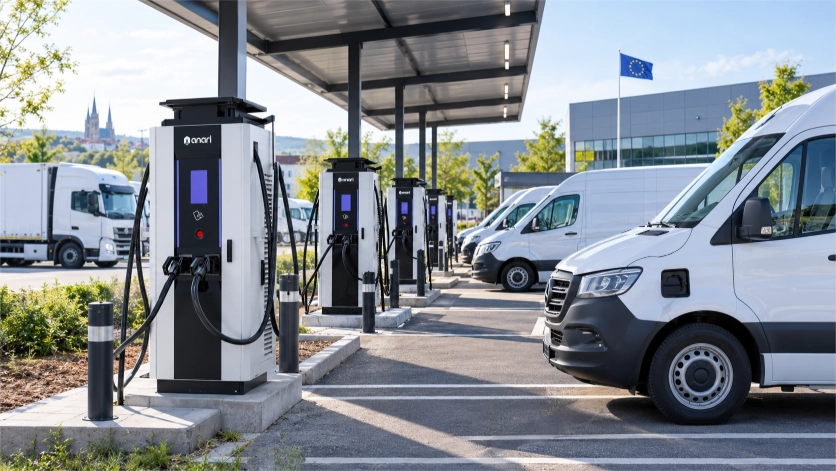
A private EV owner can postpone a charge. A fleet operator cannot. Every one of your vehicles must be ready for the next shift — and every hour a vehicle spends waiting in a charging slot is operating time lost.
Anari designs depot charging infrastructure around three facts you already know: how many vehicles return to the depot each day, how long they stay, and how much power your site can actually supply. The result is a charging system that scales with your fleet — from 20 vehicles to 300+ — without re-engineering when you grow.
Click to View Fleet Recommended Charging Stations
Fleet Charging is an Operational Problem, not a Hardware Purchase
For a private vehicle, charging is a convenience. For a commercial fleet, charging availability is operational availability. A vehicle that misses its morning readiness window is a vehicle that is not earning, not delivering, not on route.
We design for the single metric that matters in your P&L: the percentage of your fleet ready for dispatch, every morning, at the lowest total cost of ownership. Sizing, the AC/DC mix, load management, and the deployment sequence all serve that number — not the other way around.
Eight Fleet Types, One Sizing Logic
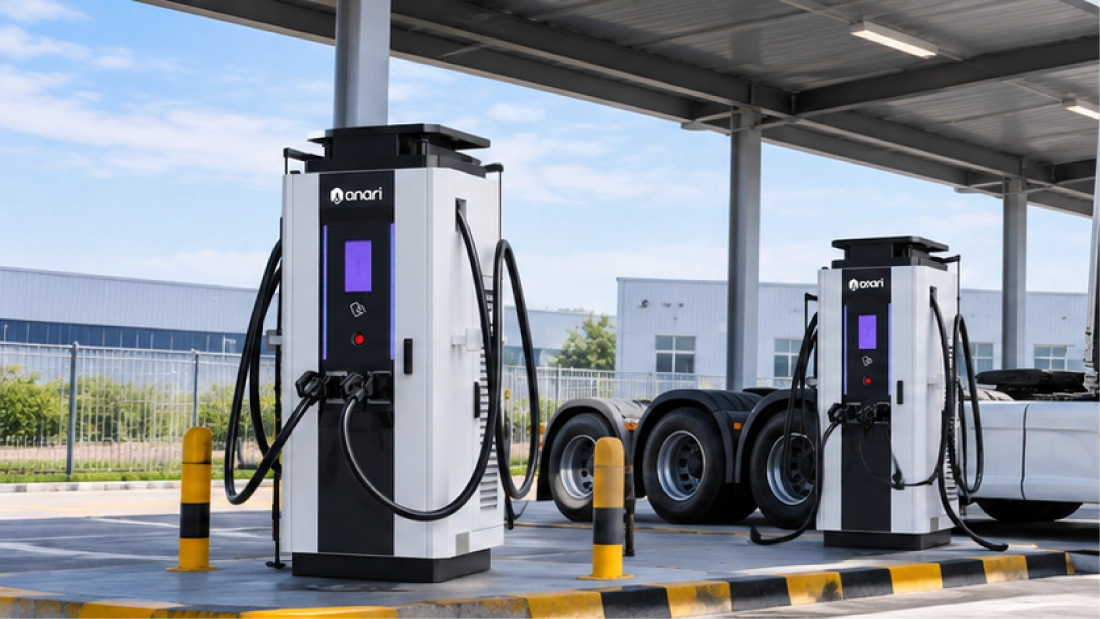
Different fleets charge differently. We match the mix to the operation:
| Segment | Operating Pattern | Recommended Charging Mix |
|---|---|---|
| Courier / last-mile delivery | Fixed depot, fixed routes, nightly return, high daily frequency | 11–22 kW AC overnight + 60–120 kW DC for peak periods |
| Taxi / ride-hailing | High daily mileage, high utilization — charging downtime is lost revenue | 60–240 kW DC fast charging |
| Logistics & distribution | Large depots, fixed routes, high utilization, long-term EV headroom | 22 kW AC + 120–240 kW DC |
| Corporate fleet | Overnight charging dominates | 7–22 kW AC, cost + load management focused |
| Service fleet (telecom, utility, construction, security) | Fixed depot + fixed service area, nightly return | AC-dominant, a limited number of DC units |
| Rental / leasing | Concentrated vehicle parking, fast turnover, unified management | Large AC deployment + DC top-up |
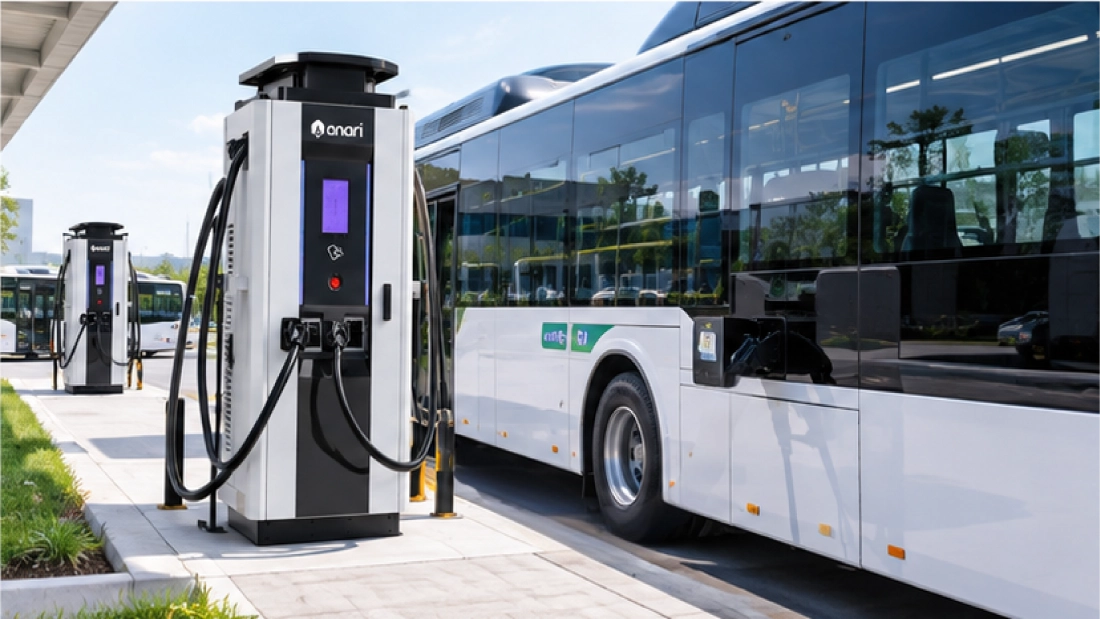
| Bus / shuttle | Fixed routes + fixed depot, longer project cycles | 120–360 kW DC |
| Heavy-duty / truck depot | High power demand, longer cycles | 360 kW DC, staged deployment |
The sizing rule: if the majority of your vehicles park for 6–10 hours overnight, AC charging is the most cost-effective base. Reserve DC power for the vehicles where turnover time directly affects utilization.
The Five Fleet Charging Problems
1. Your grid capacity is usually smaller than your fleet’s demand.
Twenty 22 kW chargers represent 440 kW of theoretical simultaneous load — most depots cannot supply that. Dynamic load balancing distributes the available power according to each vehicle’s state of charge and charging schedule, so your fleet charges within the capacity you actually have. Sizing formula: required busbar capacity = total daily charging demand of the fleet ÷ available charging window. Load balancing lets you add vehicles later without re-running the supply.
2. Charging downtime is revenue you do not collect.
For high-utilization fleets, the cost of an inefficient charging window is quantifiable: downtime cost = hours in the charging slot × fleet utilization × average revenue per vehicle-hour × days per month. The AC/DC mix exists to shrink that window for the vehicles where it matters.
3. Total cost, not unit price, is what your CFO approves.
The complete system — chargers, load management, integration, installation — is what you are actually buying. We price on total cost of ownership: capital cost, energy cost, demand-charge exposure, and the cost of lost operating time.
4. Supplier distance is a real risk — we remove it.
Warranty backed by a remote engineering team, commissioning support, and regional spare-parts availability. Your depot does not depend on a cross-continental service trip.
5. Your fleet will not stay the size it is today.
Designing for 20 vehicles today and re-engineering at 100 is the expensive path. Our modular architecture keeps spare busbar capacity and a staged deployment plan, so Phase 2 hardware extends Phase 1 without rework.
How We Size Your Depot
We start from four inputs you already have. No placeholders, no assumptions:
| Input | What We Determine |
|---|---|
| Vehicles returning to depot per day | Number of AC units and their power class |
| Vehicles needing rapid turnover between shifts | Number of DC units and 60–360 kW mix |
| Available site power | Load-balancing plan within your actual capacity |
| Existing CSMS / backend | OCPP 1.6J integration — charger monitoring, energy data, session data, fault monitoring |
Three Deployment Stages, Pilot First
Stage 1 — Basic fleet charging. AC chargers + OCPP 1.6J integration. Right for fleets of 20–50 vehicles running overnight charging.
Stage 2 — Fleet charging system. Adds DC fast charging + dynamic load balancing. For 50–300 vehicles where utilization depends on rapid turnover.
Stage 3 — Fleet energy system. Adds PV + BESS + EMS. For 300+ vehicles or depots facing grid limits, high energy prices, or unstable supply. This is where charging becomes an energy-management asset.
Each stage begins as a pilot defined as commercial validation, not a sample-unit sale. Success criteria are fixed before deployment:
- Technical: uptime, charging stability, OCPP/remote-monitoring behavior
- Operational: charging time per vehicle, morning readiness rate, charger utilization
- Economic: energy consumption, peak load, charging cost
- Commercial: your team’s readiness to scale
The pilot outputs three things: documented feedback, rollout requirements, and the next order. Then: first order → fleet rollout → multiple depots.
Where We Focus
Fleet electrification is moving fastest where the vehicles are arriving and the infrastructure is still being built. Anari concentrates its fleet deployments in the regions where that gap is widest:
- Eastern Europe — Bulgaria, Romania, Poland, Czechia, Hungary, Greece, Serbia, Albania
- Caucasus & Central Asia — Georgia, Armenia, Kazakhstan, Uzbekistan, Azerbaijan
- Latin America — Argentina, Colombia, Uruguay, Ecuador, Panama, Brazil
- Southeast Asia — Thailand, Vietnam, Indonesia, Philippines
These are markets actively in construction, not saturated installed bases: IEA reports non-China emerging-market EV sales grew roughly 80% in 2025, with Southeast Asia more than doubling and Latin America up around 70%; Poland’s TEN-T ultra-fast-charge coverage rose from about 20% at the end of 2024 to 59% by mid-2026. Anari already works with fleet, charging, and energy customers across these regions — which is why our references and regional support sit where your operation does.
Why Anari
Cost-effective — China supply chain, complete-system TCO, not unit-price shopping.
Flexible — 7 to 360 kW across AC and DC, OEM/ODM when you need it.
Scalable — pilot → rollout → multiple depots, one architecture throughout.
Solution-oriented — charger + OCPP 1.6J + load management + PV/BESS, delivered as one system.
Deployed scale behind it:
2,800+ Charging Units 丨 22+ Countries and Regions 丨Peak Efficiency ≥96%
OCPP 1.6J 丨 Standard Lead Time 30 Days
Warranty with Remote Engineering and Regional Spare-parts Availability
Start with a Fleet Charging Assessment
Twelve questions define your project — we will not quote without answers to them:
- How many vehicles are in your fleet today?
- How many are electric — or electric-ready?
- Do most vehicles return to the same depot each day?
- How long do they stay overnight or between shifts?
- What is the available electrical capacity at your site?
- What charging equipment do you currently have?
- Do you need mainly overnight charging, or fast top-up between shifts?
- Which vehicles drive utilization — where does turnover time cost you?
- Do you already run an OCPP backend / CSMS?
- When do you plan to deploy?
- What is your fleet’s growth plan over the next 24 months?
- What would “success” look like in your first 90 days of operation?
[Request your fleet charging assessment] — we return a sizing plan, an AC/DC recommendation, and a pilot outline built on your inputs.
FAQ
Do I need DC fast chargers for my fleet?
Only where utilization demands it. If most vehicles park 6–10 hours overnight, AC charging is the cost-effective base; DC is reserved for vehicles whose charging time is currently eating operating time.
My depot’s grid capacity is limited. What do we do?
Dynamic load balancing spreads available power across vehicles by state of charge and schedule. Where limits are structural, PV + BESS adds capacity without a grid upgrade.
Do the chargers work with our existing backend?
Yes. OCPP 1.6J integration covers charger monitoring, energy data, session data, and fault monitoring against your CSMS.
How fast can we go from decision to live?
Standard lead time is 30 days. The pilot runs against success criteria agreed before deployment, so the rollout decision is a documented one, not a gamble.
What happens if a charger fails?
Warranty coverage, remote engineering triage, and regional spare-parts availability — your depot is not dependent on a cross-continental service call.