




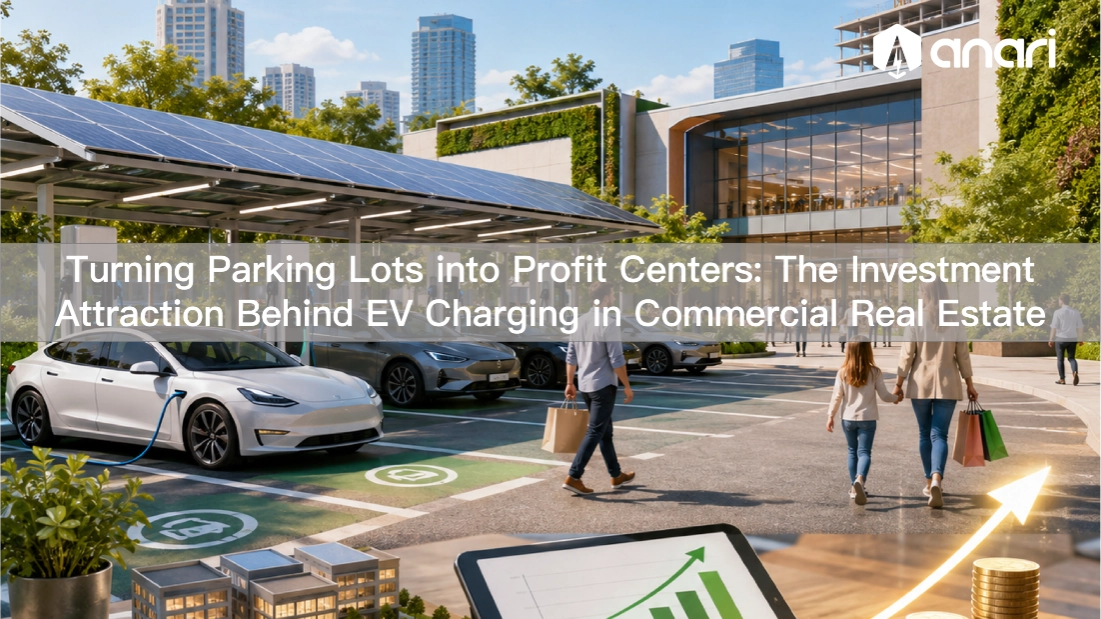
When charging stations shift from being supporting facilities to assets, parking lots transform from Cost Centers into profit centers — in Eastern Europe, this transformation is happening faster than expected.
In the past, parking lots of commercial properties were simply regarded as “necessary supporting facilities” — building garages was a planning requirement, and maintaining parking spaces counted as operational costs. But the rising penetration rate of electric vehicles is rewriting this equation. In Eastern Europe, changes are accelerating: in the first nine months of 2025, electric vehicle sales in Poland more than doubled, ranking first in the EU in terms of growth rate. Transforming a parking lot into a profit center requires no out-of-pocket investment, no technical expertise, and only a different approach to cooperation.
1. A Special Time Window for Central and Eastern Europe
Unlike Western European markets, Eastern Europe is at a unique turning point of the “chicken-and-egg” dilemma. By the end of 2024, there were over 900,000 public charging points across the EU — but the European Automobile Manufacturers Association estimates that 8.8 million will be needed by 2030, representing a nearly tenfold gap. The more intractable issue is not the total number, but the distribution: while the EV penetration rate in Northern Europe exceeds 3%, it remains below 0.88% in most parts of Eastern Europe.
But this is precisely the window of first-mover advantage for commercial real estate.
There is a clear competitive variable for commercial real estate players in Eastern Europe: getting a head start on deploying charging infrastructure while the regional market remains a “blue ocean” means locking in high-quality partners, securing prime locations, and building brand recognition. By the time charging becomes a standard feature and you are forced to play catch-up, all the good spots will already be taken, and your bargaining power will have been squeezed.
2. How to settle this account in Central and Eastern Europe?
Let’s start with a real case:
Eleport’s expansion across eight Central and Eastern European countries: The European Investment Bank (EIB) is providing a €35 million loan to support Eleport in deploying over 250 ultra-fast charging hubs in Croatia, the Czech Republic, Estonia, Latvia, Lithuania, Poland, Slovakia and Slovenia, all located at large commercial and shopping centres. Each site will be equipped with up to 12 charging plugs, with a maximum power output of 400kW per plug.
The Case of Poland-based CD Locum: This developer, with nearly 25 years of experience and a track record of over 140,000 square meters of developed commercial space, has opted to enter a strategic partnership with Eleport. The first batch of 20 charging points has been deployed across 5 cities, with the flagship site in Kraków boasting a power output of 600kW. Notably, the equipment is supplied by Ekoenergetyka, a local Polish manufacturer — a clear indication that the local supply chain has reached maturity.
The case of NEPI Rockcastle in Poland: As the largest retail real estate operator in Central and Eastern Europe, it has deployed 114 ultra-fast charging points in shopping malls across 11 cities, with a maximum power output of 400kW per plug. NEPI Rockcastle has a clear stance: “Combining visits to shopping malls with vehicle charging brings convenience and saves time” — this is a pragmatic attitude of commercial real estate taking the initiative to embrace charging infrastructure.
The common feature of these cases is that the venue owner does not bear the construction and operation & maintenance costs, yet gains increased customer flow, asset appreciation and continuous revenue sharing.
3. Business Model: Zero Cost, Instant Returns
The cooperation model in the Eastern European market is similar to that in China, yet it boasts unique advantages backed by EU policies.
Tier 1: Direct revenue sharing. The prevailing cooperation model in the market is that operators make full investment in construction and take charge of operation and maintenance, while site providers offer venues and power access to obtain a share from charging service fees. With zero initial investment, returns start generating from day one.
Tier 2: EU policy dividend. This is a unique advantage of the Eastern European market. Poland’s National Fund for Environmental Protection has signed EU funding agreements worth nearly 1.265 billion zloty (approximately 292.5 million euros) for the construction of power grids supporting charging infrastructure, with an additional 2 billion zloty earmarked specifically for the charging stations themselves. These funds will ultimately reduce the implementation cost of projects and shorten the Payback Period, while commercial real estate owners will have the opportunity to benefit indirectly through cooperation.
Tier 3: commercial customer acquisition effect. Research shows that car owners are willing to stay for an hour or longer while charging. For commercial real estate, this means additional consumption duration and average transaction value — the catering, retail and entertainment sectors in shopping malls can all benefit from this. Eleport’s partner G City Europe has set its sights on exactly this point: its shopping malls are “key destinations for thousands of people every day”, which perfectly aligns with the deployment logic of charging infrastructure.
Tier 4: First-mover competitive advantage. The Eastern European EV charging market is still in its early stage – currently, no charging network in Poland has reached break-even, and leading players in the sector are targeting positive EBITDA within two years. For commercial property owners, this means entering the market now brings stronger bargaining power and more favorable cooperation terms. Once the market matures, the initiative will shift from property site providers to charging operators.
4. Why is now the best time for commercial real estate in Central and Eastern Europe?
Demand side: Poland has around 120,000 electric vehicles in circulation, a figure expected to double next year and approach 1 million by 2030. The government projects that the number of charging stations across the country will rise to 87,000 by 2030 — a figure still lagging behind Western Europe, but one that represents a staggering growth rate.
Supply side: Mature charging operators (such as Eleport, which operates in six countries with over 400 fast charging points) already exist in Eastern Europe and continue to receive international capital support. Leading players are competing for “prime locations” — shopping malls, retail parks, transportation hubs — all of which are core assets of commercial real estate.
Policy side: The EU’s Alternative Fuels Infrastructure Regulation (AFIR) requires member states to install charging stations along the Trans-European Transport Network, with billions of euros in funding being rolled out. Central and Eastern European countries are accelerating efforts to close the gap with Western Europe in terms of charging density – Hungary has doubled the number of charging stations in the past three years and announced that all major highways will be electrified by 2025. Government funds and EU policies are lowering the threshold and risks for commercial real estate to deploy charging infrastructure.
Conclusion
The value of parking lots is being reassessed. They are no longer just spaces for parking vehicles, but have evolved into energy service nodes, commercial traffic access points, and sustainable income-generating assets.
For commercial real estate in Central and Eastern Europe, choosing the right cooperation model matters more than obsessing over whether to build or not. Find a reliable charging operator, trade your space for revenue sharing, turn your parking lot into a profit center at zero cost — during this “blue ocean window” of the regional market, this calculation is well worth a careful consideration.