



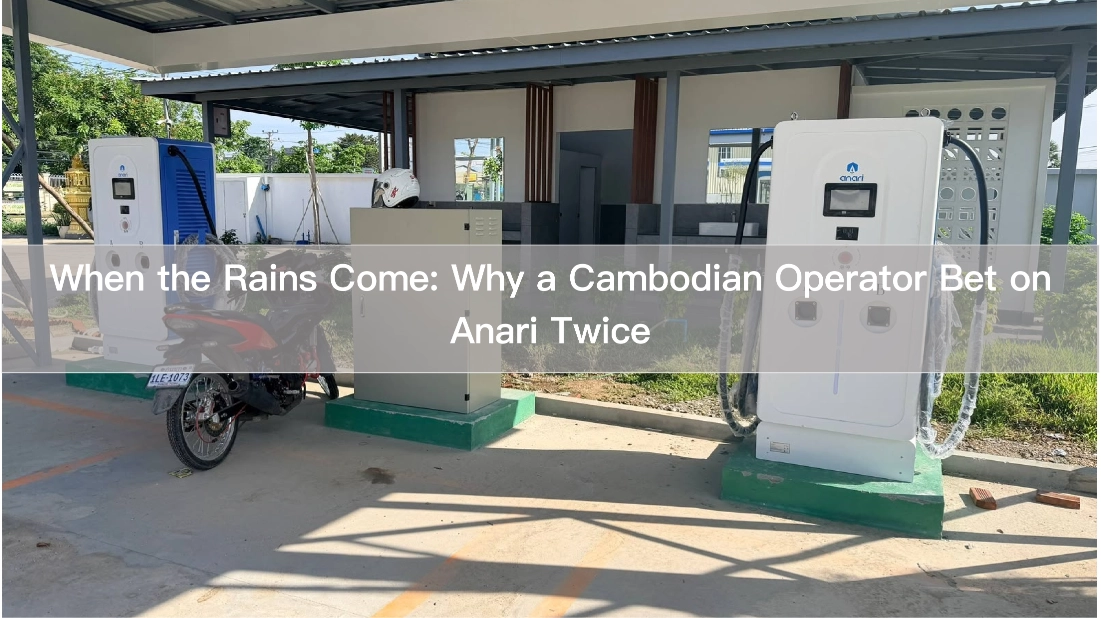
The first time the monsoons hit Phnom Penh after the 60-240kW Commercial Fast DC EV Charging Station(Pales DC Series) chargers went live, the operator’s site manager did something he hadn’t done with the old hardware: he slept through the night.
No calls at 3am. No trucks dispatched in the rain. No angry drivers honking at a dead screen.
At that moment — the absence of a phone call — is the real story behind this deployment.
1. The Operator Who Knew What He Didn’t Want
This customer isn’t new to EV charging. He runs stations along Phnom Penh’s national highway, where the traffic is steady and the expectations are unforgiving. A driver pulling up at 11pm with 12% battery doesn’t care about your supply chain problems or your “industry-leading MTBF.” They care about one thing: does the charger work, right now, in this rain.
He’d already been running Anari’s Integrated Floor-Mounted DC EV Charging Station Dual / Three Guns For Commercial Use(Vulco DC Series) — the premium line — for over a year. They worked. When something broke, someone answered. That baseline of trust is easy to claim in a brochure and nearly impossible to earn in practice. It gets earned at 2am on a Tuesday.
So when he needed to expand capacity with a tighter budget, he didn’t go shopping. He came back to Anari and asked: what do you have that costs less but doesn’t compromise on the things that matter?
He wasn’t looking for the cheapest option. He was looking for the cheapest option that wouldn’t wake him up at 3am.
2. Three Chargers, One Non-Negotiable
The deployment: two 180kW dual-gun units and one 240kW dual-gun unit, all GB/T, all outdoors, all exposed to whatever the sky decides to do.
Phnom Penh’s climate doesn’t negotiate. Daytime temperatures sit above 33°C for most of the year. Humidity rarely dips below 70%. And from May to October, the sky opens up — 1,400mm of rain, much of it in concentrated bursts that turn roads into rivers within minutes.
A DC fast charger pushing 240kW in those conditions generates enormous internal heat while surrounded by saturated, 35°C air. The cooling margin isn’t “tight” — it’s nonexistent unless the thermal architecture was designed for it from the start.
This is where most “economy” chargers fail. Not catastrophically — they don’t explode or catch fire. They derate. They throttle output from 180kW to 90kW. They trip on voltage fluctuations and wait for a manual reset. The charger is “working” — the station owner is losing money.
The operator had been through that movie before. He wasn’t buying another ticket.
3. What Pales DC Series Actually Is (and Isn’t)
The 60-240kW Commercial Fast DC EV Charging Station(Pales DC Series) is not Anari’s flagship. The Vulco line holds that position — higher power ceiling, more advanced cooling, more features. Pales is the answer to a different question: what if you need Vulco-level thermal reliability but your budget says economy?
The answer involved three design decisions that don’t show up in a spec sheet comparison but become everything in the field: IP55 isn’t a rating, it’s a promise.
The enclosure is sealed against direct rainfall and sustained humidity. But the less obvious part is the internal dehumidification — active moisture management that prevents condensation on the power electronics. In a tropical environment, condensation kills more chargers than lightning strikes. Most economy chargers treat humidity as an afterthought. Product was designed by engineers who’ve spent time in Shenzhen summers — they know what 90% humidity does to a circuit board. Voltage tolerance you don’t think about until you need it.
Cambodia’s grid fluctuates. ±15% variation is routine — not a fault condition, just how the grid behaves. Most chargers in this price range have a narrow input window. They trip. They need manual resets. Pales DC Series was designed for Chinese provincial grids that have the same problem, so the wide-voltage tolerance is baked into the power module spec, not added as a line item. The thermal IP came from Vulco.
This is the part that matters. P60-240kW Commercial Fast DC EV Charging Station(Pales DC Series) uses forced-air cooling, not liquid. But the airflow path design, the heatsink geometry, the derating curves — all of it was validated on the Vulco platform first. You’re not buying a cheaper charger with unknown thermal behavior. You’re buying a Vulco-class thermal simulation in a cost-optimized package. The customer doesn’t need to know that — they just need to know the charger doesn’t derate at 35°C. But the reason it doesn’t is because the thermal model was proven on a higher-end line.
4. The Part That Doesn’t Fit in a Comparison Table
I asked the sales director what made this deal close.
She said: “They’d already worked with us. They knew that when something went wrong, we answered.” That’s it. Not the IP rating. Not the voltage range. Not thermal architecture. The customer chose Anari again because, the first time, they had a problem — and every charger eventually had a problem — someone picked up the phone and fixed it.
Hardware specs get you shortlisted. Service keeps you in the fleet.
A repeat purchase where the customer moves from your premium line to your economy line is the hardest test in B2B hardware. You can convince a new buyer on a spec sheet and a pitch deck. You cannot convince a repeat buyer on anything except their own experience. This operator knew exactly what Anari’s hardware looked like after 18 months in tropical conditions. He knew what the service response felt like. And he still chose to spend more money with the same supplier — just on a cheaper product line.
That decision is the only case study that matters.
5. What This Means If You’re Buying
Three things worth taking from this:
——”Tropical-grade” is not about the spec sheet. It’s about whether the engineers who designed the cooling system have ever stood next to a charger in 35°C, 90% humidity, at 2pm in July. If the answer is no, the IP rating on the datasheet is a lab number, not a field number.
——Input voltage range matters more than peak efficiency. In a market with grid instability, a charger that stays online through fluctuations is worth more than a charger that’s 1.5% more efficient but trips three times a day. Every trip loses revenue. Every reset is a maintenance call.
——Repeat buyers are your only honest review. Certifications prove compliance. Case studies prove nothing except that someone was willing to be quoted. But a customer who already operates your hardware and chooses to give you more money? That’s not a review. That’s a verdict.
The 60-240kW Commercial Fast DC EV Charging Station(Pales DC Series) runs 60kW to 240kW, OCPP 1.6J/2.0.1 compatible, IP55-rated, and operates from -30°C to 55°C. It’s our answer to the question: “what if I need commercial-grade reliability but I’m not buying the flagship?”