




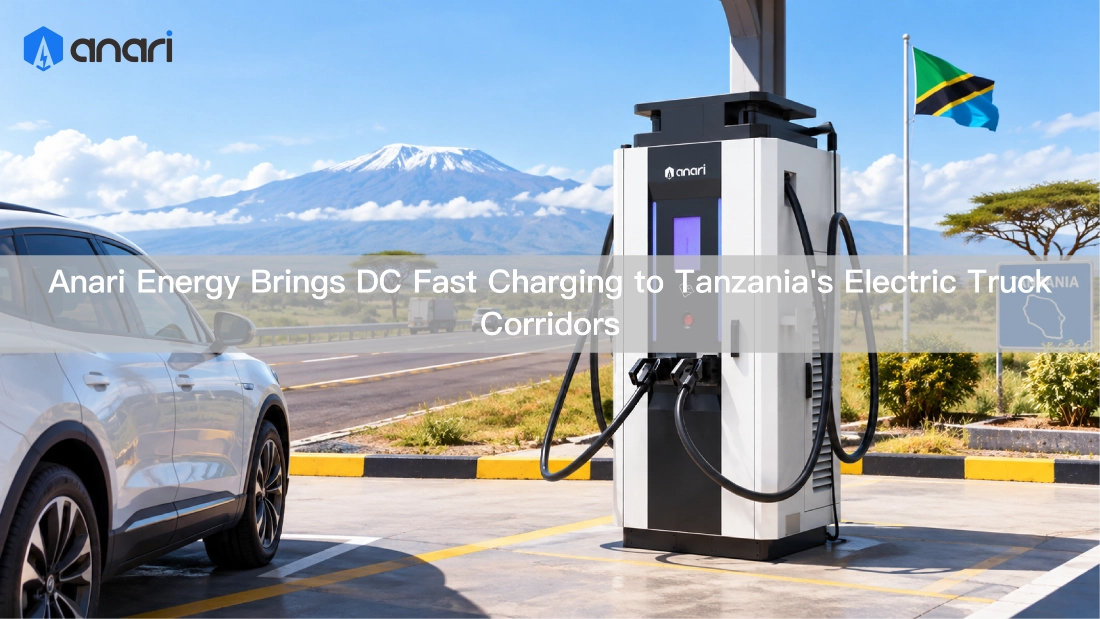
Anari Energy is supplying a Tanzanian CPO operator with Vulco DC fast chargers and MCP-series mobile EV charging vehicles to electrify truck freight on national highway corridors — a combined fixed-plus-mobile EV charging station deployment aimed squarely at electric trucks, one of the first of its kind in East Africa.
The order pairs two Anari product lines: Vulco DC fast chargers (60–480 kW) for highway service points, and truck-mounted mobile charging vehicles for depots, peak demand and interim service while grid connections are still being built. Below is the corridor logic behind the deployment, the regional context across Tanzania, the Democratic Republic of Congo and Zambia, and what comes next.
1. Why Tanzania’s Highway Corridors are Becoming Electric Truck Routes
Tanzania’s national freight moves along a small set of trunk corridors out of Dar es Salaam, East Africa’s principal port: the Dar es Salaam–Mwanza route to the lake region, and the TAZAMA route (Dar es Salaam–Tunduru–Mbeya) into the southern and western highlands. These corridors are where electric trucks first make economic sense, because:
- Fleet operators know the routes, so charging demand can be planned stop by stop.
- Dar es Salaam concentrates demand — port drayage and inland transloading create short, high-frequency trips that suit DC fast charging.
- The EV pickup wave is already on the road. JTP Auto and other manufacturers have put Chinese-built electric pickups into Tanzanian service and are developing high-speed charging stations starting in Dar es Salaam (per public reporting, early 2026).
The policy layer just caught up with the hardware layer. Tanzania’s National EV Policy Framework was finalized and adopted by the Ministry of Transport in June 2025, with EV implementation roadmaps prepared for Dodoma, Mwanza and Dar es Salaam, and a public-transport electrification programme that explicitly includes heavy-duty vehicles (CTC-N National Development Environment Forum for Tanzania, 2025).
That is a CPO operator’s market window: the charging network has to exist before the fleet scales, and the corridors that carry freight get built first.
2. The Regional Picture: Tanzania, DRC and Zambia in One Table
The three countries in this corridor network have very different energy fundamentals — and that difference is exactly why the mobile charging component matters:
| Country | Electricity Access (2023) | Context for EV Charging |
| Tanzania | 48.3% | National EV policy adopted June 2025; urban charging sparse, concentrated in Dar es Salaam and mainly for 3-wheelers; heavy-duty e-mobility programme under planning |
| Democratic Republic of Congo | 22.1% | World’s largest copper belt freight system; grid reach into mining and border corridors is limited; largest hydro-potential economy on the continent |
| Zambia | 51.1% | Copper belt logistics hub; national electrification target of 51% by 2030; truck traffic on the Dar–Mbeya–Livingstone axis |
Two readings from the table matter for anyone planning EV charging station capacity in this region:
- In Tanzania and Zambia, urban grids can anchor fixed stations — but the service points 80–120 km apart on a corridor are where grid connection lead times are longest.
- In the DRC’s western approaches and border crossings, “grid connection” is often not a matter of months but of years, or of a dedicated line. A truck-mounted EV charging station with its own battery removes that dependency entirely.
That second point is the design reason the Tanzanian operator is buying both fixed and mobile units in one programme.
3. Why Anari’s Product Set Fits This Region
| Capability | Vulco DC Series | MCP Mobile Charging Vehicle |
| DC Power | 60–480 kW | 60–180 kW |
| Connector Standards | CCS2 / GB/T (per project) | GB/T, CCS2 configurable |
| On-board Storage | —— | 37–210 kWh, truck-mounted |
| DC Efficiency at Normal Output | ≥96% | ≥92% |
| Protocol | OCPP 1.6J | OCPP 1.6J |
| Protection | IP54 / IK08 | IP54 / IK08 |
| Availability Evidence | MTBF up to 100,000 hours | MTBF up to 100,000 hours |
Four of these capabilities are region-specific, not generic:
3.1 Hot-climate derating, not cold.
The Vulco series operates to +55°C with output reducing only above that point. East and Central African corridors run hot and dusty year-round; IP54 and IK08 are the right protection class for open service points and public roadside sites.
3.2 Mobile units that fast-charge trucks, not just stop-and-go cars.
The MCP series carries 37–210 kWh and up to 180 kW DC on a truck chassis — enough to move a depot fleet or hold a corridor stop open between grid upgrades, without waiting for a new substation.
3.3 OCPP 1.6J, no vendor lock-in.
A CPO operator running multiple corridors will run multiple backends; open-protocol chargers mean the network stays manageable when the operator grows across Tanzania and into DRC or Zambia.
3.4 Manufacturer-direct supply.
Anari designs and manufactures the Vulco and MCP lines in-house, with a standard lead time of around 30 days. As of Q4 2026, Anari has shipped more than 2,820 chargers to 100+ customers across 30+ countries, with Africa a supported market; over 100 engineers work on the product lines.
The combined economics for a CPO operator: fixed Vulco stations at the highest-traffic service points, MCP vehicles covering the rest of the corridor and the fleet depot — so the charging network is never constrained by a single grid timetable.
4. What Comes Next?
- Phase 2 of the corridor follows the same logic west and south: the Tabora–Ilobo approach toward the DRC’s western border and the Mbeya–Livingstone route into Zambia’s copper belt are where the next electric truck lanes will form.
- Standalone service points will move to PV + battery + DC hybrids where grid extension is not economical — a configuration Anari’s product lines already support.
- The Dar es Salaam and Mwanza city roadmaps from the 2025 national EV policy are the near-term demand anchors; corridor infrastructure built for trucks will double as the backbone for urban DC charging.
For CPO operators in the region, the planning rule is the same as anywhere else in the world, just more urgent here: build the fixed stations where the dwell time is, and keep a mobile fleet on the corridor while the grid catches up.
———
About Anari Energy — Anari Energy (anariev.com) designs and manufactures DC fast chargers and mobile EV charging vehicles for CPO operators and fleet customers in Europe, the Middle East, Central Asia, Southeast Asia, Africa and South America. The Vulco DC series covers 60–480 kW; the MCP mobile series covers 60–180 kW DC on truck-mounted platforms with 37–210 kWh storage. OCPP 1.6J. Standard lead time ≈ 30 days.