




1. Four cabinets, six bays, one connection
A charging site is usually described by its total power. That number tells you almost nothing about whether it works.
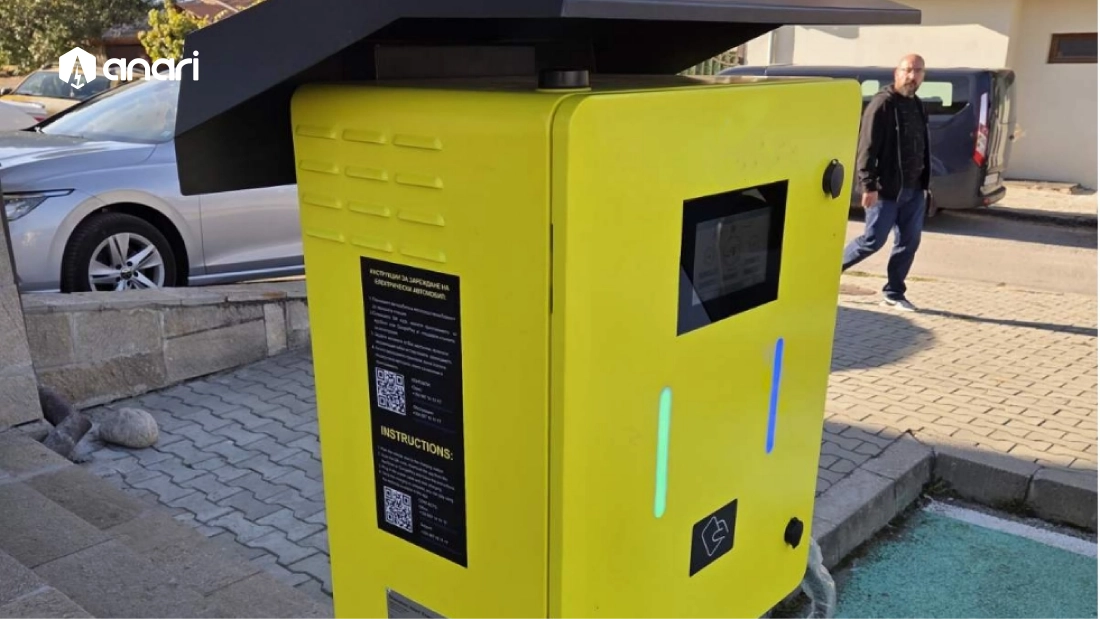
The Bulgarian project in this case is 120kW of installed DC capacity split across four Castor cabinets: two single-gun 20kW units and two dual-gun 30 to 40kW units, giving six DC connectors. A single 120kW cabinet would have carried the same headline number and delivered two connectors. The site would have been identical on a brochure and useless in operation.
Order in September 2026, commissioning in October 2026. This is the reasoning that produced the layout.
2. Why not one 120kW unit
The customer is a parking operator, and the site is a commercial car park with public access. The obvious configuration was one large cabinet. Three facts ruled it out.
| Item | One 120kW dual-gun cabinet | Four Castor cabinets, 2x20kW + 2×30-40kW |
|---|---|---|
| Connectors | 2 | 6 |
| Grid connections needed | 1 high-capacity feed | 4 smaller feeds on existing capacity |
| Effect of one failure | Site offline | One to two connectors offline |
| Fit to dwell profile | Same speed for every bay | Power matched to bay type |
| Connection upgrade risk | High | Low |
| Capital per connector | Lower | Higher, until the upgrade cost is counted |
The decisive line is the fifth one. A commercial car park in Sofia or Plovdiv typically has a supply sized for lighting, lifts and HVAC. Adding a 120kW charging load may require a distribution upgrade: an application, a fee, and a construction timeline the operator does not control. Once that cost and delay are priced in, the distributed layout is the cheaper site and the one that opens this year.
The second decisive line is redundancy. A single cabinet is a single point of failure for the whole site. Four cabinets mean a fault removes one or two connectors and leaves the car park earning. At a site where the operator is trying to build a charging habit among repeat visitors, that difference matters more than peak power.
3. Regulation builds the corridor; car parks build the habit
Bulgaria sits inside a regulatory build-out that is easy to mistake for the whole market.
The EU Alternative Fuels Infrastructure Regulation requires member states to deliver fast charging at defined intervals along the TEN-T network, with minimum aggregated power per site. Bulgaria is on the Orient/East-Med corridor and the routes linking Sofia, Plovdiv and the Black Sea ports, so corridor charging is arriving as public infrastructure, funded by utilities and infrastructure capital.
But a corridor charger serves a driver passing through. A car park serves a driver who is already parked, and that network is built by whoever owns the car park, on a budget two orders of magnitude smaller. It is also the network that creates daily charging habits, because a driver who charges where they work or shop charges far more often than one who charges on a twice-yearly road trip.
Which means the parking segment is where an operator can build a defensible position without competing against regulated infrastructure capital. It also means the segment is price-sensitive in a way highway hubs are not, which is exactly why right-sizing matters.
4. Assigning bays by dwell, not by power
The mixed configuration only works if the bays are assigned to the right dwell profile, and this is the part most operators get wrong.
Two single-gun 20kW units serve the long-dwell bays: all-day parking, offices, long shopping visits. A vehicle parked for two hours takes on about 40kWh, which covers a normal daily commute for a passenger EV. There is no reason to offer 120kW to a vehicle that is staying for two hours; the grid cost of that capability is spent whether or not it is used.
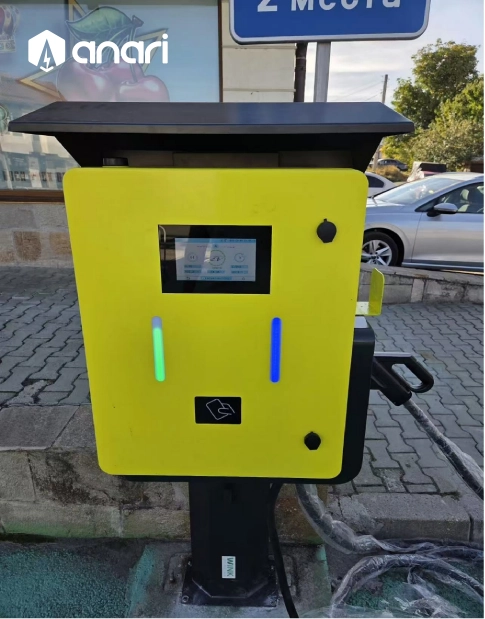
Two dual-gun 30 to 40kW units serve the bays with faster turnover and the sites where two vehicles need service at once. Each cabinet splits output between two connectors, so four service points come from two supplies.
The platform fits this segment rather than being adapted to it. Castor covers 20kW single-connector and 30 to 40kW dual-connector configurations, with OCPP 1.6J, IP54 enclosure and IK08 impact rating, forced-air cooling, 96 percent or higher peak efficiency, and a rated range from minus 30 to plus 70 degrees Celsius with output reducing above 55. The 55 degree threshold rather than 50 is relevant in a Bulgarian summer, where a car park surface can sit well above air temperature.
5. Commissioning a distributed site
Four cabinets mean four connection points, and that changes the commissioning job. A distributed site is a small electrical network, not a single appliance.
- Capacity survey before configuration. The site’s spare capacity is measured and documented, then the mix of single and dual units is set bay by bay against that number rather than against a generic layout. This is the step that prevents a design that works on paper and trips on load.
- Distribution design. Four cabinets require a protection and cabling design rather than a single feed. This is the work that carries the calendar, and doing it before the equipment ships is what keeps the project inside one month.
- Staged energisation. Cabinets energised and verified in sequence: insulation and earthing, rated output, meter accuracy, OCPP 1.6J connectivity, connector lock, emergency stop. Where a dual-gun cabinet serves two bays, commissioning also verifies that the output allocation behaves as designed when both are occupied.
- Pricing by bay type. A mixed-power site needs pricing that reflects the difference between a 20kW bay and a 40kW bay. Configuring that at handover avoids the common post-launch problem of a site that is technically live and commercially mispriced, where high-power bays are occupied all day by vehicles that would have been fine at 20kW.
6. The TCO case for redundancy
At a parking site the TCO question is not which cabinet is cheapest per kilowatt. It is how much charging capacity the site can install without buying a new connection, and what a failure costs.
| Cost layer | What belongs in it | Note for a Bulgarian car park |
|---|---|---|
| Hardware | 4 cabinets, 6 connectors | Anari quotation |
| Grid and make-ready | Connection works if required, distribution, protection, cabling | The item that decides the design |
| Installation | Labour, testing, handover | Local contractor |
| Energy | kWh at the site’s commercial tariff, in lev or euro, plus any capacity charge | Capacity charges dominate at high power |
| Network and software | OCPP back-end, payment, connectivity | Fixed cost, shared across the site |
| Maintenance | Preventive service, spares, warranty beyond year 2 | Four cabinets, plan intervals together |
| Downtime exposure | Revenue lost while a cabinet is out | Smaller per event, more events avoided |
Three variables move the answer.
- Capacity cost avoided. The comparison that matters is not 20kW against 120kW on hardware price. It is a site that opens against a site that never opens because the connection upgrade does not clear. Assign a value to the delay, because a car park waiting eighteen months for a utility is a car park watching a competitor install.
- Revenue per connector, not per cabinet. Six connectors at 20 to 40kW can out-earn two connectors at 120kW if the dwell profile suits them. Model revenue per connector at the site’s real dwell times.
- Redundancy value. One failure out of four cabinets removes a fraction of capacity. One failure out of one cabinet removes the site. At a parking location where the operator is building repeat behaviour, the second case costs more than the hardware differential.
Payback (months) = Total CAPEX / (Monthly energy revenue − Monthly energy cost − Monthly OPEX)
Run it on the site’s actual dwell mix. A benchmark from a highway hub will overstate revenue per connector by a wide margin, and a benchmark from a depot will understate it.
6. What Bulgarian parking operators should copy
Bulgaria’s charging market is being written by regulation first and demand second. Across the EU the public charging base passed roughly 1.1 million points by the end of 2025, five times the 2020 figure, with the build concentrated on motorway corridors and dense urban areas. Car parks sit outside that build, which is the opportunity and the constraint at once.
Three things from this deployment are worth copying.
- Right-sizing is a competitive advantage, not a compromise. An operator who can electrify six bays on an existing supply will electrify more sites than a competitor waiting for a capacity upgrade. Over three years coverage compounds, and coverage is what makes a charging brand usable to a driver who does not plan ahead.
- Mixed power is a portfolio decision. A site with 20kW and 40kW bays serves two customer types at once and prices them differently. That is retail design, not engineering compromise, and it produces better utilisation than a uniform layout.
- Standards protect the asset. OCPP 1.6J means the operator can change back-end providers, join a roaming platform, and reprice without replacing hardware. In a market where the software layer is still consolidating, protocol openness is what preserves the value of the cabinets through the consolidation.
For Anari, Bulgaria is a reference in an EU member state under an active regulatory timetable, at a site size far more common than the megawatt hubs that dominate trade press. For the operator, the outcome is six DC connectors across four cabinets on an existing connection, commissioned in one month, priced by bay type, running an open protocol with a two-year warranty.
Sources
- Regulation (EU) 2023/1804 on the deployment of alternative fuels infrastructure, TEN-T fast charging requirements.
- European Environment Agency, sustainability of Europe’s mobility systems, 2025, TEN-T charging objectives.
- Transport & Environment, EU public charging point count at the end of 2025.
- Anari Energy product specification, Castor DC series.
- Deployment record: Anari Energy, project data verified Q4 2026.
Related reading:·Castor 20-40kW DC wallbox charger · Commercial site selection framework · Grid capacity vs charger power